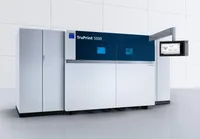
The TRUMPF TruPrint 5000 is a high-end industrial LPBF system featuring three 500 W lasers and preheating of the build chamber to 500 °C – engineered for serial production of metal parts with zero tolerance for distortion and cracking. A Ø 300 × 400 mm build volume, automated powder-handling options and production-cell integration make it well suited to aerospace, energy and tooling.
What it is
The TruPrint 5000 applies laser powder-bed fusion (LPBF) with three fully independent 500 W laser optics each covering the entire build area simultaneously – triple throughput versus single-laser machines. The defining differentiator is integrated preheating to 500 °C: alloys with high carbon or nickel equivalent (tool steels, superalloys) are prone to thermal cracking in conventional LPBF – preheating eliminates the temperature gradient, enabling crack-free direct printing. The system supports full automation: automatic job changeover, a sieving station and a closed powder-handling option that shields the operator from reactive metals such as titanium.
Technical specifications
| Technology | LPBF (Laser Powder Bed Fusion) |
|---|---|
| Build volume | Ø 300 × 400 mm (cylindrical) |
| Laser system | 3 × 500 W fiber laser, independent optics with full-field coverage |
| Preheating | up to 500 °C (standard for tool steels and superalloys) |
| Layer thickness | 20 – 100 µm |
| Class / Price | Industrial · ~€1,000,000 |
Applications and industries
- Serial production of metal parts – three lasers cover the full field in parallel, reducing build time by up to 3× versus single-laser LPBF – economically justified for repeating production batches (Industrial manufacturing and Industry 4.0)
- Tool steels and crack-sensitive alloys – preheating to 500 °C enables direct LPBF printing of H13, 1.2344 and nickel superalloys without thermal cracking or a separate degassing furnace step (Die and mold manufacturing)
- Aerospace and energy – heavy nickel and titanium components – combustion chambers, turbine blades, structural parts – with full closed-loop powder handling for reactive materials (Aerospace and energy)
Production workflow
- System preparation: load and sieve powder, verify inert atmosphere (O₂ < 0.1 %). Clean powder with correct particle size distribution and controlled atmosphere – prerequisite for defect-free layers.
- Start the preheating cycle – bring the platform to the target temperature (typically 200–500 °C depending on material). Uniform temperature throughout the build volume – eliminates temperature gradients that cause cracking and warping.
- Execute three-laser alignment: synchronization and focus calibration of each optical head. The three laser fields overlap without banding or defocused zones – guarantees homogeneous density across the full volume.
- Start the automated LPBF build process; the system layers, melts and re-coats powder without manual intervention. Continuous, automated build cycle with real-time melt-pool and layer-consistency monitoring.
- Post-build: cool down under inert gas, extract parts, separate and recover unused powder. Safe handling of reactive metals; powder recovery reduces material cost.
- Thermal treatment (stress-relief anneal or HIP) and machining to final tolerances. Residual stresses are relieved, density reaches > 99.9 %, and surface meets engineering requirements.
Key considerations
Materials and applications
Pick a material/alloy this machine processes to see its properties and typical applications:
Conclusion
The TruPrint 5000 sets the standard for high-throughput metal LPBF: three lasers and preheating to 500 °C unlock materials and geometries unreachable by conventional LPBF. It is the right choice for organisations targeting serial production of crack-sensitive or high-temperature alloys with automated, closed powder handling and full production-cell integration.
The full picture
This article is one page from The Big Book of 3D Printing: 704 illustrated pages covering every technology, material and fix in one reference.
Read it on Kindle →Engineer, author of The Big Book of 3D Printing and additive manufacturing expert
Updated on 5 August 2026
This article was written with AI assistance; the facts were checked against the sources on 5 August 2026.