

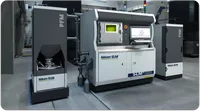
The SLM 280 is an industrial Selective Laser Melting (SLM/LPBF) printer from SLM Solutions (Nikon), engineered to produce full-density metal parts exceeding 99.9% density. With a 280×280×365 mm build volume, up to three lasers delivering a combined 2100 W and bidirectional powder recoating, the machine is designed for aerospace, automotive and heavy tooling applications.
What it is
The SLM 280 operates on the Laser Powder Bed Fusion (LPBF) principle: also known as Selective Laser Melting or Direct Metal Laser Sintering (DMLS). A thin layer of metal powder is deposited on the build platform; one or more laser beams then selectively melt the zones defined by the CAD geometry. The platform drops by one layer thickness (typically 20–60 µm) and the cycle repeats until the part is complete. The defining advantage of the SLM 280 is its multi-laser configuration: with 1, 2 or 3 lasers (each 400 W or 700 W) throughput scales almost linearly, while bidirectional powder recoating further cuts cycle time. The entire build chamber operates under an inert gas atmosphere (Ar or N₂) to prevent oxidation of reactive alloys.
Technical specifications
| Technology | SLM / LPBF (Selective Laser Melting, Laser Powder Bed Fusion) |
|---|---|
| Build volume | 280 × 280 × 365 mm |
| Laser configuration | 1, 2 or 3 lasers: 400 W or 700 W each (up to 2100 W combined power) |
| Layer thickness | 20 – 60 µm (depending on material) |
| Powder recoating | bidirectional: reduces cycle time |
| Atmosphere | inert gas: argon (Ar) or nitrogen (N₂) |
| Achievable density | above 99.9% for most alloys |
| Class / Price | Industrial · ~€600,000 |
Applications and industries
- Aerospace structural components: manufacturing of lightweight, topology-optimised load-bearing elements in Ti6Al4V and Inconel 718: brackets, nozzles, fuel manifolds, with density above 99.9% and mechanical properties comparable to wrought material (Aerospace and defence)
- Automotive and motorsport: precision parts for racing cars, hydraulic manifolds and lightweight structural components in AlSi10Mg and 316L stainless steel with internal channels impossible to achieve by conventional machining (Automotive and motorsport)
- Tooling with conformal cooling: injection-moulding and pressing dies in maraging steel with built-in conformal cooling channels that follow the cavity profile exactly, cutting cycle time by up to 40% and improving surface quality of moulded parts (Tooling and manufacturing)
Production workflow
- Chamber preparation: verify oxygen level, load powder and set the build platform. Oxygen level below 0.1%, inert atmosphere confirmed; powder evenly loaded in the feed hopper.
- SLM multi-laser melting: layer-by-layer fusion following CAD geometry with optimised parameters (power, scan speed, hatch spacing, layer thickness). Fully dense metal structure above 99.9% density; minimal residual stress with the correct scan strategy.
- Thermal post-processing and removal from platform: stress-relief heat treatment, HIP if required, EDM or mechanical cutting. Residual stresses relieved; parts with density and mechanical properties ready for final machining.
- Finishing: bead blasting, machining of functional surfaces, coatings (PVD, anodising) as required. Final geometry within tolerance and surface roughness to specification; part ready for assembly or certification.
Key considerations
Materials and applications
Pick a material/alloy this machine processes to see its properties and typical applications:
Conclusion
The SLM 280 is a mature industrial metal printer capable of producing certifiable components with density indistinguishable from wrought material. The multi-laser configuration and bidirectional recoating make it competitive in throughput for series batches, while the broad alloy portfolio positions it as a versatile platform for aerospace, automotive and medical applications. Mandatory post-processing and the specific powder-safety requirements must be built into the production workflow from the outset.
The full picture
This article is one page from The Big Book of 3D Printing: 704 illustrated pages covering every technology, material and fix in one reference.
Read it on Kindle →Engineer, author of The Big Book of 3D Printing and additive manufacturing expert