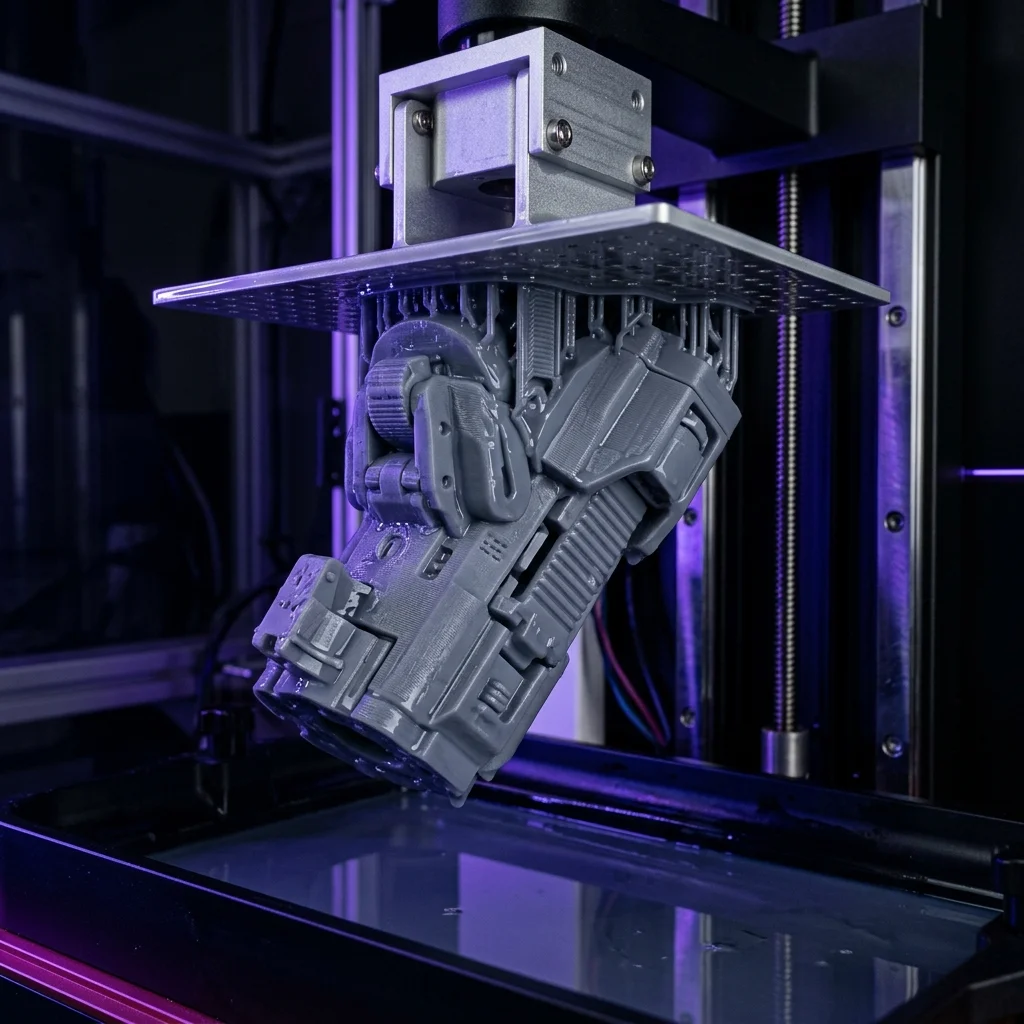
Tough resin (also known as ‘engineering resin’ or ‘ABS-like resin’) resolves one of SLA technology’s historical weaknesses: the brittleness of standard resin. With 3-10× higher impact resistance than standard resin and properties similar to injection-molded ABS, tough resin is indispensable for engineering prototypes that will be mechanically tested: electronics enclosures with snap-fits, hinge mechanisms, load-bearing brackets. Formlabs Tough 2000 is the standard, but the market has many alternatives (Siraya Tenacious, Phrozen Aqua-Gray, Anycubic Engineering). In this guide we cover the differences between tough resins, when Formlabs is worth it vs alternatives, and real engineering applications.
Why tough resin, not standard
Standard SLA resin (Formlabs Grey, Anycubic Standard) has excellent resolution and optics but is brittle as glass. A small functional prototype (50×50×30 mm) breaks if dropped from 30 cm. A snap-fit joint cracks on the first snap. An engineering enclosure with threads cracks when a bolt is tightened.
Tough resin keeps SLA resolution (25-50 µm) but adds:
- Impact strength: 3-10× higher than standard resin
- Flexural strength: 50-80 MPa (close to injection-molded ABS)
- Elongation at break: 10-15% (vs 3-5% for standard)
- Tensile strength: 35-50 MPa (vs 25-35 for standard)
When tough resin is the optimal choice:
- Snap-fit joints. Electronics enclosures that need tight snap-fit without screw assembly.
- Hinge mechanisms. Small hinge mechanisms for miniature boxes, lid latches.
- Gears. Small low-speed gears (not for high-speed machines: Nylon-CF is better).
- Industrial prototype enclosures. Sensor housings, measurement device cases.
- Bearing housings (low-speed). For prototypes and testing.
When tough resin is NOT optimal:
- Transparent applications (Clear Resin makes more sense).
- Jewelry / casting models (Castable Resin is specialized).
- Dental and medical work (Dental SG, BioMed Amber with certifications).
- High temperature (HDT of tough resin is 50-60°C: standard resin is higher).
- UV exposure (most tough resins yellow in 6-12 months in the sun).
Tough resin types
Formlabs Tough 2000 (€250/liter):
Industry standard. PMMA-modified resin. Similar to injection-molded ABS. Recommended for Formlabs Form 3+ and Form 4. Not recommended for hobby MSLA printers (exposure parameters aren’t optimized).
Specs:
- Tensile strength: 40-45 MPa
- Flexural strength: 75-85 MPa
- Impact strength: 50-70 J/m
- Elongation at break: 10-13%
Formlabs Tough 1500 (€250/liter):
Lower-grade version of Tough 2000. Softer, more flexible, but with lower tensile strength. Recommended for snap-fit and hinge mechanisms that need a little give.
Siraya Tech Tenacious Resin (€55/liter):
Hobbyist alternative to Formlabs Tough. Similar mechanical characteristics at a quarter of the price. Works on any MSLA printer (Anycubic, Elegoo, Phrozen). Recommended for boutique engineering prototypes without special certifications.
Phrozen Aqua-Gray Tough (€60/liter):
Taiwanese manufacturer. Optimized for Phrozen Sonic Mighty 8K and similar 12K MSLA printers. Quality, economical, good availability.
Anycubic Engineering Resin (€45-€55/liter):
Budget tough resin for Anycubic Photon Mono M5s and Saturn 3 Ultra. Slightly lower quality than Siraya or Phrozen, but economically sensible for volume prototyping.
Elegoo ABS-Like Resin 2.0 (€40-€50/liter):
Elegoo’s alternative. Mimics ABS but in reality is less heat-resistant (HDT 45°C vs 80°C for injection-molded ABS).
3DXTech HD-PV (€95/liter):
Professional SLA resin for industrial prototypes. High quality, good heat resistance (HDT 95°C). More expensive than hobby alternatives, cheaper than Formlabs.
Recommendation by application:
- Hobby prototypes: Anycubic Engineering (€45/liter)
- Boutique engineering prototypes: Siraya Tenacious or Phrozen Aqua-Gray
- Certified engineering prototypes: Formlabs Tough 2000
- High-load prototypes: 3DXTech HD-PV
Recommended printers
For hobby and boutique applications:
- Anycubic Photon Mono M5s (€368): 12K MSLA, excellent resolution (19 µm XY). Works with any hobby tough resin.
- Elegoo Saturn 3 Ultra (€402): larger build volume than Photon M5s, same resolution. Recommended for larger prototypes.
- Phrozen Sonic Mighty 8K (€420): alternative with slightly higher resolution (28 µm XY).
For professional engineering prototypes:
- Formlabs Form 3+ (€3500): premium SLA with validated process. Recommended if you make certified engineering prototypes.
- Formlabs Form 4 (€4500): 4× faster than Form 3+, excellent for series prototypes.
For large engineering prototypes:
- Peopoly Forge (€5800): large build volume (320×320×400 mm) for prototypes 200+ mm.
- Anycubic Photon M3 Premium (€600): large 7K MSLA, good alternative to Forge at a hobby price tier.
For industrial applications (with full certification):
- 3D Systems ProJet 7000 HD (€80,000+): industrial SLA with high repeatability.
- EnvisionTEC Vida HD (€30,000-€50,000): professional SLA for dentistry and engineering.
For a small engineering studio needing tough resin prototypes (5-20 per month): Anycubic Photon Mono M5s (€368) + 2-3 liters Siraya Tenacious (€110-€165) + Wash & Cure station (€150) = €628-€683 for a full start. ROI in 2-4 months at €30-€80 per prototype revenue.
Optimal settings and processing
Layer exposure:
Tough resins require slightly longer exposure than standard. Standard recommendations for 12K MSLA:
- Bottom layers: 30-50 seconds (vs 20-30 for standard)
- Standard layers: 2.5-3.5 seconds (vs 1.8-2.2 for standard)
- Number of bottom layers: 5-8
Under-exposure causes layer delamination. Over-exposure causes lower resolution and support-mark issues.
Layer height:
- 0.05 mm for fine details (slow: 8-12 hours per 100 mm height)
- 0.10 mm standard (4-6 hours per 100 mm)
- 0.15 mm for fast prototyping (3-4 hours per 100 mm)
Supports:
Tough resins want thicker supports than standard (3-5% thicker). Otherwise supports crack during printing.
- Tip size: 0.55-0.65 mm (vs 0.45-0.50 for standard resin)
- Density: medium-heavy
- Angle: 60-70°
Post-processing:
Step 1: Remove from build platform. Tough resin adheres MORE strongly to the platform than standard. PEI plate with a thin layer of Magigoo adhesive, and a metal scalpel for removal.
Step 2: Wash in IPA. 3-5 minutes in clean IPA. Not more: tough resin absorbs IPA and softens. Side effects: surface becomes tacky, dimensions change by 1-2%.
Step 3: Air-dry or pat with paper towel.
Step 4: UV cure. 10-30 minutes in UV chamber. CRITICAL for tough resins: under-cured resin is more brittle than fully cured. Form Cure (€350) or Anycubic Wash & Cure 2.0 (€150) recommended for beginners.
Step 5: Stabilization. After full UV cure, let part sit 24 hours at room temperature for final stabilization of polymer network. Full mechanical characteristics achieve after 48 hours.
Step 6: Additional processing. Sanding for smoothness (only 240-400 grit, finer sandpaper clogs from soft surface). Primer + airbrush for painting (standard).
Real engineering applications
Example 1: Enclosure for a medical sensor prototype
Customer: a small medical company developing a new blood-flow sensor model. Has a functional PCB prototype, needs 5-10 enclosures for hospital testing.
Solution: Anycubic Photon Mono M5s with Siraya Tenacious. Enclosure 80×40×20 mm with snap-fit cover, USB-C hole, built-in PCB holder. Printing 6 enclosures in one build = 4 hours.
Cost: €35 material (Siraya Tenacious) + €60 design labor = €95 for 5-10 enclosures. Alternatives: injection molding from a Chinese bureau (€1500 mold + €5 per enclosure = €1525 for the first 5) or CNC ABS milling (€20 per enclosure = €100). SLA with tough resin is the most economical for small series (1-50 pieces).
Example 2: Hinge mechanisms for cosmetic packaging
Customer: a cosmetics company with custom production of luxury cream boxes. Needs 30 unique hinge mechanisms for presentation.
Solution: Phrozen Sonic Mighty 8K with Phrozen Aqua-Gray Tough. Hinge mechanism with integrated spring (FlexFiber design). Printing 8 mechanisms in one build = 5 hours.
Cost: €25 material + €40 labor = €65 for 30 mechanisms. Alternatives: metal CNC mechanism (€15-€25 per piece = €450-€750) or plastic injection (€2000 mold + €2 per piece). SLA tough resin is optimal for boutique series.
Example 3: End-of-arm tooling (EOAT) for lab testing
Customer: pharmaceutical company with an automated packaging line. Testing a new bottle format: needs a custom EOAT.
Solution: Formlabs Form 3+ with Formlabs Tough 2000. EOAT 120×80×50 mm with built-in rubber gaskets (TPU prototypes separately). 12 design iterations over 2 weeks of testing.
Cost: €150 material (for 12 versions) + €400 design and testing labor = €550 total over 2 weeks. Alternatives: aluminum EOAT with CNC (€800-€1500 + 2-3 weeks delivery for each iteration). SLA tough resin is optimal for iterative testing.
Example 4: Threaded caps for industrial bottles
Customer: small chemical products firm. Needs custom threaded caps for 50 ml bottles.
Solution: Anycubic Photon Mono M5s with Anycubic Engineering Resin. Threaded cap with integrated sealing spring. 20 caps in one build = 3 hours.
Cost: €15 material + €20 labor = €35 for 100 caps (5 builds). Alternatives: Chinese injection-molded packaging (€800 mold + €0.10 per cap = €810 for the first 100 + 4-6 weeks delivery). SLA is optimal for boutique series under 1000 pieces.
Economic analysis: when SLA tough resin is optimal:
- 1-50 pieces: SLA always wins (vs CNC, molding, metal).
- 50-500 pieces: SLA competes with CNC and cheap injection packaging.
- 500-10,000 pieces: switch to injection-molded SLS PA12 (Polymaker or Bambu Lab P1S), more economical per piece.
- 10,000+ pieces: switch to injection-molded ABS / PC / Nylon from a professional bureau.
Frequently Asked Questions (FAQ)
Interactive Analyzer for Sla With Tough Resin, For Engineering Prototypes And Snap-Fit Joints
Select a profile to view detailed analysis.
The full picture
This article is one page from The Big Book of 3D Printing: 704 illustrated pages covering every technology, material and fix in one reference.
Read it on Kindle →Engineer, author of The Big Book of 3D Printing and additive manufacturing expert
Updated on 11 September 2026
This article was written with AI assistance; the facts were checked against the sources on 11 September 2026.