

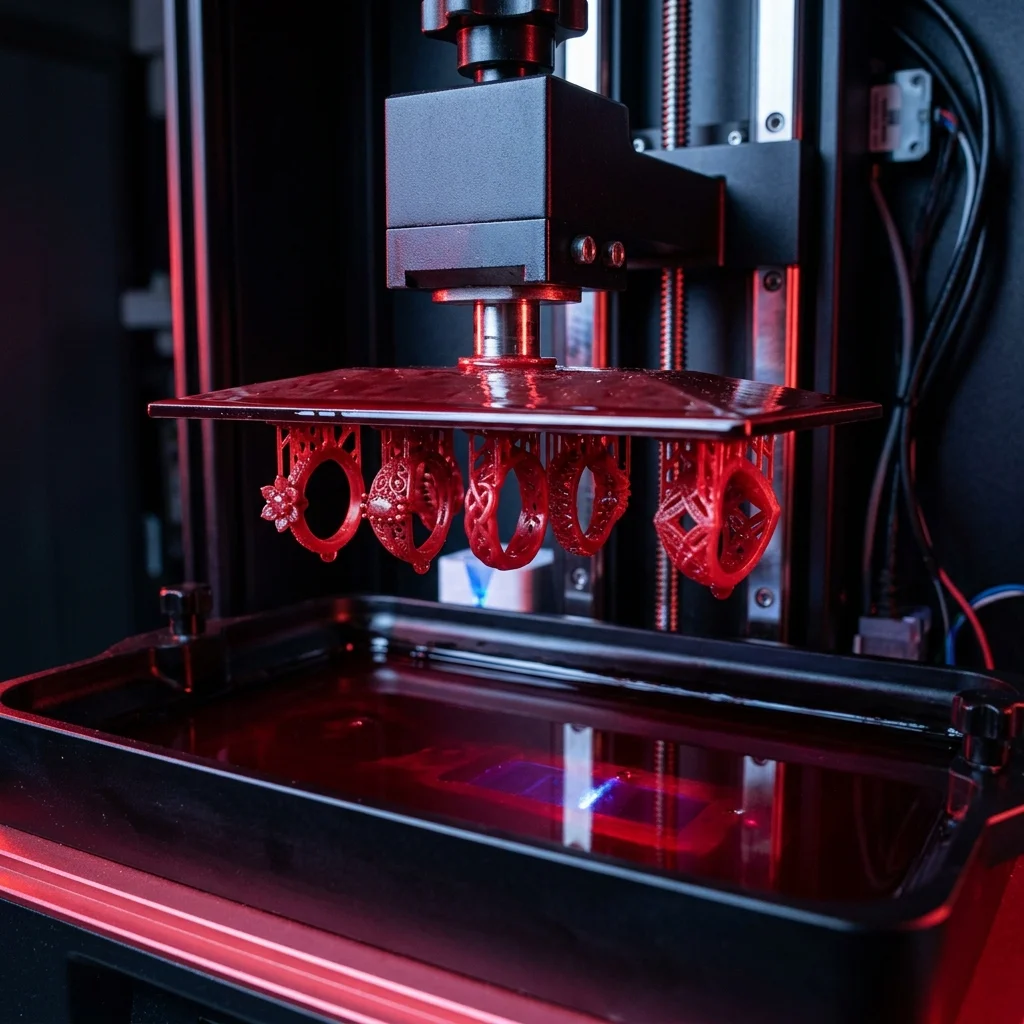
Castable resin is a specialized material for jewelry and dental industries: resin that burns cleanly without ash at high temperature, allowing precise metal casting (gold, silver, platinum) or wax. This is one of the most significant technologies 3D printing has brought to traditional crafts. Before MSLA and SLA, casting work required hand-carving of wax: 8-16 hours per ring, years of jewelry experience. Now with an SLA printer and castable resin, a jeweler makes a custom ring from CAD to cast ring in 24-48 hours. In this guide we cover castable resin types, suitable printers, and the real workflow from CAD to cast jewelry.
Why castable resin, not wax
Traditional jewelry and dental casting uses beeswax or synthetic wax. The jeweler hand-carves a model from a wax block, then pours it in gypsum (‘investment’), which is fired to 800°C and the wax vaporizes, leaving a cavity for metal casting.
Before 3D printing the jeweler had two options:
- Hand carving wax. 8-16 hours per ring, 16-30 hours per complex pendant. Requires years of jewelry experience. Quality depends on the hand.
- CNC milling of wax. 1-3 hours per piece, but with size limits (the mill can’t reach internal undercuts) and no possibility for complex original forms (web structures, fractals).
SLA with castable resin solves both:
- Time: CAD to cast part 24-48 hours (vs weeks by hand).
- Complexity: SLA prints webs, internal undercuts, any CAD-feasible form.
- Repeatability: one CAD design prints 100 identical models (for a ring shop series).
- Cost: SLA resin model = €1-€3 in material vs €5-€10 hand-carved wax.
Key property of castable resin: clean burnout with no ash. At 700-800°C the resin vaporizes completely (like wax), leaving a clean cavity in the investment. Standard SLA resin does NOT burn cleanly: leaves ash that contaminates the cast.
Casting types with castable resin:
- Lost wax casting. Resin model → gypsum investment → kiln → metal in cavity. For jewelry, dental, small metal components.
- Sand casting. Sand mold around resin model → metal casting. For larger components.
- Vacuum casting. Silicone mold around resin model → plastic or polyurethane castings. For small series (5-50 pieces).
Castable resin types
Formlabs Castable Wax 40 (€275/liter):
Industry standard. 40% real beeswax + resin. Burns clean: no ash at 700°C. Recommended for Formlabs Form 3+ and Form 4. Resolution: 25 µm.
Specs:
- Burnout temperature: 700-800°C
- Residual ash: < 0.05%
- Cost per 100 ml: €27.50
- A typical ring requires 2-5 ml = €0.55-€1.40 in material
Formlabs Castable Wax (€275/liter):
Also known as ‘Castable Wax 100’. Resin only without wax, more robust in printing but slightly more residual ash (0.1%). Recommended for beginner jewelers.
Siraya Tech Castable (€65/liter):
Hobbyist alternative to Formlabs Castable. Similar casting characteristics at a quarter of the price. Works on MSLA printers. Recommended for jewelry startups or hobbyists.
Phrozen Wax-like Castable (€70/liter):
Taiwanese competitor. Quality castable resin, good availability.
Anycubic Castable Resin (€55/liter):
Budget castable resin. Higher residual ash (0.3%): acceptable for hobby applications, not for fine jewelry.
Detax Freeprint Cast (€350/liter):
Dental castable resin. Specialized for dental crowns, partial dentures, bridges. Certified for Detax exocad system. More expensive than standard castable resins.
3DXTech CastIt (€95/liter):
Professional castable resin for industrial applications. Small metal components for aerospace, specialty mechanical parts.
Recommendation by application:
- Hobbyist jeweler: Siraya Castable (€65/liter)
- Boutique jewelry studio: Phrozen Wax-like (€70/liter) or Formlabs Castable Wax 40 (€275/liter for repeatability)
- Dental lab: Detax Freeprint Cast (€350/liter)
- Industrial metal prototypes: 3DXTech CastIt (€95/liter)
Recommended printers
For hobbyist jewelers and startup studios:
- Anycubic Photon Mono M5s (€368): 12K MSLA, excellent resolution (19 µm XY). Works with Siraya Castable, Phrozen Wax-like, Anycubic Castable.
- Elegoo Saturn 3 Ultra (€402): larger build volume for a series of rings in one build.
- Phrozen Sonic Mighty 8K (€420): alternative with slightly higher resolution.
For boutique jewelry studios with custom production (5-30 orders/month):
- Formlabs Form 3+ (€3500): premium SLA with validated process. Recommended for custom production with serial repeatability.
- Formlabs Form 4 (€4500): 4× faster than Form 3+, ideal for ring series.
- Phrozen Sonic Mini 8K (€350): alternative MSLA with small volume but high resolution (22 µm).
For dental labs:
- Formlabs Form 3+ with Dental SG / Castable Wax 40: standard for dental 3D printing.
- Desktop Health Einstein Pro XL (€8500): professional dental DLP with integration to exocad and 3Shape.
- EnvisionTEC Vida HD (€30,000-€50,000): industrial dental SLA.
For industrial metal prototypes:
- 3D Systems ProJet 3600 W (€80,000+): professional SLA with multi-material support.
- EnvisionTEC Perfactory 4 (€35,000): DLP with high repeatability.
For a small jewelry studio needing 10-30 rings/month: Anycubic Photon Mono M5s (€368) + 1 liter Siraya Castable (€65) + Wash & Cure station (€150) + Small burnout kiln (€500-€1000 used) + Vacuum casting station for metal (€2000-€4000 for a beginner kit) = €3083-€5583 for a full start. ROI: 6-12 months at €100-€500 per ring revenue.
Workflow from CAD to cast ring
Step 1: CAD design
Start with CAD software: Rhino + RhinoGold (€2000/year), Matrix Gold (€800/year), or free alternatives (Blender for general CAD, RhinoCAM for jewelry).
CAD principles for SLA casting:
- Minimum wall thickness: 0.4-0.6 mm (for 22 µm MSLA).
- Minimum prong wall thickness for stone settings: 0.3 mm on the prong walls.
- Drain holes for resin, at least 1 mm diameter at the lowest point of closed volumes (so uncured resin can drain).
- Stone settings: make the seat 0.05 mm smaller than the stone size (for press-fit assembly after casting).
- Allowances for cast shrinkage: add 0.05-0.1 mm to critical dimensions (the cast shrinks 0.5-1%).
Step 2: Slicer prep
ChiTuBox or Lychee Slicer for MSLA. PreForm for Formlabs.
Castable resin optimizations:
- Layer height: 0.05 mm for fine details (slow, 5-8 hours for a 30 mm ring).
- Layer height: 0.10 mm for standard (3-4 hours).
- Layer exposure: 3-4 seconds (for 12K MSLA).
- Bottom layers: 8-12 at 40-60 seconds exposure.
- Supports: thick (0.55-0.65 mm tip), dense, 45-60° angle.
Step 3: Print
One ring 25×20×15 mm prints in 2-3 hours on Anycubic Photon Mono M5s. 5-10 rings in one build = 2-3 hours (print time is independent of the number of rings in the volume).
Step 4: Removal and washing
- Remove the print from the platform.
- Wash in IPA for 3-5 minutes.
- Dry with air.
Step 5: UV cure
- 10-15 minutes in UV chamber (Anycubic Wash & Cure 2.0 or Form Cure).
- Castable resins want slightly shorter curing than standard (to stay a bit soft before burnout).
Step 6: Support removal
Carefully cut supports with fine jewelry pliers. Don’t leave residue that would create ash.
Step 7: Investment (gypsum casting)
- Place the resin model in a gypsum form with investment gypsum mix (Plasticast, R&R).
- Vacuum for air bubble removal.
- Let set 1-2 hours.
Step 8: Burnout (resin burning)
- Place the form in a specialized burnout kiln.
- Programmed temperature profile:
- 0-2 hours: up to 300°C (slow, to not crack the gypsum)
- 2-4 hours: 300-650°C (main burnout cycle)
- 4-6 hours: 650-800°C (full burnout of residues)
- 6-8 hours: hold at 800°C (stabilization)
- 8-10 hours: slow cooling to 500°C (ready for metal casting)
Step 9: Metal casting
- Vacuum or centrifugal casting of gold/silver alloy into the prepared cavity.
- Casting time: 5-15 minutes.
Step 10: Gypsum removal and cleaning
- Plunge into cold water (gypsum disintegrates).
- Cut the cast jewelry from the sprue.
- Clean with sandblast, sanding, polishing.
- Stone setting: adjust with hand tools.
- Set the stone.
Total time from CAD to finished ring: 24-72 hours.
Real examples from jewelry practice
Example 1: Custom silver ring with diamond
Customer: a young jeweler with a small studio and custom production.
Solution: Anycubic Photon Mono M5s with Siraya Castable. CAD design (2 hours), 3D print (3 hours), investment and burnout (12 hours automated), silver casting (1 hour), cleaning and polishing (2 hours), stone setting (30 minutes).
Cost:
- Resin: €1.50
- Gypsum: €2
- Silver: €25 (5 g × €5/g)
- Diamond: €150-€500 (depending on size and quality)
- Labor: €100-€200 (depending on rate)
- Total: €278-€728
Retail price in store: €600-€1500. Margin: 50-70%.
Example 2: Series of 20 identical engagement rings
Customer: jewelry shop, order for store series.
Solution: Phrozen Sonic Mighty 8K with Phrozen Wax-like Castable. CAD design (4 hours), 20 rings in 2 builds (4 hours printing), investment and burnout (12 hours), serial casting (4 hours), cleaning (10 hours).
Series cost:
- Resin: €15
- Gypsum: €20
- Silver: €500 (20 rings × 5 g × €5/g)
- Labor: €600
- Total: €1135 for 20 rings = €56.75 per ring.
Retail price: €150-€300 per ring. Margin: 60-70%.
Example 3: Platinum ring for a wedding ceremony
Customer: luxury jeweler, order for a platinum ring with 0.5 ct diamond.
Solution: Formlabs Form 3+ with Castable Wax 40 (higher repeatability for luxury clients). 1 ring per print = 2.5 hours.
Cost:
- Resin: €1.50
- Gypsum: €2
- Platinum: €450 (10 g × €45/g)
- 0.5 ct diamond: €1500
- Labor: €300
- Total: €2253.50
Retail price: €4000-€6000. Margin: 40-50%.
Example 4: Dental gold crown
Customer: dental lab working with hospital dentists.
Solution: Formlabs Form 3+ with Castable Wax 40 (Dental Wash & Cure). Digital tooth scan → CAD design in exocad → 3D print → investment → burnout → dental gold casting → processing and polishing.
Cost per crown:
- Resin: €0.80
- Gypsum: €1
- Dental gold: €120-€180 (2-3 g × €60/g)
- Labor: €80
- Total: €202-€262
Patient price: €450-€800 (with 40-50% lab margin + 30-40% dentist margin).
Example 5: Custom jewelry for corporate gift
Customer: an IT company ordering 30 identical engraved jewelry badges as employee gifts.
Solution: Anycubic Photon Mono M5s with Anycubic Castable. CAD design with engraved logo (1 hour), 30 badges in 2 builds (4 hours), investment and burnout (12 hours), silver casting (3 hours), cleaning (8 hours).
Cost:
- Resin: €10
- Gypsum: €15
- Silver: €450 (30 badges × 3 g × €5/g)
- Labor: €400
- Total: €875 for 30 badges = €29.20 per badge.
Corporate price: €50-€80 per badge (including engraving and packaging). Margin: 40-50%.
Frequently Asked Questions (FAQ)
Sla With Castable Resin, For Jewelry And Dental Casting Exposure Calculator
Calculate optimal resin print time.
The full picture
This article is one page from The Big Book of 3D Printing: 704 illustrated pages covering every technology, material and fix in one reference.
Read it on Kindle →Engineer, author of The Big Book of 3D Printing and additive manufacturing expert