

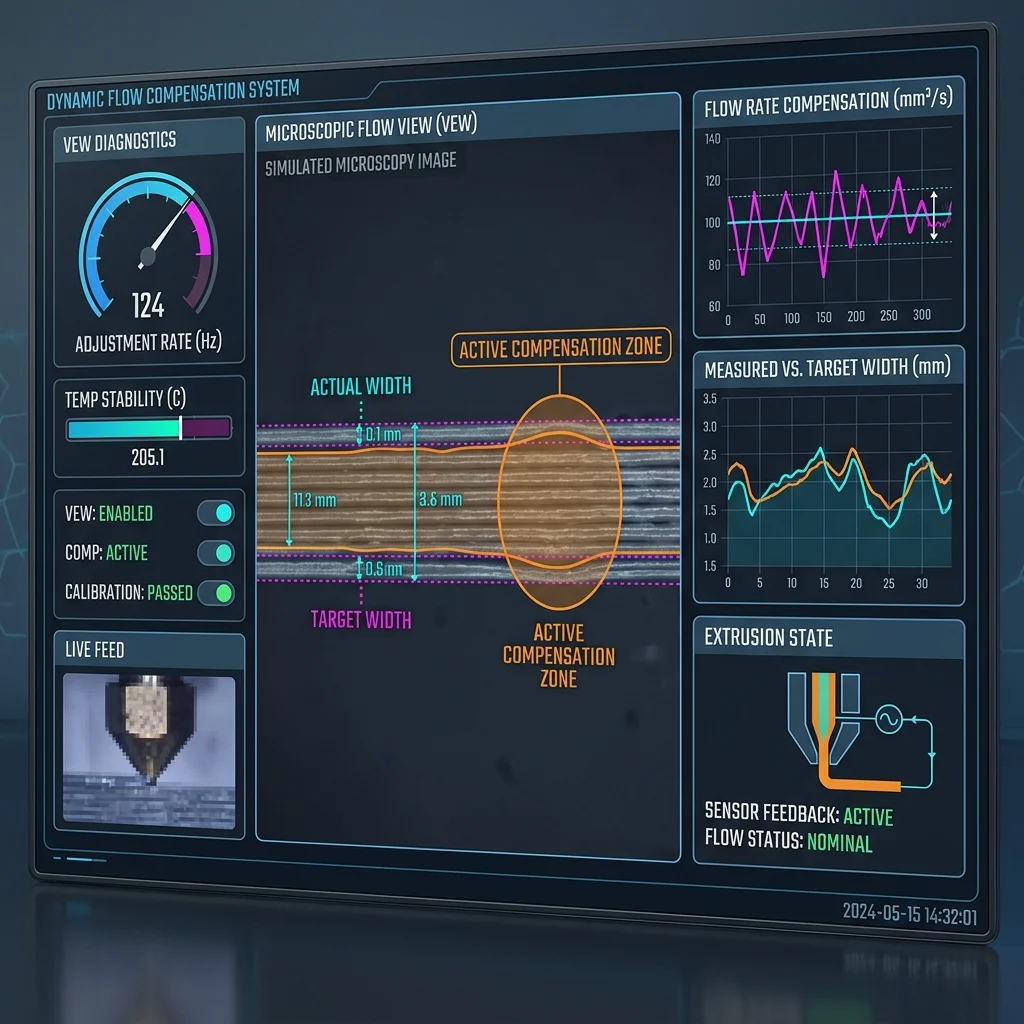
In 2025–2026, real-time flow width compensation automatically corrects extrusion flow rate to maintain constant bead width regardless of speed, angle, and geometry: a critical step toward self-tuning printers.
The Problem: Width Variation
Bead width varies with speed (thinner at high speed), corners (thicker at sharp turns), retraction (thinner after retraction), and temperature (±2°C = ±5–10% viscosity change).
Interactive Filament Selector
Answer 3 quick questions and find the optimal material for your project.
1. What are the mechanical requirements for the part?
2. What temperature will the part operate at?
3. Are there any specific environmental requirements?
Our recommendation:
PLA filament
Ideal for easy printing, model visualization and decorative parts.
Compensation Approaches
- Pressure Advance (Klipper): Software pre-compensation of hydraulic delay. Increases E-feed on acceleration, decreases on deceleration.
- Closed-Loop Flow Control: Optical sensor measures bead width in real-time, adjusts E-steps. Research-phase.
- Predictive Flow Compensation: ML predicts flow rate correction from G-code without additional sensors.
Pros and Cons
Pros:
- Improved Accuracy: Constant width → more precise parts.
- Better Appearance: Uniform beads without variation.
Cons:
- Complexity: Closed-loop requires additional sensor.
- Calibration: Pressure Advance requires precise tuning.
FAQ
Real-Time Flow Width Compensation For Fdm Printing Calculator
Interactive optimization calculator.
The full picture
This article is one page from The Big Book of 3D Printing: 704 illustrated pages covering every technology, material and fix in one reference.
Read it on Kindle →Engineer, author of The Big Book of 3D Printing and additive manufacturing expert