

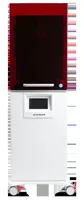
The Asiga PRO 4K is an industrial DLP printer featuring a true 4K optical engine and a fully open material platform, engineered for production reliability in dental laboratories, jewellery casting houses and engineering departments. It delivers micron-level accuracy on every cycle without lock-in to proprietary resins.
What it is
The PRO 4K is Asiga's lead model in the production DLP line. At its core is a 4K DLP projector with SPS (Smart Pixel System) technology: each pixel is controlled individually, delivering a uniform UV dose across the entire platform and repeatable geometry from build to build. Unlike most industrial systems, the PRO 4K runs an open material platform: the user profiles any resin through Asiga Composer and retains full control over curing parameters. The machine is aimed at sectors where accuracy is a regulatory requirement: dental prosthetics, surgical guides, investment casting wax patterns and Class IIa medical devices.
Technical specifications
| Technology | DLP 4K (SPS: Smart Pixel System) |
|---|---|
| Build volume | 119 × 67 × 75 mm |
| XY resolution | 27 µm (pixel) |
| Material system | OPEN: any photopolymer resin, user-profiled |
| Calibration | automatic UV intensity + SPS per-pixel correction |
| Class / Price | Industrial · ~€20 000 |
Applications and industries
- Dental manufacturing – serial production of surgical guides, temporary crowns, positioners and splints using ISO 10993-certified biocompatible resins (Dental laboratories and clinics)
- Jewellery investment casting: wax-up and castable patterns with zero-ash burnout, ready directly for investing and casting in precious metals (Jewellery industry)
- Audiology and medical devices: custom hearing aid shells, ear moulds and medical prototypes from biocompatible resins with sub-50 µm accuracy (Medical and audiology)
Production workflow
- Clean the build platform with IPA and inspect the FEP/PDMS membrane for uniformity. A clean, undamaged membrane ensures uniform layer release and prevents laminar defects.
- Run the automatic SPS UV intensity calibration. Each of the 4K pixels receives individual correction: uniform dose across the full field with no peripheral fall-off.
- Profile the resin in Asiga Composer: enter Ec, Dp and immersion speed parameters. Precise cure-depth control, no over-curing of fine details and no insufficient inter-layer adhesion.
- Print a calibration grid and measure XY and Z accuracy with a digital micrometer. Verified deviation under ±25 µm: readiness for certified production.
Key considerations
Materials and applications
Pick a material/alloy this machine processes to see its properties and typical applications:
Conclusion
The Asiga PRO 4K is the choice for operations where accuracy is not an option but a regulatory requirement. The open material platform gives the freedom to work with any certified resin, while SPS calibration ensures every pixel of the 4K array delivers a predictable UV dose. The result: repeatable production of dental, medical and jewellery parts at micron-level precision, build after build.
The full picture
This article is one page from The Big Book of 3D Printing: 704 illustrated pages covering every technology, material and fix in one reference.
Read it on Kindle →Engineer, author of The Big Book of 3D Printing and additive manufacturing expert