

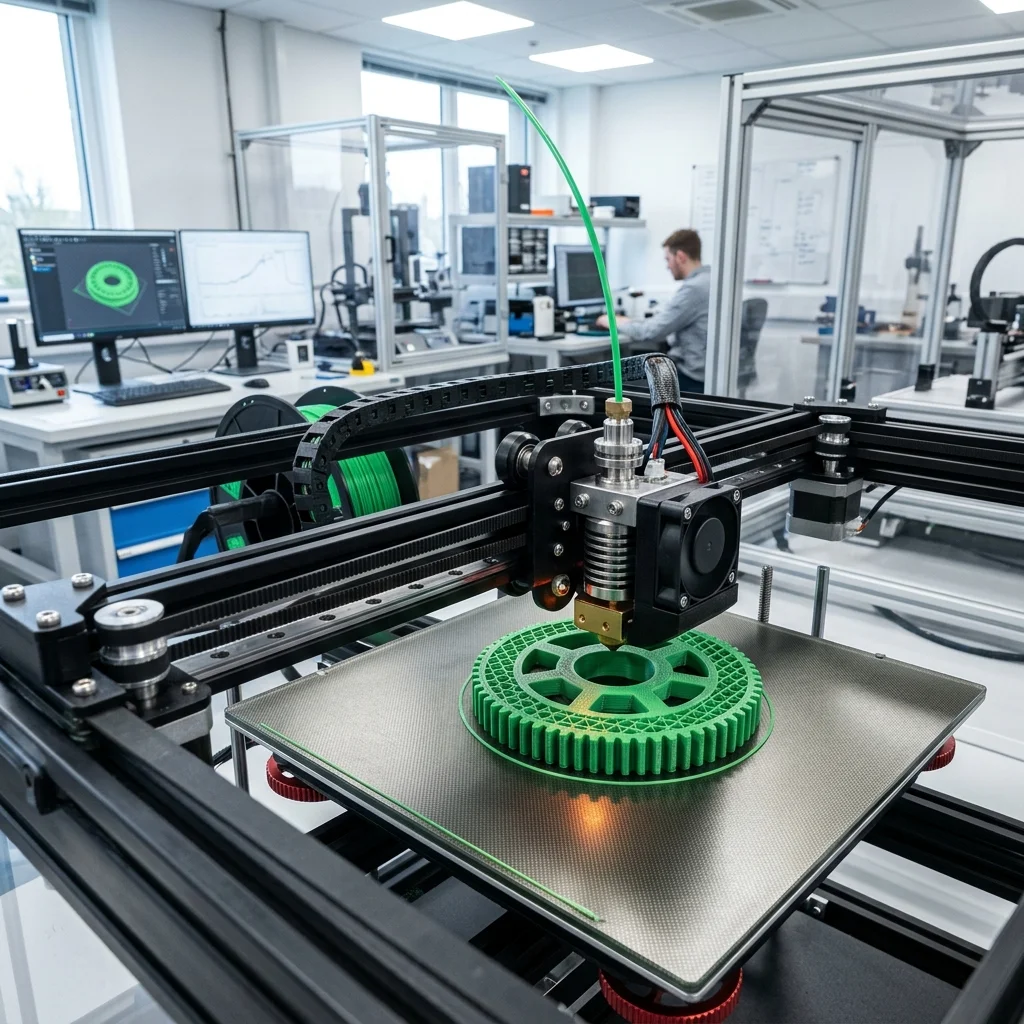
In the world of additive manufacturing, the eternal conflict has always been between production time and part precision. Every maker wants their parts finished 'yesterday,' but simultaneously expects flawless surfaces free of artifacts like ringing or ghosting. The truth is, this balance isn't found by simply tweaking the speed slider in your slicer; it requires a deep understanding of the machine's underlying physics.
To get the most out of your 3D printer, you must think beyond basic settings. It demands harmony between the mechanical rigidity of the frame, the intelligence of the firmware, and the thermodynamics of the extrusion system. Let's break this process down to its core components and explore how modern technologies are rewriting the rules of the game.
The Physics of Motion: Inertia, Mass, and Vibration
At the heart of the speed conundrum lies classical mechanics. When a print head (hotend) travels at high velocity and suddenly changes direction at a sharp corner, its mass generates kinetic energy that must be absorbed by the frame. If the system lacks rigidity, this energy translates into vibrations. The result? Artifacts known as 'ringing' or 'ghosting' echoing across the surface of your print.
This is why printer kinematics are critical. Systems like CoreXY or Delta naturally excel at high speeds compared to classic Cartesian (bed-slinger) designs because they minimize moving mass (lightweight toolheads and stationary Z-axis beds). Investing in linear rails, securing frame extrusions, and properly tensioning belts are the foundational steps to taming inertia.
Firmware Magic: Acceleration, Jerk, and Input Shaping
Raw speed alone isn't as problematic as acceleration and the sudden change in motion vectors (Jerk or Junction Deviation). High acceleration drastically reduces print times but places immense mechanical stress on the system. Enter modern firmware ecosystems like Klipper and Marlin 2.1+.
The most revolutionary feature today is Input Shaping (resonance compensation). By using accelerometers (like the ADXL345), the firmware 'listens' to the printer's natural resonant frequencies and actively modifies G-code motion paths in real-time to neutralize them. This technology allows machines to operate at jaw-dropping accelerations of 10,000 mm/s² and beyond, while maintaining crystal-clear wall quality, effectively eliminating the traditional need for compromise.
Volumetric Flow and Extrusion Dynamics
Your kinematics might be lightning-fast, but can your plastic melt quickly enough? At elevated speeds, the bottleneck often shifts to the Volumetric Flow Rate of the hotend, measured in mm³/s. If the gantry moves faster than the heater block can melt the filament, you will experience severe under-extrusion and weak layer adhesion.
To compensate, pushing boundaries requires High-Flow hotends with extended melt zones or advanced nozzles (like CHT geometries). Furthermore, tuning Linear Advance (or Pressure Advance in Klipper) is absolutely mandatory. This feature compensates for the pressure lag inside Bowden or Direct-drive extruders, ensuring that during rapid acceleration or deceleration, the volume of extruded plastic remains perfectly consistent. Without it, fast corners quickly turn into bloated, deformed blobs.
Slicer Strategies for the Modern Maker
The final tier of optimization happens in the slicer. Smart printing doesn't mean blindly cranking up global speed multipliers. The most effective approach is targeted differentiation: outer walls (perimeters) should be printed slower (e.g., 60-80 mm/s) to guarantee a pristine, artifact-free surface finish.
Conversely, inner walls, infill patterns, and non-extruding travel moves can be pushed to the absolute mechanical limit of your machine. Utilizing features like Adaptive Layer Height also plays a massive role: allowing thicker layers for straight, fast vertical sections and ultra-fine layers for complex curves. Through these intelligent slicing tactics, you capture the best of both worlds: structural integrity, stunning aesthetics, and hyper-optimized print times.
Conclusion
The balance between speed and quality is no longer a strict compromise between two extremes; it is a solvable engineering puzzle. With the correct synergy of rigid mechanics, intelligent firmware utilizing Input Shaping, a high-flow extrusion system, and strategic slicing, you can shatter traditional limitations. The future of 3D printing isn't just faster: it's profoundly smarter.
The full picture
This article is one page from The Big Book of 3D Printing: 704 illustrated pages covering every technology, material and fix in one reference.
Read it on Kindle →Engineer, author of The Big Book of 3D Printing and additive manufacturing expert