

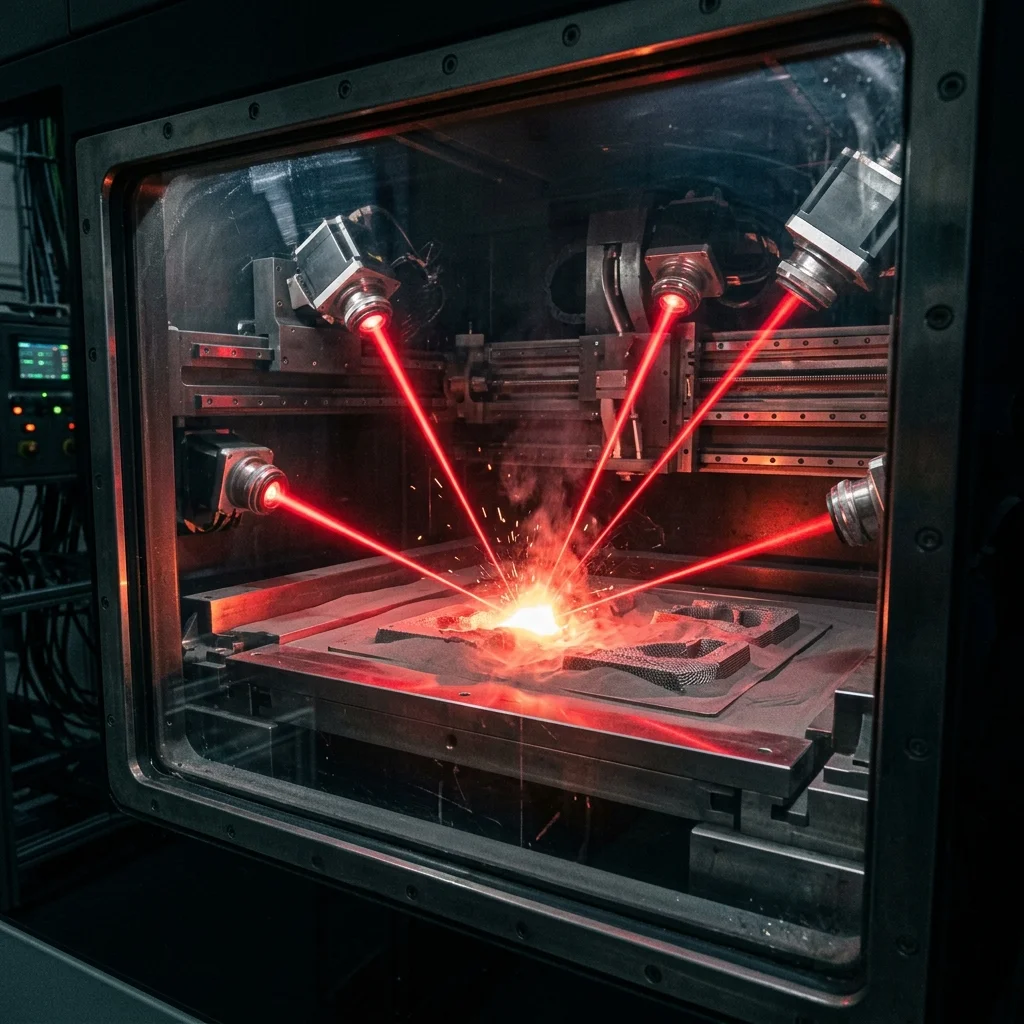
In 2025–2026, multi-laser PBF-LB (Powder Bed Fusion: Laser Beam) systems have become the standard for industrial metal additive manufacturing at scale. Systems with 4, 8, and even 12 lasers operating simultaneously on a single build platform deliver 4–12× productivity increases, making PBF economically viable for serial production.
Physics of Multi-Laser Scanning
The Single-Laser Bottleneck
With a single laser (typically 200–500W Yb-fiber at 1070 nm), the laser must scan the entire cross-section area for each layer. For a large build volume (400×400 mm) at 40 μm layer thickness, single-layer scan time can exceed 30–60 minutes.
The Solution: Parallelism
Multi-laser systems divide the build field into zones (or use overlap strategies), where each laser processes its own segment. With 4 lasers, layer time drops ~4×. With 8 lasers: ~8×.
| Laser Count | Throughput (cm³/hr) | Representative System |
|---|---|---|
| 1 × 400W | 15 – 25 | EOS M 290 |
| 4 × 400W | 60 – 100 | EOS M 400-4, SLM 500 |
| 4 × 700W | 80 – 130 | TRUMPF TruPrint 5000 |
| 8 × 700W | 140 – 200 | SLM 800 (Nikon SLM) |
| 12 × 1000W | 200 – 350 | SLM NXG XII 600 |
Interactive Filament Selector
Answer 3 quick questions and find the optimal material for your project.
1. What are the mechanical requirements for the part?
2. What temperature will the part operate at?
3. Are there any specific environmental requirements?
Our recommendation:
PLA filament
Ideal for easy printing, model visualization and decorative parts.
Multi-Laser Challenges
1. Stitching
When adjacent lasers process neighboring zones, the boundary creates a stitch zone. If laser parameters are not precisely calibrated, this zone may exhibit different microstructure, porosity, or residual stresses.
2. Gas Flow Management
Shielding gas (argon/nitrogen) must carry away metal fumes and spatter. With 8–12 lasers generating spatter simultaneously, gas flow must be significantly more powerful and precisely directed.
3. Thermal Management
Multiple lasers generate substantially more heat in the build chamber, requiring more robust cooling systems and homogeneous platform preheating.
Pros and Cons
Pros:
- Dramatic Productivity Increase: 4–12× faster than single-laser systems.
- Larger Build Volume: Machines like NXG XII 600 reach 600×600×600 mm.
- Serial Production: Makes PBF cost-effective for runs of 100–10,000 parts.
- No Quality Sacrifice: With proper calibration, quality equals single-laser output.
Cons:
- Extreme Cost: NXG XII 600 costs > €2,000,000.
- Complex Calibration: Each laser requires individual calibration plus stitch zone optimization.
- Higher Gas Consumption: Increased gas flow for spatter management.
- Specialized Personnel: Operators must understand multi-laser physics.
FAQ
Interactive Analyzer for Multi-Laser Pbf-Lb Systems: 4–12 Lasers For Serial Metal Production
Select a profile to view detailed analysis.
The full picture
This article is one page from The Big Book of 3D Printing: 704 illustrated pages covering every technology, material and fix in one reference.
Read it on Kindle →Engineer, author of The Big Book of 3D Printing and additive manufacturing expert