

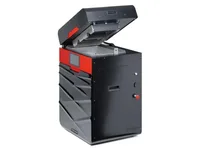
The Sinterit Lisa Pro is a compact benchtop SLS machine from a Polish manufacturer that puts selective laser sintering within reach of small businesses and R&D labs. With a 110×160×245 mm build volume, a diode laser and an optional nitrogen atmosphere, the Lisa Pro offers an open material system and a reliable SLS process without the need for a large production floor.
What it is
The Lisa Pro is the step above the base Sinterit Lisa: larger chamber, improved thermal homogeneity and an optional nitrogen atmosphere that reduces oxidation and broadens compatible materials (including TPU and TPE). The machine runs on an open material system, meaning the user is not locked to the manufacturer's own powder cartridges. It is aimed at prototyping departments, small runs of functional parts and research teams that need true SLS geometric freedom: no support structures, in a benchtop footprint.
Technical specifications
| Technology | SLS: Selective Laser Sintering |
|---|---|
| Build volume | 110 × 160 × 245 mm |
| Laser | diode laser |
| Nitrogen atmosphere | optional (reduces oxidation, broadens material range) |
| Material system | open: supports third-party powders |
| Class / Price | Industrial · ~€19,500 |
Applications and industries
- Functional nylon prototypes (PA12 and PA11 parts with near-end-use mechanical properties) testing form, fit and load without support structures (Industrial design and R&D)
- Flexible TPU and TPE parts (Elastic geometries impossible with FDM) seals, dampers, medical consumables with complex internal structure (Medical and consumer goods)
- Small-batch end-use parts (Production of 1–500 customized functional components without tooling) economically viable at low volumes (Manufacturing and aerospace)
Production workflow
- Preparation: fill the build chamber with powder (fresh or refresh blend), level the layer and verify the heating system. A uniform powder layer and stable chamber temperature, the foundation for homogeneous sintering.
- SLS sintering: set parameters (laser power, scan speed, powder temperature) per material profile; start the build. The laser selectively sinters each layer; unsintered powder acts as natural support for subsequent layers.
- Cooling: allow the build cake to cool slowly inside the chamber (can take 6–24 h depending on volume) without interruption. Gradual cooling prevents thermal stresses and warping in the parts.
- Unpacking and finishing: remove the build cake, clear residual powder with a sandblaster (Sandblaster/ATEX), then sand, polish or dye as needed. Clean, finished SLS parts with the required surface finish for the application.
Key considerations
Materials and applications
Pick a material/alloy this machine processes to see its properties and typical applications:
Conclusion
The Sinterit Lisa Pro is the right choice when true SLS design freedom and PA12/TPU materials are required but the budget and floor space do not allow a next-tier industrial machine. Its open material system, nitrogen option and compact footprint make it an exceptionally versatile tool for R&D departments and small manufacturers seeking reliable functional parts without support structures.
The full picture
This article is one page from The Big Book of 3D Printing: 704 illustrated pages covering every technology, material and fix in one reference.
Read it on Kindle →Engineer, author of The Big Book of 3D Printing and additive manufacturing expert