

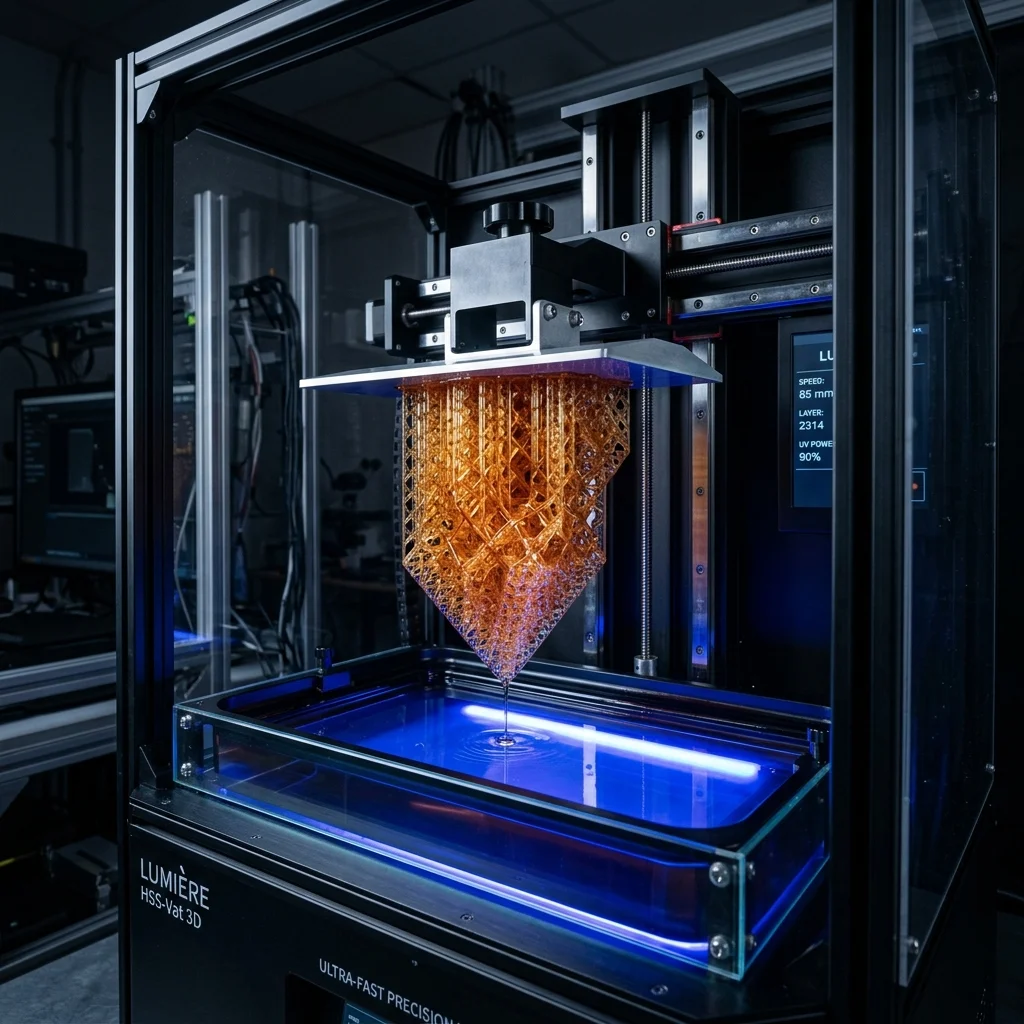
In 2025–2026, Continuous Liquid Interface Production (CLIP) has established itself as the fastest vat polymerization technology in commercial additive manufacturing. By eliminating the mechanical peel-and-refill cycle that limits conventional DLP, CLIP achieves build speeds 25–100× faster while producing isotropic, layer-less parts.
This article examines the oxygen-inhibition physics, optical projection systems, and commercial applications driving the adoption of high-speed CLIP technology.
The Fundamental DLP Bottleneck: The Print-Peel-Refill Cycle
In standard DLP, each layer requires:
- Projection: UV light cures one layer of resin (~1–10 seconds).
- Peeling/Tilting: The cured layer must be separated from the vat floor (~2–5 seconds), generating mechanical stress.
- Recoating: Fresh liquid resin refills the gap (~1–3 seconds).
- Repeat: The build platform descends by one layer height.
Total time per layer: 5–20 seconds. For a 1000-layer part → 1.5–5.5 hours. Most of the time (60–70%) is “dead”: mechanical pauses, not curing.
CLIP: The Oxygen Dead Zone
Joseph DeSimone (Carbon founder) patented CLIP in 2015. The key innovation is an oxygen-permeable window (typically amorphous fluoropolymer: Teflon AF 2400):
Operating Principle
- Oxygen Inhibits Polymerization: Oxygen molecules ($O_2$) quench the free radicals generated by UV photoinitiators. Where oxygen is present, the resin cannot cure.
- Dead Zone: Oxygen diffuses through the permeable window, creating a thin liquid layer (10–20 μm) between the window and the curing resin. This layer never solidifies.
- Continuous Pull: Since the part never adheres to the vat floor, the build platform rises continuously, without peel pauses.
- Automatic Resin Refill: Hydrodynamic flow continuously delivers fresh resin into the dead zone, eliminating the recoating step.
Result: Instead of discrete layers, CLIP produces a continuous, layer-less structure at Z-speeds of 100–1000 mm/hr (standard DLP: 10–30 mm/hr).
Interactive Filament Selector
Answer 3 quick questions and find the optimal material for your project.
1. What are the mechanical requirements for the part?
2. What temperature will the part operate at?
3. Are there any specific environmental requirements?
Our recommendation:
PLA filament
Ideal for easy printing, model visualization and decorative parts.
Optical System: High-Power DLP Projector
CLIP employs an industrial DLP projector with UV LEDs (385 nm or 405 nm) and a pixel resolution of 50–75 μm. Unlike standard DLP, the projector operates in continuous mode: projecting dynamically changing images (video stream) rather than static layers:
| Parameter | Standard DLP | Carbon CLIP |
|---|---|---|
| Projection Mode | Discrete layers | Continuous video stream |
| Z-Speed | 10 – 30 mm/hr | 100 – 1000 mm/hr |
| Layer Cycle | 5 – 20 seconds | Continuous (no layers) |
| Peeling | Mandatory | Eliminated |
| Surface Finish | Step lines visible | Layer-less (smooth) |
| Z-Axis Strength | Lower (inter-layer weakness) | Homogeneous (isotropic) |
Pros and Cons
Pros:
- Extreme Speed: 25–100× faster than standard DLP for most geometries.
- Layer-Less Surface: Eliminates visible staircase artifacts.
- Isotropic Mechanical Properties: No inter-layer weakness, strength is uniform in all directions.
- Scalability: Enables mass production of customized parts.
Cons:
- Closed Ecosystem: Carbon CLIP is available only via subscription with proprietary resins.
- High Entry Cost: Carbon M-series costs $50,000+ for hardware plus monthly subscription.
- Limited Build Volume: Maximum part size is constrained by DLP projector area.
- Resin Formulation Sensitivity: Not all resins are CLIP-compatible, specialized formulation required.
Frequently Asked Questions (FAQ)
Interactive Analyzer for Clip: High-Speed Continuous Vat Polymerization
Select a profile to view detailed analysis.
The full picture
This article is one page from The Big Book of 3D Printing: 704 illustrated pages covering every technology, material and fix in one reference.
Read it on Kindle →Engineer, author of The Big Book of 3D Printing and additive manufacturing expert