

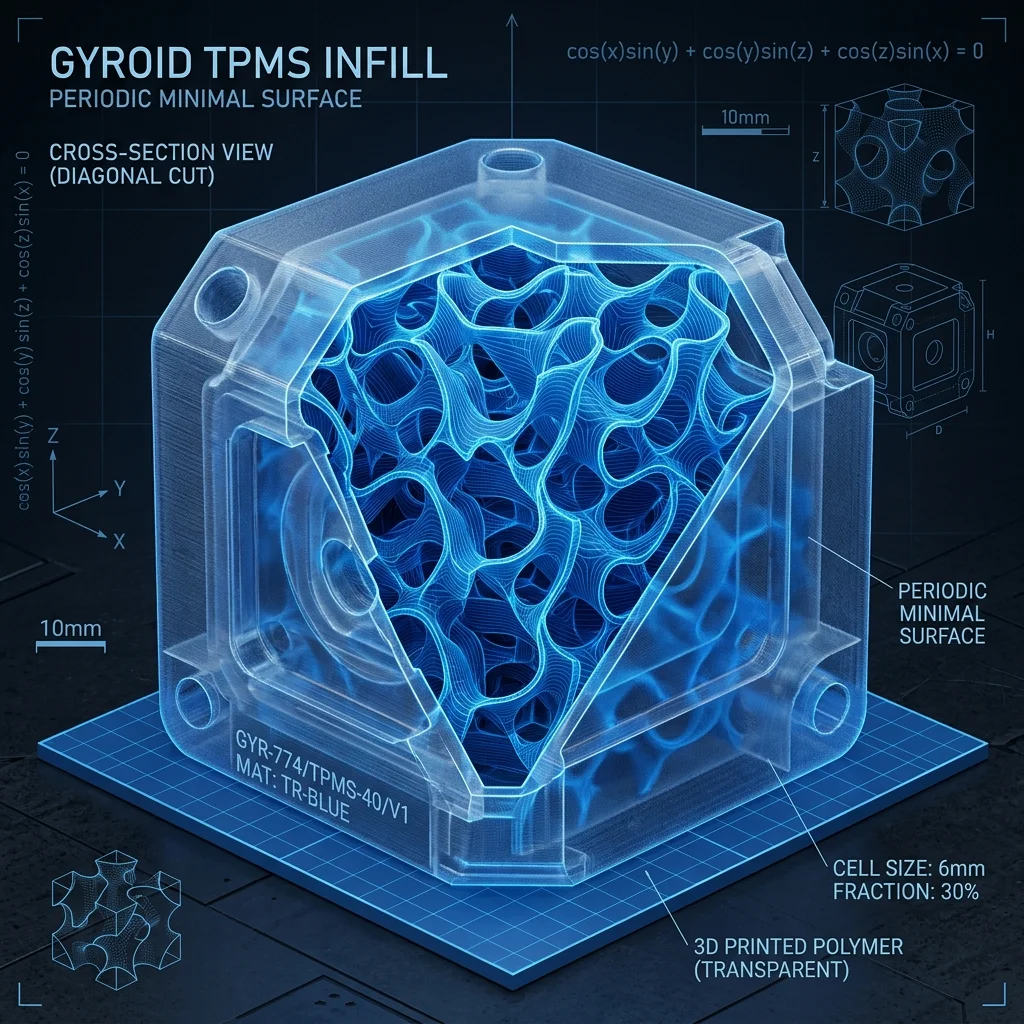
In 2025–2026, generative infill structures and particularly Gyroid infill have become central to optimizing 3D printed parts for strength, weight, and print time. Gyroid is a triply periodic minimal surface (TPMS) with unique mechanical properties and isotropic strength.
Gyroid Mathematics
$$sin(x)cos(y) + sin(y)cos(z) + sin(z)cos(x) = 0$$
Properties: isotropic strength, continuous surface (no intersections), self-supporting, visually striking.
Interactive Filament Selector
Answer 3 quick questions and find the optimal material for your project.
1. What are the mechanical requirements for the part?
2. What temperature will the part operate at?
3. Are there any specific environmental requirements?
Our recommendation:
PLA filament
Ideal for easy printing, model visualization and decorative parts.
Infill Pattern Comparison
| Pattern | Isotropy | Strength (20%) | Speed | Vibration Damping |
|---|---|---|---|---|
| Grid | Anisotropic | Moderate | Fast | Low |
| Gyroid | Isotropic | Excellent | Medium | High |
| Cubic | Isotropic | Good | Fast | Moderate |
| Lightning | N/A | Minimal | Fastest | N/A |
Generative Approaches
- Topology-Optimized Infill: Variable density based on FEA stress analysis.
- Voronoi Infill: Natural tessellation pattern.
- Stress-Adaptive Density:AI dynamically varies density based on FEA stress map.
Pros and Cons
Pros:
- Isotropic Strength: No “weak direction.”
- Excellent Damping: Absorbs vibrations better than grid.
- Self-Supporting: No internal supports needed.
Cons:
- Print Speed: Slower than grid/cubic.
- Not Always Optimal: Honeycomb may be better for pure compression.
FAQ
Interactive Analyzer for Generative Infill And Gyroid Structures For Optimal Strength
Select a profile to view detailed analysis.
The full picture
This article is one page from The Big Book of 3D Printing: 704 illustrated pages covering every technology, material and fix in one reference.
Read it on Kindle →Engineer, author of The Big Book of 3D Printing and additive manufacturing expert