

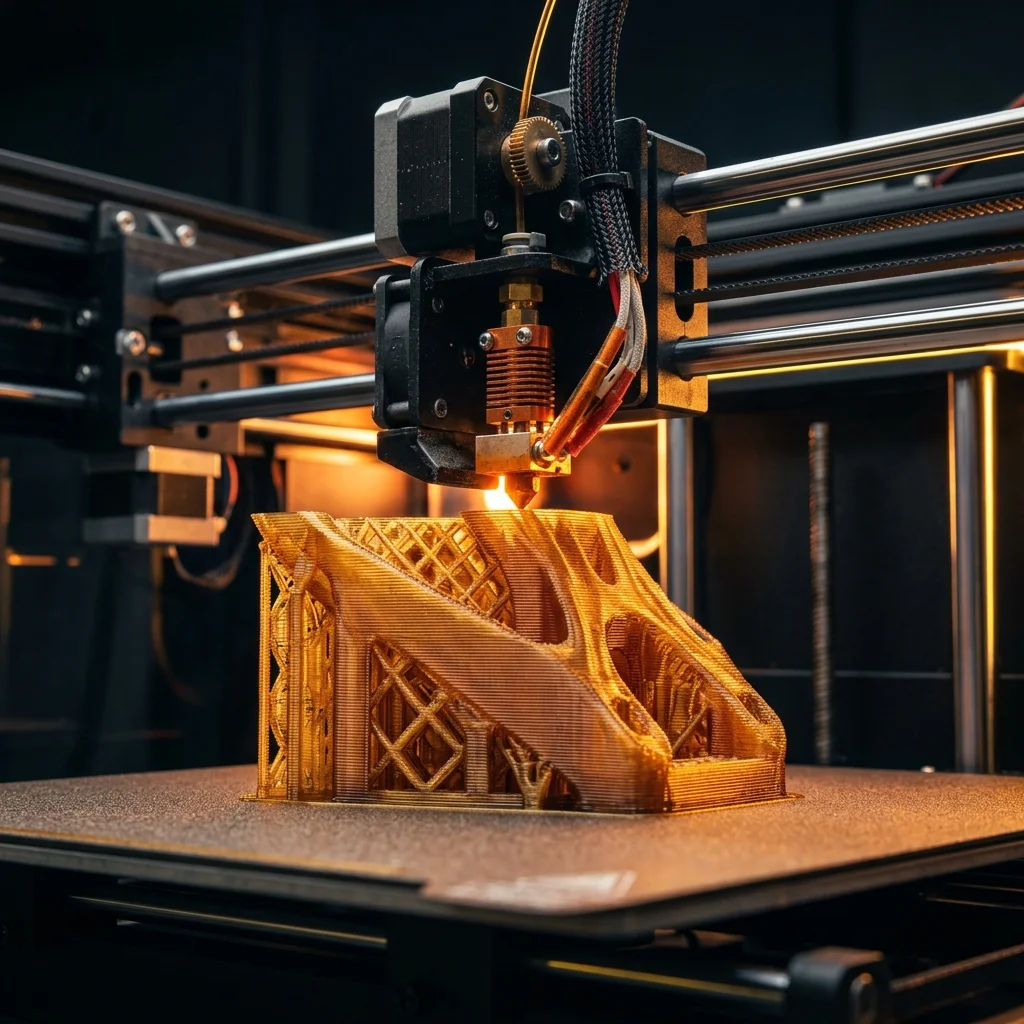
PEEK (polyether-ether-ketone) and ULTEM (polyetherimide) are the highest-tech engineering plastics that can be printed with FDM technology. They’re used in jet engines, medical implants, nuclear reactors, and high-temperature electronic modules. With HDT up to 250°C, biocompatibility for long-term body contact, and exceptional chemical resistance: PEEK and ULTEM are materials that previously required metallurgical equipment. But printing PEEK or ULTEM is not trivial: it requires a specialized printer (Intamsys, Stratasys, Markforged) with a hotend at 360-400°C and an actively heated chamber at 90-120°C. A standard Bambu or Prusa CANNOT. In this guide we cover PEEK and ULTEM variants, specialized printers, and real industrial applications.
Why PEEK and ULTEM
PEEK characteristics:
- HDT: 230-250°C
- Tensile strength: 95-110 MPa (close to unannealed aluminum)
- Flexural strength: 170 MPa
- Biocompatibility: long-term body contact (Class IIa)
- Chemical resistance: resistant to all acids except fluorine, to all bases
- UV resistance: 10+ years outdoors
- Flame resistance: V-0 rating without additives
- Price: €350-€500/kg (200-300× pricier than standard PLA)
ULTEM (1010, 9085, 2300) characteristics:
- HDT: 210-220°C
- Tensile strength: 80-90 MPa
- Cheaper than PEEK (€180-€280/kg)
- Biocompatibility: limited (only 1010 series)
- Easier to print than PEEK
- Flame resistance: V-0 rating
When PEEK or ULTEM make sense:
- Aerospace applications. Light structural elements with high temperature. Boeing 787 uses over 1000 PEEK parts for interior and cabin systems.
- Medical implants. PEEK replaces metal for spinal implants, oral implants. Semi-transparent under X-ray, biocompatible for decades.
- High-temperature electronic enclosures. Sensor enclosures in fuel systems, nuclear reactors, oil well drilling.
- Chemically resistant parts. Pumps, piping, reaction vessels in oil and chemical industry.
- Industrial tooling. Grinding fixtures, machining jigs at 200°C+.
- Aerospace prototypes. For testing functional parts before metal production.
When PEEK / ULTEM aren’t sensible:
- Decorative applications (PLA at €25/kg does the same visually, without 200× price difference).
- Simple functional parts without specific temperature or chemistry requirements (Polymaker PC-Max at €65/kg is sufficient).
- Small prototypes without certification (standard FDM is sufficient).
- Small hobby series (the specialized printer at €8000+ overshoots the need).
Recommended printers
IMPORTANT: PEEK and ULTEM require a specialized printer. Standard Bambu, Prusa, Anycubic, Creality CANNOT print these materials. Requirements:
- Hotend: 360-400°C (standard printers max 300°C)
- Actively heated chamber: 90-120°C (standard printers up to 60°C)
- Hardened steel nozzle (CF-reinforced versions abrade)
- High-temperature print bed: up to 160°C (standard 110°C)
Desktop industrial printers:
- Intamsys Funmat HT (€8,000-€12,000): Chinese manufacturer specialized in PEEK and ULTEM. 360°C hotend, 90°C chamber. The most accessible desktop PEEK printer.
- Intamsys Funmat Pro 410 (€18,000): professional version with a larger build volume.
- 3ntr A4 (€15,000-€25,000): European competitor with 400°C hotend and 90°C chamber.
- Aon3D HT3 (€80,000+): industrial, 460°C hotend.
Industrial systems:
- Stratasys Fortus 450mc (€150,000+): industrial FDM leader. PEEK, ULTEM 9085, ULTEM 1010 support.
- Stratasys F900 (€500,000+): top Stratasys printer for aerospace.
- Markforged FX20 (€60,000): carbon-fiber reinforced PEEK + ULTEM.
- Roboze Argo 500 (€150,000+): Italian competitor.
- 9T Labs FDM-X (€200,000+): Swiss manufacturer, specialized composites.
Industrial PEEK printers are owned by:
- Military and defense contractors
- Major research institutes
- Aerospace partnership labs
For one-off PEEK or ULTEM prototypes: order from a European bureau (German Stratasys centers, Italian Roboze distributors). Price for a single prototype: €200-€2000 depending on size and complexity, lead time: 2-4 weeks.
PEEK and ULTEM filament types
PEEK variants:
- Standard PEEK: Victrex PEEK 450G in semi-crystalline form. Semi-transparent white, excellent mechanical strength.
- PEEK-CF (15% carbon fibers): increased flexural strength (up to 220 MPa), lower thermal expansion coefficient.
- PEEK-GF (15-30% fiberglass): increased strength, lower electrical conductivity.
- PEEK Medical Grade (PEEK Implant Grade) – biocompatible for long-term body contact. ISO 10993, USP Class VI certification.
- PEEK Antibacterial, with antibacterial additives for medical applications.
Recommended PEEK brands:
- Solvay KetaSpire (Victrex competitor): €380-€450/kg.
- Evonik Vestakeep: €400-€500/kg.
- 3DXTech PEEK: €350-€420/kg.
- Apium PEEK: €380/kg, specifically optimized for Apium printers.
ULTEM variants:
- ULTEM 1010: biocompatible, FDA-certified for dental and medical work. €280-€350/kg.
- ULTEM 9085: standard ULTEM with FAR 25.853 aviation certification (for aircraft interior components). €200-€280/kg.
- ULTEM 2300: fiberglass-filled, higher strength. €240-€320/kg.
- ULTEM 1000: standard ULTEM without special additives. €180-€220/kg.
Recommended ULTEM brands:
- Stratasys ULTEM 9085: industry standard. €280/kg (Stratasys printers only).
- 3DXTech ULTEM: €200-€280/kg, broader availability.
- Roboze ULTEM 9085: €260/kg.
- Markforged ULTEM: €280/kg (Markforged printers).
For most applications, start with ULTEM 9085 (easier to print than PEEK, cheaper). For applications above 200°C or biocompatibility: move to PEEK or ULTEM 1010.
Optimal settings for PEEK on Intamsys Funmat HT
These settings are specific to Intamsys Funmat HT with Victrex PEEK 450G. Other printers and PEEK brands may need minor adjustments.
Hotend temperature: 380-400°C. PEEK won’t extrude below 360°C. Above 400°C, slow polymer chain degradation begins.
Bed temperature: 130-160°C. Standard 145°C. Below 130°C: part lifts. Above 160°C: bed may warp.
Chamber temperature: IMPORTANT! 90-120°C actively heated. Without an active chamber PEEK prints will delaminate 80-90% of the time. Intamsys Funmat HT actively maintains 90°C chamber temperature.
Print speed: 20-40 mm/s. PEEK prints slowly: much slower than standard FDM. A typical 100×100×100 mm prototype takes 8-16 hours.
Retraction: PEEK is highly viscous, minimal retraction needed. Direct drive: 0.5-1 mm @ 25 mm/s.
Cooling: 0% for PEEK. PEEK does NOT like cooling: slow cooling needed for semi-crystalline structure.
Layer height: 0.15-0.25 mm standard. Thinner (0.10 mm) is possible but doubles time.
Infill: 50-100% for functional PEEK parts. PEEK is expensive: usually you want maximum strength from limited material volume.
Wall pattern: 6-10 walls. Key to PEEK strength.
Supports: PEEK supports are hard to remove. Where possible print without supports or with soluble alternatives (but most soluble supports degrade at PEEK temperatures).
Post-print: annealing: PEEK from FDM print is amorphous (no crystalline structure). For full mechanical characteristics, heat treatment (anneal) is needed: 4-6 hours at 200°C in an oven. This stabilizes the crystalline structure and increases strength 30-50%.
Filament drying: REQUIRED. PEEK absorbs 0.5-1% moisture. Before printing: 12-24 hours at 120°C in a specialized dryer (Intamsys Funmat HT has built-in drying).
Real applications and industrial examples
Aerospace industry:
Boeing 787 Dreamliner has over 1000 ULTEM 9085 parts: air ducts, cabin components, tool brackets. ULTEM 9085 has FAR 25.853 certification for flammability and toxic fumes: required for aircraft interiors.
Aerospace MRO (Maintenance, Repair, Overhaul) labs print replacement ULTEM parts for passenger aircraft. Spare part lead time from 3D printing: 24-48 hours vs 6-12 weeks for original Boeing/Airbus components. ULTEM component cost: €200-€2000 by size.
Medical implants:
PEEK spinal implants. PEEK replaces metal implants in spine surgery with several advantages:
- Closer to natural bone density: reduces stress on adjacent vertebrae
- Radiolucent: enables clearer monitoring of bone fusion
- Biocompatible for decades (PEEK implants last 30+ years in vivo)
Major hospitals use PEEK spinal implants from European suppliers. Cost per implant: €1500-€5000 (including surgical planning and patient-specific design).
Dental implants:
ULTEM 1010 and PEEK Implant Grade for partial dentures and surgical guides. Less radiopaque than metal, easier on the patient. Cost: €300-€1200 per piece.
Oil and chemical industry:
PEEK pumps, piping, reaction vessels. PEEK withstands corrosive chemicals (hydrochloric acid, phosphoric acid) better than stainless steel at equivalent cost.
Major refineries have installed PEEK components in critical systems. Service comes from European suppliers (3T RPD in Italy, FKM in Germany).
Automotive prototypes:
ULTEM 9085 for prototypes of engine components, exhaust systems, high-temperature electronic enclosures. Major automaker service centers occasionally order ULTEM prototypes from European bureaus.
Academic-research applications:
Technical universities: have Intamsys Funmat HT printers in engineering labs. Used for theses and doctoral dissertations in high-temperature plastics.
Cost-benefit for industrial PEEK order:
Single PEEK component 50×50×30 mm: €200-€800 by complexity and certification. With full certification (Aerospace or Medical Grade): €1500-€5000.
For small companies PEEK and ULTEM rarely make economic sense: usually an aluminum or steel prototype covers the need. PEEK / ULTEM is justified only when a specific requirement (high temperature, biocompatibility, aerospace or medical certification) mandates it.
Frequently Asked Questions (FAQ)
Fdm With Peek And Ultem, Industrial High-Tech Materials Calculator
Interactive optimization calculator.
The full picture
This article is one page from The Big Book of 3D Printing: 704 illustrated pages covering every technology, material and fix in one reference.
Read it on Kindle →Engineer, author of The Big Book of 3D Printing and additive manufacturing expert