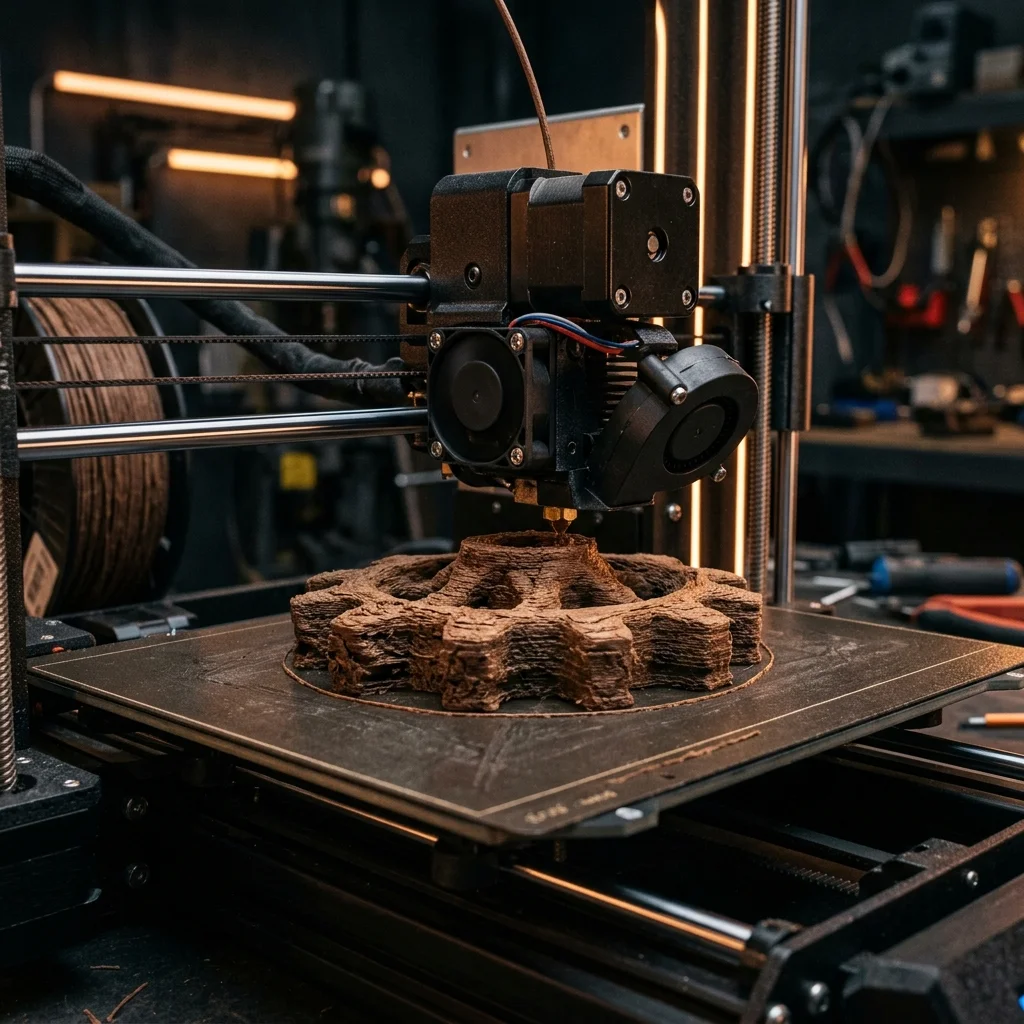
3D printing with specialty composite filaments (containing wood or metal particles) pushes the boundaries of FDM technology beyond standard plastics. These materials offer unique aesthetics, weight, and texture, allowing you to create parts that visually and tactilely resemble real wood, copper, bronze, or steel. However, achieving quality results requires specific hardware preparation and precise print tuning.
What are metal and wood filaments?
Composite FDM filaments consist of a base polymer (usually PLA) mixed with fine powder particles of the respective material. For wood filaments, this is fine wood dust or cork, while metal filaments use particles of copper, bronze, brass, or stainless steel.
These additives can make up to 80% of the filament by weight (especially in heavy metal composites), fundamentally changing how the material behaves during melting and extrusion. While the final parts do not possess the structural strength of pure metal or wood, they offer an authentic look and can be post-processed using traditional techniques (sanding, polishing, staining).
Essential Hardware Requirements
Printing with composites requires mandatory printer modifications to avoid damage and clogs:
1. Abrasion-Resistant Nozzle (Hardened Steel / Ruby) Metal and wood particles are highly abrasive. A standard brass nozzle will be ruined and widened after printing just a few hundred grams. Using a hardened steel, ruby, or tungsten carbide nozzle is strongly recommended.
2. Larger Nozzle Diameter To prevent clogging from the larger particles suspended in the filament, the absolute minimum nozzle size is 0.4 mm, but the best and most reliable results are achieved with 0.6 mm or 0.8 mm nozzles.
3. Direct Drive Extruder Because composite filaments are often much more brittle than standard PLA, a direct drive extruder provides a much more reliable filament feed path compared to long Bowden tube systems.
Recommended 3D Printers
Not every printer is ready for abrasive materials ‘out-of-the-box’. Here are the leading models that handle them exceptionally well:
1. Bambu Lab X1-Carbon This model comes standard with a hardened steel extruder gear and nozzle, making it perfectly ready for abrasive materials right out of the box. Its closed chamber and flow sensors ensure a smooth process.
2. Prusa Research Prusa i3 MK4 Thanks to its precise Nextruder, the MK4 reliably feeds even brittle wood filaments without snapping. However, it is critical to replace the stock brass nozzle with an ObXidian or other wear-resistant nozzle before starting.
3. UltiMaker S7 A professional system that utilizes a dedicated Print Core CC designed specifically for abrasive composite materials. It offers perfect repeatability and reliability for industrial users.
Recommended Material Brands
Choosing a high-quality composite is critical. Low-grade filaments often have inconsistent particle distribution, leading to constant clogs.
1. ColorFabb Pioneers in composite materials. Their Woodfill (featuring fine wood fibers) and Copperfill/Bronzefill (with exceptionally high metal content) are industry standards for artistic applications.
2. Fillamentum The Timberfill series offers a phenomenal variety of wood shades (Light Wood, Rosewood, Champagne) that genuinely smell like real wood while printing and absorb wood stain beautifully.
Printing and Post-Processing Specifics
Print settings differ significantly from standard PLA. With wood filaments, changing the hotend temperature by just a few degrees can alter the color of the printed part (higher temp = darker color), allowing you to simulate artificial wood grain.
Post-processing is where the magic happens. Wood parts need to be lightly sanded to expose the wood particles, after which they can be stained and varnished. Metal parts initially look dull and clay-like. Only after aggressive sanding and polishing with steel wool or in a rock tumbler does the part develop the shine and cold feel of real metal.
Frequently Asked Questions (FAQ)
Fdm 3D Printing With Metal And Wood Filaments, Full Guide Calculator
Interactive optimization calculator.
The full picture
This article is one page from The Big Book of 3D Printing: 704 illustrated pages covering every technology, material and fix in one reference.
Read it on Kindle →Engineer, author of The Big Book of 3D Printing and additive manufacturing expert
Updated on 11 September 2026
This article was written with AI assistance; the facts were checked against the sources on 11 September 2026.