

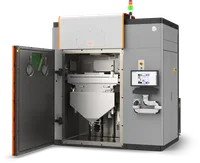
The 3D Systems DMP Flex 350 is an industrial direct metal printing (DMP/LPBF) machine built to produce dense, high-integrity metal parts from reactive alloys such as titanium and cobalt-chrome. Its vacuum-purged, inert-atmosphere chamber keeps oxygen below 25 ppm: a critical condition for achieving near-zero porosity in aerospace and medical components.
What it is
The DMP Flex 350 uses Direct Metal Printing: 3D Systems' branding for Laser Powder Bed Fusion (LPBF). A 500 W fiber laser selectively melts successive layers of metal powder on a 275×275×420 mm platform. The key differentiator is the vacuum chamber: before every build the chamber is evacuated and backfilled with argon, maintaining O₂ < 25 ppm. This makes the machine particularly suited to reactive metals (Ti, CoCr), where even trace oxygen causes oxidation and degraded mechanical properties. An additional advantage is the Removable Print Module (RPM): the platform carrying the built block can be extracted and transferred directly to a furnace for heat treatment without touching the parts. The machine targets aerospace manufacturers, medical and dental OEMs, and semiconductor tooling companies.
Technical specifications
| Technology | DMP / LPBF (Laser Powder Bed Fusion) |
|---|---|
| Build volume | 275 × 275 × 420 mm |
| Laser power | 500 W fiber laser |
| Chamber atmosphere | Vacuum + argon purge, O₂ < 25 ppm |
| Build platform | Removable Print Module (RPM) |
| Class / Price | Industrial · ~€700 000 |
Applications and industries
- Aerospace titanium components: Structural load-bearing parts, brackets and heat exchangers in Ti6Al4V with near-zero porosity (> 99.9% density), meeting AS9100 and DO-160 requirements. (Aerospace and defense)
- Medical implants and dental prosthetics – Patient-specific orthopaedic implants, dental crowns and bridges in CoCr and Ti6Al4V with osseointegrative porous lattice structures, compliant with ISO 13485. (Medical and dental)
- Precision industrial and semiconductor tooling: Nozzles, conformal cooling channels and test fixtures in 17-4PH stainless steel and Inconel 718 for semiconductor equipment and injection moulds. (Semiconductor and precision engineering)
Production workflow
- Prepare the powder feed system and inspect the powder batch (morphology, moisture, particle size distribution). Powder meets OEM specification: correct sphericity and no agglomerates.
- Load the Removable Print Module (RPM), seal the chamber and run the vacuum-to-argon purge cycle (O₂ < 25 ppm). Low-oxygen inert atmosphere is confirmed by the built-in O₂ sensor: reactive metals can be built without oxidation risk.
- Run the DMP build using validated laser parameters (power, speed, hatch spacing, layer thickness) for the selected material. Consolidated layers with minimal porosity, stable melt pool and controlled residual stress.
- Extract the RPM, transfer to furnace and apply heat treatment (HIP and/or stress-relief annealing) to reduce residual stresses. Residual stresses relieved and microstructure homogenised: parts ready to be separated from the platform.
- Cut parts from the platform (EDM or band saw), clean residual powder and apply finishing (CNC machining, polishing, shot peening). Parts with final dimensional tolerances and surface finish, ready for NDT inspection and delivery.
Key considerations
Materials and applications
Pick a material/alloy this machine processes to see its properties and typical applications:
Conclusion
The DMP Flex 350 sets the quality bar for industrial metal AM: its vacuum chamber and removable print module make it the preferred choice wherever low-oxygen atmosphere and microstructural verification are certification requirements. For aerospace titanium structures, medical implants with osseointegrative lattices and semiconductor tooling demanding zero tolerance for inclusions, the machine offers a proven production route from powder to certified metal part.
The full picture
This article is one page from The Big Book of 3D Printing: 704 illustrated pages covering every technology, material and fix in one reference.
Read it on Kindle →Engineer, author of The Big Book of 3D Printing and additive manufacturing expert