

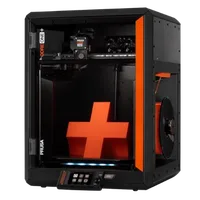
The Prusa Core One is Prusa Research's enclosed CoreXY FDM printer: a machine that marries the familiar simplicity of the PrusaSlicer ecosystem with the engineering rigour required for technical polymers. With a 250 × 220 × 270 mm build volume, automatic Input Shaper resonance compensation and a fully enclosed chamber, the Core One is the natural next step for anyone who has outgrown the MK4 and needs more demanding materials.
What it is
The Core One is Prusa's answer to enclosed CoreXY machines: a design where the printhead moves in the horizontal plane while the platform descends along the Z axis only. The result is more uniform acceleration, less vibration and real speeds above 200 mm/s without sacrificing quality. The enclosed chamber retains heat and shields ABS, ASA, PC and CF-Nylon from sudden cooling: the primary cause of warping in engineering polymers. The machine lives entirely within the Prusa ecosystem: PrusaSlicer, Prusa Connect and the optional MMU for multi-material printing.
Technical specifications
| Technology | FDM (CoreXY, enclosed chamber) |
|---|---|
| Build volume | 250 × 220 × 270 mm |
| Maximum speed | up to 500 mm/s (recommended 200–300 mm/s) |
| Resonance compensation | Input Shaper (automatic) |
| Multi-material | MMU (optional), up to 5 materials |
| Class / Price | Prosumer · ~€1400 |
Who it’s for
- Jigs and fixtures production: manufacturing of specialised production jigs from CF-Nylon and PC with high tensile strength and durability inside an enclosed chamber (Automotive)
- Rapid iterative prototyping: creating functional prototypes to verify form, fit and ergonomics in hours rather than days, with accuracy guaranteed by CoreXY kinematics (Industrial design and R&D)
- Education and STEM labs: teaching 3D design and manufacturing in school and university labs with a machine capable of genuine technical-material printing (Education)
Calibration step by step
- Clean the PEI plate with isopropyl alcohol (IPA) and run the automatic bed levelling. A degreased, geometrically level surface: guaranteed first-layer adhesion.
- Fine-tune Z-offset during the first-layer print. The first layer adheres firmly without being squished: preventing bed adhesion failure and elephant's foot.
- Run flow calibration via a Print Flow Tower in PrusaSlicer. Precise extrusion without under- or over-extrusion.
- Run the automatic resonance compensation (Input Shaper). Suppressed vibrations and ringing at higher speeds: visibly cleaner walls.
Common defects and fixes
Recommended settings by material
Pick a material to see the recommended temperatures (empirical ranges from 561 OrcaSlicer/Bambu profiles) plus machine-specific tips:
Conclusion
The Core One is the logical upgrade for the Prusa user ready for engineering materials and higher throughput, without leaving the ecosystem they already trust. The enclosed chamber opens the door to ABS, ASA, PC and CF-Nylon, CoreXY kinematics save real time on complex parts, and PrusaSlicer together with Prusa Connect guarantee the familiar workflow.
The full picture
This article is one page from The Big Book of 3D Printing: 704 illustrated pages covering every technology, material and fix in one reference.
Read it on Kindle →Engineer, author of The Big Book of 3D Printing and additive manufacturing expert