

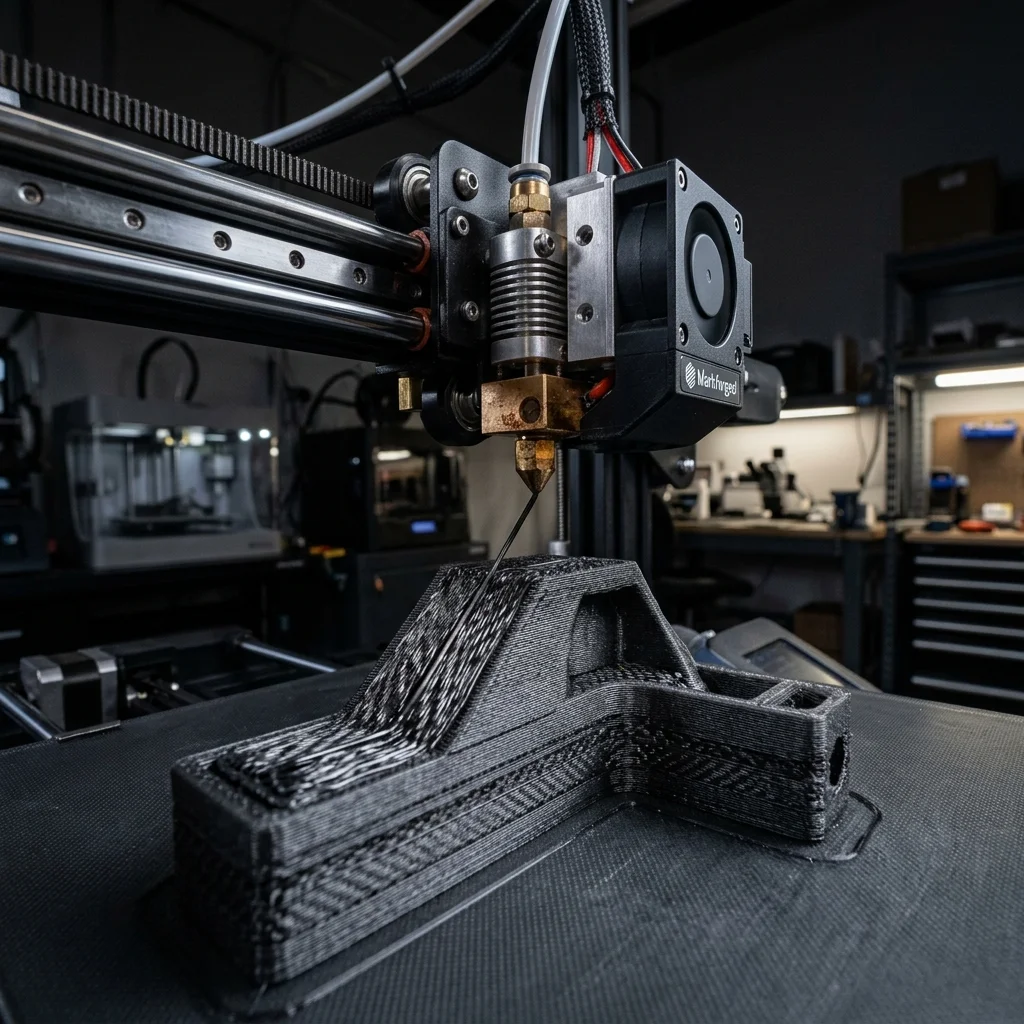
In 2025–2026, Continuous Fiber Reinforcement (CFR) has transformed 3D-printed polymer parts from prototyping curiosities into structural components that compete with aluminum. Instead of chopped fibers, CFR deposits a continuous strand of carbon, glass, Kevlar, or HSHT glass directly into the polymer matrix during printing.
Mechanics of Continuous Reinforcement
Chopped vs. Continuous: The Fundamental Difference
- Chopped fibers: Short fibers (50–200 μm) randomly oriented. Increase modulus 2–3× but cannot carry high tensile loads: force transfers through shear in the polymer matrix.
- Continuous fibers: Uninterrupted strand laid along the full part length. Force is carried directly by the fibers: analogous to rebar in concrete. Result: 10–20× higher strength and modulus in the fiber direction.
| Property | Nylon (Neat) | Nylon + Chopped CF | Nylon + Continuous CF |
|---|---|---|---|
| Tensile Strength | 50 MPa | 85 MPa | 590 MPa |
| Elastic Modulus | 1.7 GPa | 4.5 GPa | 60 GPa |
| Elongation | 30% | 4% | 1.5% |
| Specific Strength | Low | Moderate | Comparable to Al 6061 |
Interactive Filament Selector
Answer 3 quick questions and find the optimal material for your project.
1. What are the mechanical requirements for the part?
2. What temperature will the part operate at?
3. Are there any specific environmental requirements?
Our recommendation:
PLA filament
Ideal for easy printing, model visualization and decorative parts.
Fiber Types and Applications
| Fiber | Modulus | Tensile Strength | Applications |
|---|---|---|---|
| Carbon Fiber | 60 GPa | 800 MPa | Structural brackets, drone wings, robot arms |
| Fiberglass | 21 GPa | 590 MPa | Jigs, fixtures, mounting brackets |
| Kevlar (Aramid) | 27 GPa | 610 MPa | Impact-absorbing components, protective elements |
| HSHT Glass | 21 GPa | 600 MPa | High-temperature applications (up to 150°C) |
Pros and Cons
Pros:
- Metal-Like Strength: Continuous CF achieves specific strength comparable to aluminum 6061.
- Rapid Structural Prototyping: Replaces CNC-machined aluminum for design iterations.
- Custom Fiber Orientation: Fibers align precisely with load paths (similar to composite ply layup).
- Lightweight Structures: 60% lighter than aluminum equivalents.
Cons:
- Closed Ecosystem (Markforged): Fibers are proprietary and expensive.
- Anisotropy: Strength is high only in the fiber direction, transverse strength is matrix-limited.
- Geometry Limitations: Fibers cannot follow sharp corners (< 90°) without breaking.
- Post-Processing: Fiber layers are difficult to machine (sanding, drilling).
FAQ
Continuous Fiber Reinforcement (Cfr): Metal-Like Strength From A 3D Printer Calculator
Interactive optimization calculator.
The full picture
This article is one page from The Big Book of 3D Printing: 704 illustrated pages covering every technology, material and fix in one reference.
Read it on Kindle →Engineer, author of The Big Book of 3D Printing and additive manufacturing expert