

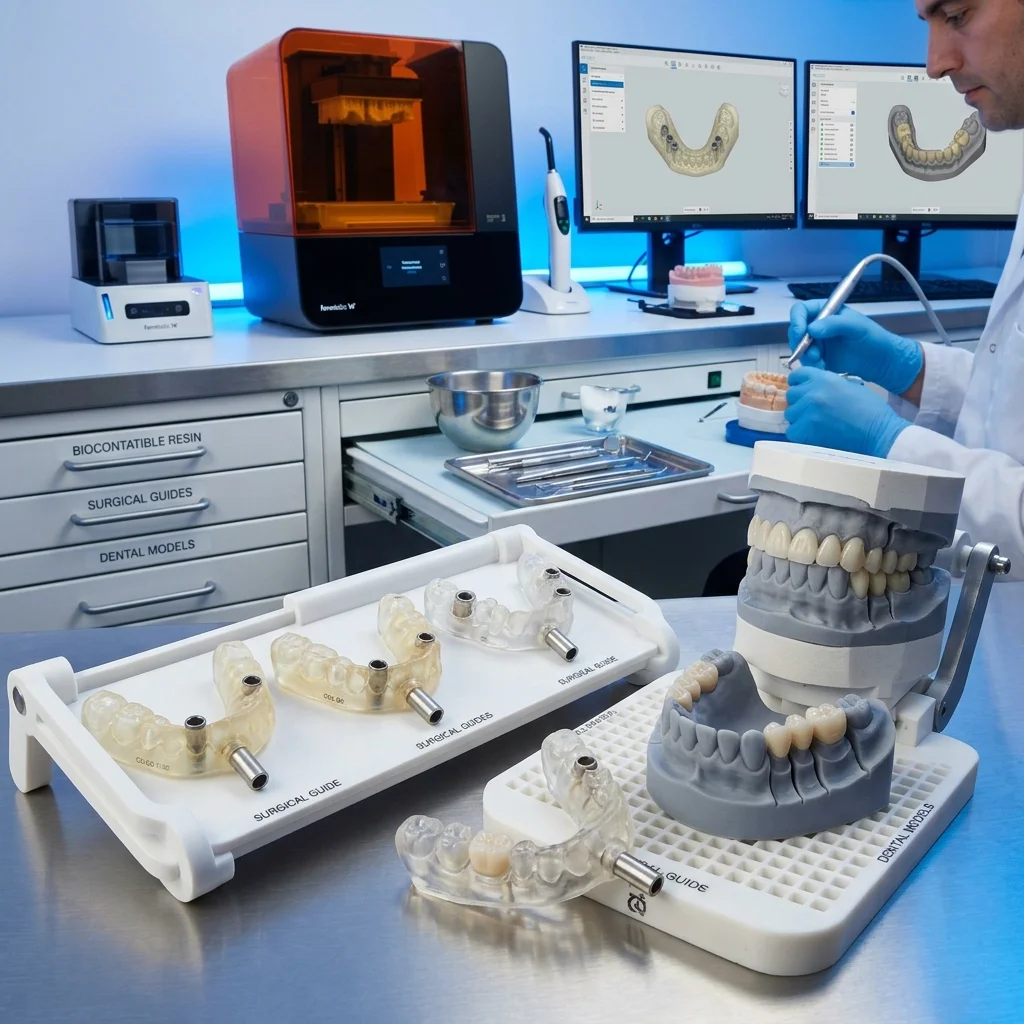
Today, we are diving into one of the most strictly regulated and technologically intensive sectors of additive manufacturing: digital dentistry. At EduFacturing, we often say that 3D printers are just the “picks and shovels,” but the true revolution lies in the chemistry and physics of materials. In 2025–2026, biocompatible resins are no longer just for temporary provisionals; they are steadily moving into permanent restorations and the direct printing of orthodontic appliances.
Let’s explore the engineering behind these materials, their physicochemical properties, and why biocompatibility is a system protocol rather than just a label on a bottle.
Physics and Chemistry of Biocompatibility: What Happens Under the Hood?
Unlike standard photopolymers designed for hobbyist printing, dental biocompatible resins are formulated to meet entirely different standards. They are primarily composed of highly purified methacrylate monomers and oligomers (such as UDMA – urethane dimethacrylate, Bis-GMA, and reactive diluents like TEGDMA), combined with precise photoinitiators (typically TPO – diphenyl(2,4,6-trimethylbenzoyl)phosphine oxide) and nano-ceramic or glass fillers to enhance mechanical strength.
The key engineering challenges here are twofold:
1. Degree of Conversion (DoC)
During photopolymerization, liquid monomers are linked into a solid polymer network by breaking carbon-carbon double bonds (C=C). For standard resins, the degree of conversion rarely exceeds 60–70%, which is sufficient for mechanical stability. However, for biocompatible resins, the degree of conversion should be targeted at 85–95% for maximum safety.
It is important to note that this is not an absolute regulatory limit; biocompatibility can still be achieved at 70–80% DoC, provided that unreacted monomers are thoroughly extracted during the washing process. If this threshold is not met and free monomers remain trapped, under the influence of saliva and temperature inside the oral cavity, these leachable monomers migrate into the patient’s tissues. They have proven cytotoxicity (ISO 10993-5) and can trigger allergic reactions, tissue necrosis, or long-term sensitization.
2. Wavelength: 385 nm vs. 405 nm
In 2025–2026, the industrial standard for professional dental printing has resolutely shifted to 385 nm UV light sources (DLP and LCD), moving away from classic 405 nm light engines.
- Optical Physics: At 385 nm, light scattering (governed by Rayleigh scattering, which is inversely proportional to the fourth power of the wavelength (lambda^{-4})) is physically higher compared to 405 nm. However, the increased resolution is achieved due to the significantly higher absorption of UV light by the photoinitiators (such as TPO) and UV blockers within the resin. This limits the depth of penetration (critical cure depth (C_d)) and eliminates lateral cure bleed, ensuring extreme precision at the marginal borders of crowns and bridges: a critical requirement to prevent microleakage and secondary caries.
- Spectral Efficiency: Since TPO has its absorption peak around 380–385 nm, polymerization occurs with much higher efficiency. This enables resin formulations with lower concentration of photoinitiators, avoiding yellowing and minimizing biocompatibility risks.
The Validation Chain: The Second Law of Dental 3D Printing
We must be absolutely clear: no resin is biocompatible by itself in the bottle. Biocompatibility is the result of strictly adhering to a validated chain of processes (Validation Chain). If you modify even a single parameter, the medical certification of the final part is immediately voided.
This chain consists of four mandatory steps:
- Printing: Using only validated profiles for the specific printer model, where the light intensity (mW/cm²) and exposure time per layer are laboratory-calibrated to guarantee optimal initial polymerization.
- Washing: The removal of residual liquid monomer is performed in certified washing devices (e.g., Form Wash, SprintRay ProWash S) using Isopropyl Alcohol (IPA >99%) or glycol ethers (DPM / TPM). Under-washing leaves a sticky, monomer-rich surface layer. Over-washing causes solvent absorption into the polymer matrix, leading to structural weakening and deformation.
- Drying: The part must be dried completely (typically with compressed air) to evaporate all solvent before moving to the next stage.
- Post-Curing: This is the most critical stage. Specialized curing ovens (such as the Otoflash G171, Form Cure L, or SprintRay ProCure 2) are used to combine high-intensity UV light at specific wavelengths with controlled heat (usually between 60°C and 80°C). Certain materials (like permanent crown resins) require a protective nitrogen (N₂) atmosphere. The nitrogen displaces oxygen in the chamber, preventing the formation of an oxygen-inhibition layer, which would otherwise leave the outer surface under-polymerized and sticky.
Regulatory Framework: ISO 10993 and Medical Device Classification
The clinical application of biocompatible materials is governed by their regulatory classification under European MDR (EU) 2017/745:
- ISO 10993-5 (Cytotoxicity): Assesses whether the material releases substances that kill cells.
- ISO 10993-10 (Skin Sensitization): Evaluates the potential for allergic reactions or sensitization upon long-term or repeated contact.
- ISO 10993-23 (Irritation): Evaluates local irritation of the mucosal or skin tissue (testing procedure moved from ISO 10993-10).
- ISO 20795-1/2: Defines the mechanical standards for denture bases and orthodontic resins.
| Resin Category | Medical Class (MDR) | Leading Examples (2025–2026) | Flexural Strength | Typical Clinical Application |
|---|---|---|---|---|
| Surgical Guides | Class I | Formlabs Surgical Guide, KeyPrint KeyGuide | >= 80 MPa | Templates for precise implant placement (short-term contact). |
| Bite Splints | Class IIa | KeyPrint KeySplint Soft, SprintRay NightGuard Flex | >= 50 MPa (high flexibility) | Nightguards for bruxism; requires a balance between rigidity and compliance. |
| Temporary Crowns | Class IIa | NextDent C&B Micro Filled Hybrid, Asiga DentaTooth | 100 – 130 MPa | Temporary crowns and short-span bridges worn for up to 1 year. |
| Permanent Crowns | Class IIb | SprintRay Ceramic Crown, BEGO VarseoSmile Crown plus | 110 – 230 MPa | Permanent single crowns, onlays, and veneers; highly filled with nano-ceramics. |
| Denture Bases & Teeth | Class IIa | 3D Systems NextDent Denture 3D+, Formlabs Denture Base/Teeth | >= 65 MPa | Full and partial removable dentures; exceptional wear and fracture resistance. |
Interactive defect troubleshooting guide
Pick a print defect symptom to see the causes and how to fix it.
Stringing
Possible cause: Damp filament, too high a temperature or too little retraction.
Quick fix:
- Dry the filament for 4-6 hours at 50°C.
- Lower the nozzle temperature by 5-10°C.
- Increase the retraction length by 0.5 to 1.0 mm.
Pros and Cons of Dental 3D Printing with Biocompatible Resins
Pros:
- Speed and Customization (Chairside Workflow): Print and post-process surgical guides or temporary crowns within a single patient visit (under 1 hour total using high-speed DLP/LCD printers).
- Cost Efficiency: Minimal material waste compared to subtractive milling, where most of a PMMA or zirconia block is milled away into waste dust.
- Geometric Freedom: Direct printing of hollow structures, indirect bonding trays (IBT), and complex anatomical features that cannot be machined with rotational milling burs.
- Enhanced Accuracy at 385 nm: Achieving dimensional deviations under 50 microns, ensuring an optimal marginal fit.
Cons:
- High Post-Processing Equipment Costs: Certified washing stations and curing ovens (especially nitrogen-enabled ones) can cost as much as the printer itself.
- Zero Tolerance for Protocol Deviations: Any failure in washing or post-curing times/temperatures can make the final part toxic without any visible signs of failure.
- Lower Wear Resistance than Monolithic Zirconia: While permanent hybrid resins have matured in 2026, they still have a shorter clinical lifespan compared to sintered zirconia or lithium disilicate.
Frequently Asked Questions (FAQ)
Interactive Analyzer for Biocompatible Resins: The Future Of Digital Dentistry
Select a profile to view detailed analysis.
The full picture
This article is one page from The Big Book of 3D Printing: 704 illustrated pages covering every technology, material and fix in one reference.
Read it on Kindle →Engineer, author of The Big Book of 3D Printing and additive manufacturing expert