

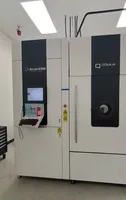
The Arcam EBM Q20plus from GE Additive is an industrial Electron Beam Melting (EBM) machine: a process where a powerful 3 kW electron beam fuses metal powder layer by layer inside a vacuum chamber at a bed temperature of around 700 °C. The result is near-zero residual stress and exceptionally dense parts from titanium and titanium aluminides, purpose-built for aerospace and orthopaedic surgery.
What it is
EBM is a cousin of laser powder-bed fusion (LPBF), but instead of a laser it uses an electron beam steered by electromagnetic lenses. The vacuum environment protects reactive metals like titanium from oxidation, while pre-heating the powder to ~700 °C reduces thermal shock between layers. This makes EBM the preferred choice for medical implants with trabecular (open-cell) structures and for aerospace components made of TiAl: a material too brittle for conventional machining. The Q20plus is optimised for high-volume production of aviation turbine blades and orthopaedic acetabular cups.
Technical specifications
| Technology | EBM: Electron Beam Melting |
|---|---|
| Build volume | Ø 350 × 380 mm (cylindrical zone) |
| Beam power | 3 kW electron beam, multi-spot scanning |
| Build environment | Vacuum (~10⁻³ mbar): no oxidation of reactive metals |
| Bed temperature | ~700 °C powder pre-heating |
| Layer thickness | 50–200 µm (material-dependent) |
| Class / Price | Industrial · ~€1,200,000 |
Applications and industries
- Aerospace TiAl components (Production of low-pressure turbine blades from gamma-TiAl) a material at half the weight of nickel superalloys and stable to 800 °C, inaccessible to conventional machining (Aerospace and aviation)
- Orthopaedic implants with trabecular structure: Acetabular cups for hip arthroplasty and spinal cages in Ti6Al4V ELI with printed open-cell surfaces that promote bone in-growth (osseointegration) without cement fixation (Orthopaedics and medical implants)
- Turbine and combustion components: Structural parts in CoCr and Inconel 718 for industrial gas turbines and aero-engines requiring density > 99.9 % and mechanical properties equivalent to forged stock (Energy and propulsion)
Production workflow
- Chamber preparation and powder loading: verify the vacuum system integrity, fill the powder distributor with certified metal powder and confirm reservoir fill level. Hermetic vacuum environment (~10⁻³ mbar) and sufficient powder supply for the entire build cycle.
- Pre-sintering and EBM process: the machine automatically pre-heats each powder layer with a defocused electron beam to ~700 °C, then performs contour and hatch melting layer by layer. A dense, sintered part with low residual stress, surrounded by a warm (lightly sintered) powder cake.
- Controlled vacuum cool-down: after build completion the chamber cools in a controlled manner under vacuum or inert gas to prevent thermal shock and oxidation. Parts reach a safe handling temperature without cracks or distortion from rapid cooling.
- Powder removal (PRS) and finishing: use the Powder Recovery System (PRS) to blow off and separate unsintered powder (recyclable); then bead-blast and (if needed) apply HIP to close any residual porosity. Clean part with a final surface roughness of Ra 25–35 µm (before polishing) and density > 99.9 % after HIP.
Key considerations
Materials and applications
Pick a material/alloy this machine processes to see its properties and typical applications:
Conclusion
The Arcam EBM Q20plus occupies a unique niche in the metal additive world: its vacuum environment and hot-bed process make it the only practical industrial choice for TiAl components and for orthopaedic implants with organic trabecular architecture. Cost and complexity place it well beyond the reach of small workshops, but for aerospace and medical OEM manufacturers it is a strategic investment that eliminates forging and grinding operations that are simply impossible with conventional technology.
The full picture
This article is one page from The Big Book of 3D Printing: 704 illustrated pages covering every technology, material and fix in one reference.
Read it on Kindle →Engineer, author of The Big Book of 3D Printing and additive manufacturing expert