

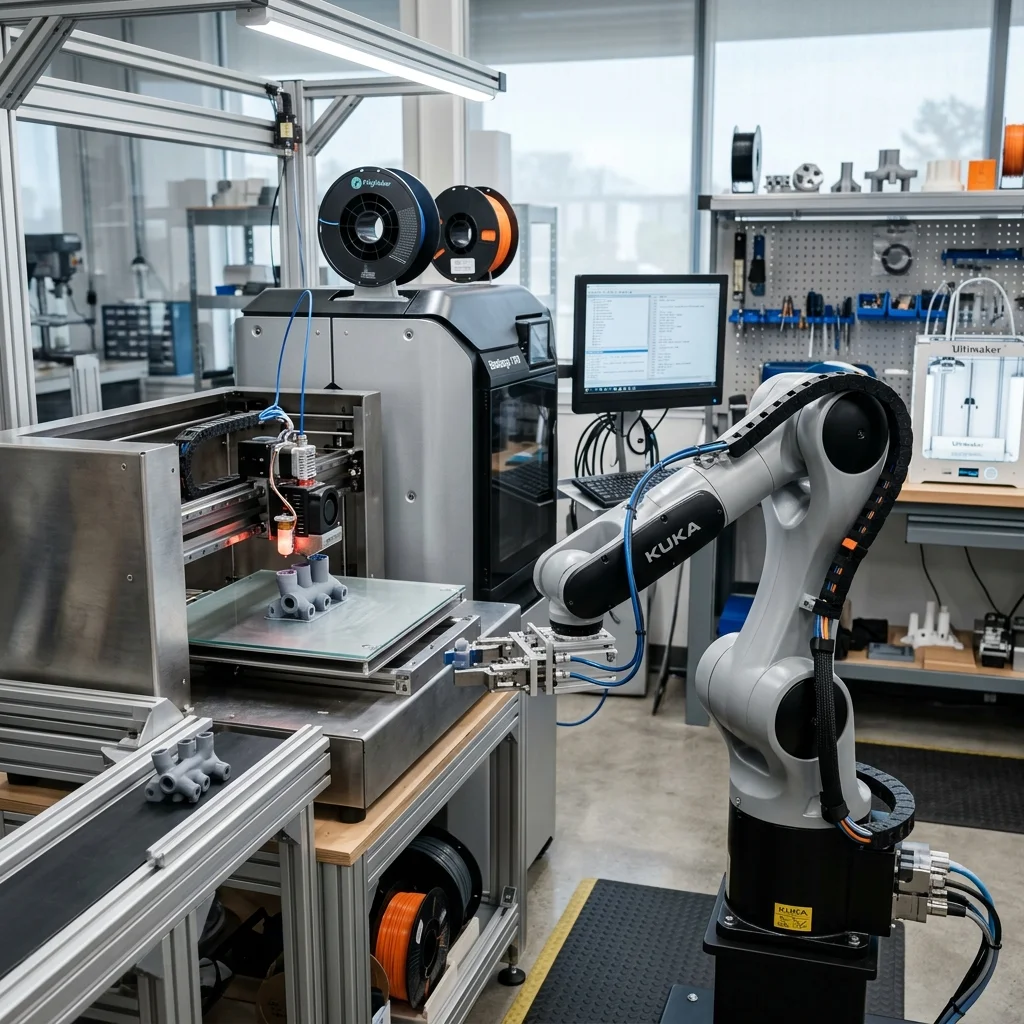
Hi Krasi. When we talk about scaling additive manufacturing, we inevitably hit a critical bottleneck: manual machine tending and the geometric constraints of traditional 3-axis kinematics. Integrating industrial and collaborative robotic arms (cobots) shatters these limitations. This approach doesn't just optimize workflows; it introduces entirely new manufacturing paradigms, from infinite continuous 'lights-out' printing to true 6-axis, support-free extrusion. Let's break down the mechanics and software architecture of this integration and see how advanced knowledge brings this hardware to life.
Direct Robotic 3D Printing (Multi-Axis Additive Manufacturing)
In this architecture, the printhead (or welding torch for metals) is mounted directly to the end-effector of a 6-axis robotic arm. This completely bypasses the volume restrictions of a standard Cartesian gantry. The biggest advantage here is non-planar printing. Because the robot can deposit material from any angle, it virtually eliminates the need for extensive support structures on complex overhangs. Furthermore, aligning the printed layers with the intended mechanical stress vectors drastically improves part strength. This method is the industry standard for Large-Scale Additive Manufacturing (LSAM) using pellet extrusion (FGF) or metal deposition (WAAM/DED).
Automated Machine Tending and Print Farm Management
Here, the robotic arm operates independently of the extrusion process, acting instead as the automated operator for a fleet of standard 3D printers. This is the key to true 'lights-out manufacturing.' The robot is programmed to open printer doors, swap flexible build plates, remove finished parts, insert empty plates, and trigger the server to start the next G-code in the queue. When integrated with Machine Vision, the robot can autonomously inspect part quality, detect failures or warped prints, and clear the bed safely, ensuring a smooth 24/7 production cycle.
Robotic Post-Processing and Hybrid Manufacturing
The automation loop doesn't end when the print finishes. Robots transport completed parts to washing and UV curing stations (for resin printing like SLA/DLP) or into chemical smoothing chambers. In advanced industrial setups, we see Hybrid Manufacturing cells. Using an Automatic Tool Changer (ATC), a single robotic arm can swap its additive extruder for a subtractive CNC spindle. After printing a near-net-shape part, the robot immediately mills the critical surfaces and tolerances down to the micron level, all within the same work cell.
The Software Bridge: Translating CAD to Robot Kinematics
The biggest hurdle in robotic integration isn't the hardware; it's the software. Traditional slicers generate 3-axis G-code, which is incompatible with complex 6-axis industrial robot controllers. To bridge this gap, we use advanced offline programming software (like RoboDK or ADAXIS) or custom ROS (Robot Operating System) implementations. These tools translate CAD toolpaths into native robot code (e.g., KUKA KRL, ABB RAPID). The software calculates inverse kinematics, handles collision avoidance, predicts singularities, and synchronizes the robot's Tool Center Point (TCP) speed precisely with the extruder's material flow.
Conclusion
Integrating robotic arms into the 3D printing ecosystem elevates additive manufacturing from a rapid prototyping tool to a continuous, high-yield industrial process. Whether deploying a robot as a multi-axis printer or as a tireless manager of your print farm, this integration is the backbone of the next-generation smart factory. These are the modern tools we must master at EduFacturing. It's time to think far beyond the traditional XYZ gantry.
The full picture
This article is one page from The Big Book of 3D Printing: 704 illustrated pages covering every technology, material and fix in one reference.
Read it on Kindle →Engineer, author of The Big Book of 3D Printing and additive manufacturing expert