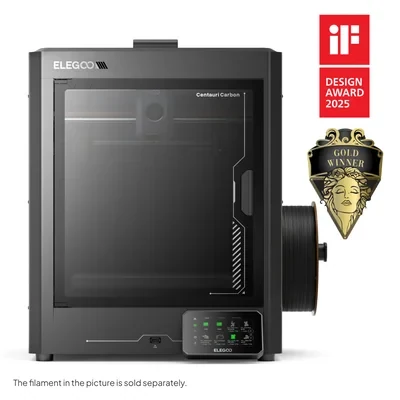
The Elegoo Centauri Carbon is an enclosed CoreXY FDM printer in the budget class, designed to bring carbon-fiber and engineering-material printing within everyone's reach. With a 256×256×256 mm build volume, speeds up to 500 mm/s and a factory-fitted hardened nozzle, the Centauri Carbon delivers CF-readiness without compromise on price.
What it is
The Centauri Carbon is Elegoo's enclosed CoreXY printer aimed at users who want to work with abrasive and technical polymers without paying a premium price. The "Carbon" in the name is not marketing: the machine ships with a factory hardened nozzle, ready for PLA-CF, PET-CF and CF-Nylon without any additional investment. The enclosed chamber retains heat for ABS, ASA and PC, while the CoreXY kinematics allow the dynamic speeds typical of higher-class machines. The printer has no AMS: it is suited for single-material runs with full freedom of filament brand choice.
Technical specifications
| Technology | FDM (CoreXY, enclosed chamber) |
|---|---|
| Build volume | 256 × 256 × 256 mm |
| Maximum speed | up to 500 mm/s |
| Nozzle | hardened steel (factory-fitted: CF-ready) |
| Calibration | automatic leveling, Input Shaper |
| Multi-material | no (single nozzle, no AMS) |
| Class / Price | Budget · ~€438 |
Who it’s for
- Rapid Prototyping: producing fast, low-cost physical models to verify form, fit and ergonomic design before mass production (Product Design and Engineering)
- Jigs and Fixtures: manufacturing custom assembly aids, alignment templates and holding fixtures using high-strength materials like CF-Nylon or PC (Automotive and Manufacturing)
- Low-Volume Production: creating customised end-use parts, replacement components or small production runs (1–100 units) without tooling costs (Consumer Electronics and Aerospace)
Calibration step by step
- Clean the PEI build plate thoroughly with isopropyl alcohol (IPA) before printing. A grease-free surface ensures optimal first-layer adhesion and prevents print failures.
- Execute the auto-bed leveling sequence and manually fine-tune the Z-offset parameter. A perfectly squished first layer with an optimal nozzle-to-bed distance, avoiding both gaps and elephant's foot.
- Print a Flow Tower test and mathematically calibrate the extruder steps (E-steps). Accurate dimensional tolerances and smooth outer walls without over-extrusion blobs or under-extrusion gaps.
- Run the automated resonance compensation test (Input Shaping). Vibrations from high-speed kinematic movements are electronically canceled, eliminating ghosting artifacts.
Common defects and fixes
Recommended settings by material
Pick a material to see the recommended temperatures (empirical ranges from 561 OrcaSlicer/Bambu profiles) plus machine-specific tips:
Conclusion
The Centauri Carbon is a compelling choice for users who want to enter the world of carbon-fiber and engineering polymers without a heavy investment. The enclosed chamber, CoreXY kinematics and factory hardened nozzle deliver CF-readiness at an accessible price: the trade-off is the absence of an AMS, but for single-material engineering printing this is rarely a limitation.
The full picture
This article is one page from The Big Book of 3D Printing: 704 illustrated pages covering every technology, material and fix in one reference.
Read it on Kindle →Engineer, author of The Big Book of 3D Printing and additive manufacturing expert
Updated on 11 September 2026
This article was written with AI assistance; the facts were checked against the sources on 11 September 2026.