

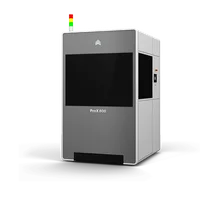
The 3D Systems ProX 800 is a high-end industrial laser SLA printer engineered for production-grade, large-format parts with exceptional surface finish. With a 650 × 750 × 550 mm build volume, a solid-state UV laser and a broad Accura photopolymer portfolio, the ProX 800 is the machine of choice for aerospace, automotive and medical industries.
What it is
The ProX 800 is the flagship of 3D Systems' stereolithography line. The printer uses a precisely directed UV laser beam to cure liquid photopolymer resin layer by layer, achieving tolerances on the order of 0.1 mm and a surface roughness of Ra < 1 μm. The large build envelope enables production of oversized master patterns for investment casting, aerodynamic profiles, medical prosthetics and production tooling. The system is compatible with the full Accura resin family, from ABS-like and transparent formulations to specialised castable and high-temperature grades. The ProX 800 targets organisations for which accuracy, scale and material properties are critical production requirements.
Technical specifications
| Technology | SLA: laser stereolithography (solid-state UV laser) |
|---|---|
| Build volume | 650 × 750 × 550 mm (large industrial format) |
| Laser | solid-state UV laser (355 nm) |
| Materials | Accura photopolymer resins (Xtreme, ClearVue, 25, castable, HPC and others) |
| Class / Price | Industrial · ~€250,000 |
Applications and industries
- Large-format precision prototypes: Production of full-scale functional prototypes: aerodynamic profiles, housings, medical devices, with a surface finish that requires no additional machining. (Aerospace, automotive, medical devices)
- Investment casting master patterns (QuickCast) (Printing hollow QuickCast patterns for investment casting) reduces weight and ensures complete burnout without shell cracking. (Metal casting and foundry)
- Production tooling and fixtures: Manufacturing heat-resistant moulds, jigs and fixtures for short-run production using Accura HPC and similar formulations. (Industrial manufacturing and R&D)
Production workflow
- Resin and platform preparation: stir the resin if it has been sitting, select the correct material profile in 3D Sprint and verify the resin level in the vat. Homogeneous resin and the correct chemistry guarantee uniform curing of every layer.
- SLA laser printing: the machine traces each layer with the UV laser, sequentially curing the resin; the platform lowers by one layer thickness (0.05–0.15 mm) after each pass. Precisely built geometry with tolerances < 0.1 mm and near-zero vibration due to the stationary vat.
- Drainage and washing: remove the platform, allow excess resin to drain, then wash the part with IPA or a dedicated solvent (TPM) in two stages. Uncured resin removed, part ready for UV post-cure without a tacky surface.
- UV post-curing and finishing: place the part in a UV oven (3D Systems ProCure) for full polymerisation, then remove supports and sand or paint as required. Maximum mechanical properties and final surface finish, the part is ready for use or the next manufacturing step.
Key considerations
Materials and applications
Pick a material/alloy this machine processes to see its properties and typical applications:
Conclusion
The ProX 800 is an uncompromising choice for organisations where build size, accuracy and surface quality are production standards, not bonuses. The large build envelope, the Accura materials portfolio and the proven QuickCast workflow make the machine indispensable in aerospace, medical and precision casting applications. Its cost and post-processing requirements place it firmly in the industrial production domain.
The full picture
This article is one page from The Big Book of 3D Printing: 704 illustrated pages covering every technology, material and fix in one reference.
Read it on Kindle →Engineer, author of The Big Book of 3D Printing and additive manufacturing expert