

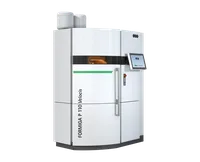
The EOS P 396 is an industrial polymer SLS machine built for functional end-use parts and short-run production. With a 340×340×600 mm build volume, a CO₂ laser and a heated chamber, it sinters nylon and specialty polymers layer by layer, without support structures, because the unsintered powder acts as a natural support for any geometry.
What it is
Selective Laser Sintering (SLS) is an additive technology in which a CO₂ laser precisely fuses layers of polymer powder according to a CAD profile. The EOS P 396 operates inside a tightly sealed, uniformly heated chamber: a prerequisite for minimizing residual stresses and ensuring consistent mechanical properties throughout the entire powder cake. The unsintered powder surrounding the parts acts as a support medium, enabling the production of overhanging geometries, internal channels and lattice structures that would be impossible or economically unfeasible with FDM or SLA. The machine targets industrial manufacturers, aerospace and medical companies, and AM service bureaus seeking stable, repeatable quality in series production.
Technical specifications
| Technology | SLS: Selective Laser Sintering (polymer powder) |
|---|---|
| Build volume | 340 × 340 × 600 mm |
| Laser | CO₂ laser, 70 W |
| Layer thickness | 0.06 – 0.18 mm (typically 0.10 mm) |
| Chamber heating | uniformly heated to ~170 °C (for PA12) |
| Supports | not required: powder supports the parts |
| Class / Price | Industrial · ~€250 000 |
Applications and industries
- Functional end-use parts and short runs: production of finished parts from PA12 and PA11 with mechanical properties comparable to injection moulding, without the need for tooling (Automotive, industrial equipment)
- Complex geometries and lattice structures (manufacture of overhanging shapes, internal channels and biomimetic lattices impossible with conventional technologies) with no additional support structures (Aerospace, medical devices)
- Durable functional prototypes: rapid prototyping of end-use parts for testing under real loads, vibrations and thermal cycles using the actual production material (R&D, consumer goods)
Production workflow
- Powder bed preparation and loading: blend and sieve a powder mixture of fresh and recycled PA12 (typically 30–50% fresh powder refresh rate), load into the reservoir and set the target chamber temperature (~170 °C for PA12). A uniform powder bed with correct density and thermal equilibrium, the foundation for homogeneous sintering.
- SLS sintering: the laser scans each layer according to the CAD profile, fusing the powder; uncovered zones remain as unsintered powder, a natural support for subsequent layers. Parts form embedded in the powder cake without any additional support structures.
- Powder cake cool-down: after the build is complete, allow the powder cake to cool slowly and in a controlled manner inside the chamber (typically 12–24 h depending on size). Controlled cooling prevents warping and residual stresses in the parts.
- Depowdering and bead-blasting: remove the powder cake, manually or with a vacuum station extract the loose powder (for recycling), then bead-blast or sandblast the surface to finalize it. Clean parts with a uniform, slightly matte surface ready for post-processing or direct use.
Key considerations
Materials and applications
Pick a material/alloy this machine processes to see its properties and typical applications:
Conclusion
The EOS P 396 is a production tool for organisations where quality, repeatability and design freedom are non-negotiable. The absence of supports unlocks geometries closed to every other technology, while the heated chamber guarantees isotropic mechanical properties throughout the powder cake. The machine demands rigorous process control (managing refresh rate, cool-down and laser parameters) but when operated correctly it delivers functional polymer parts competitive with injection moulding, without expensive tooling investment.
The full picture
This article is one page from The Big Book of 3D Printing: 704 illustrated pages covering every technology, material and fix in one reference.
Read it on Kindle →Engineer, author of The Big Book of 3D Printing and additive manufacturing expert