

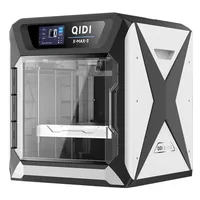
The QIDI X-Max 3 is an enclosed prosumer CoreXY printer with an actively heated chamber up to 65 °C and a large 325 × 325 × 315 mm build volume: a machine designed for engineering polymers such as CF-Nylon, PC and ABS at speeds up to 600 mm/s. When the task demands bulky, mechanically demanding parts without warping or delamination, the X-Max 3 delivers without compromise.
What it is
The X-Max 3 is QIDI's flagship for engineering desktop printing. Its actively heated chamber: up to 65 °C: is more than just a lid: it maintains a uniform ambient temperature around the part throughout the entire build, eliminating the internal stresses that cause ABS and CF-Nylon to crack or warp. Klipper-based electronics and dual direct-drive extrusion allow genuine 600 mm/s while retaining quality. The machine targets engineers, small workshops and research teams working with large-format functional parts who need chamber thermal stability that most prosumer printers simply cannot offer, and have no need for an AMS module.
Technical specifications
| Technology | FDM (CoreXY, actively heated enclosed chamber) |
|---|---|
| Build volume | 325 × 325 × 315 mm |
| Maximum speed | up to 600 mm/s |
| Chamber | actively heated up to 65 °C |
| Extruder | dual direct drive |
| Nozzle | hardened steel (standard) |
| Calibration | automatic leveling, Z-offset compensation (Klipper) |
| Firmware | Klipper (open source) |
| Class / Price | Prosumer · ~€800 |
Who it’s for
- Automotive jigs and fixtures: printing specialized production jigs and fixtures that withstand mechanical loads, using CF-Nylon inside a stable heated chamber (Automotive)
- Large-scale rapid prototyping: rapid creation of large-format prototypes for form verification, fit-check and ergonomics within hours at speeds up to 600 mm/s (Industrial design and R&D)
- Functional engineering parts: production of spare parts, electronics housings and end-use components from PC, ABS or CF-Nylon with an actively heated chamber that ensures minimal residual stress (Manufacturing and consumer electronics)
Calibration step by step
- Clean the PEI plate with isopropyl alcohol (IPA) before each print. An oil-free surface ensures maximum first-layer adhesion and prevents premature detachment.
- Run automatic leveling and fine-tune the Z-offset via the Klipper interface. A perfectly trammed platform and precise Z-offset: no "elephant's foot" or detached first layer.
- Calibrate extruder steps (E-steps) and flow rate via the M92 command in the Klipper console. Precise extrusion without under- or over-feeding: a solid structure and clean part surfaces.
Common defects and fixes
Recommended settings by material
Pick a material to see the recommended temperatures (empirical ranges from 561 OrcaSlicer/Bambu profiles) plus machine-specific tips:
Conclusion
The X-Max 3 is the choice for engineers and small workshops that need a large build volume, an actively heated chamber and reliable engineering-polymer performance, without paying for an industrial machine. Klipper provides flexibility, the direct drive handles CF-Nylon without struggle, and the 65 °C chamber solves ABS and PC warping problems once and for all.
The full picture
This article is one page from The Big Book of 3D Printing: 704 illustrated pages covering every technology, material and fix in one reference.
Read it on Kindle →Engineer, author of The Big Book of 3D Printing and additive manufacturing expert