

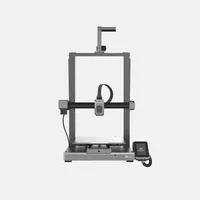
The Artillery Sidewinder X4 Plus is a large open-frame FDM printer in the prosumer class with direct drive extrusion and Klipper firmware, built for anyone who needs serious build volume without a serious price tag. With a 300×300×400 mm platform and speeds up to 300 mm/s, it delivers flexibility and throughput rarely found under €600.
What it is
The Sidewinder X4 Plus is a classic i3-style bedslinger: the moving bed handles the Y axis while the print head travels in X and Z. Direct drive means the filament motor sits right at the hotend, making flexible materials like TPU straightforward to run. Klipper firmware brings Pressure Advance and Input Shaper, tools that help the printer maintain precision even at higher speeds. The machine is fully open-frame: no enclosure, no automatic material-change system, exactly what most enthusiasts and small workshops need for PLA, PETG and functional prototypes.
Technical specifications
| Technology | FDM (Bedslinger i3-style, open frame) |
|---|---|
| Build volume | 300 × 300 × 400 mm |
| Maximum speed | up to 300 mm/s |
| Extruder | direct drive |
| Firmware | Klipper (Pressure Advance, Input Shaper) |
| Chamber / AMS | no enclosure · no multi-material |
| Class / Price | Prosumer · ~€600 |
Who it’s for
- Rapid Prototyping: producing physical models in a matter of hours to verify form, fit, and ergonomics before committing to mass production (Product Design)
- Jigs & Fixtures: manufacturing durable small-batch custom tools and templates using engineering-grade materials to assist in assembly lines (Automotive)
- Functional Components: printing end-use mechanical parts and enclosures that require structural integrity and complex geometries (Consumer Electronics)
Calibration step by step
- Clean the heated build plate with isopropyl alcohol (IPA), run the auto-leveling sequence, then fine-tune the Z-offset. A perfectly adhered first layer without the "Elephant's foot" defect (squished base) or bed adhesion failure.
- Calibrate extruder E-steps via the M92 command to ensure the correct volume of filament is fed. Accurate material extrusion, avoiding both gaps from under-extrusion and surface blobs from over-extrusion.
- Tighten all stepper motor belts and enable the resonance compensation algorithms: Input Shaper and Pressure Advance. Elimination of layer shifting and ghosting/ringing (vibrational echo) around sharp corners during high-speed printing.
Common defects and fixes
Recommended settings by material
Pick a material to see the recommended temperatures (empirical ranges from 561 OrcaSlicer/Bambu profiles) plus machine-specific tips:
Conclusion
The Sidewinder X4 Plus is an honest choice for enthusiasts and small workshops that need a large build volume, direct drive extrusion and the flexibility of Klipper without paying for an enclosure. It excels with PLA, PETG and TPU: the direct drive makes a real difference here. ABS remains risky on an open frame: achievable, but it demands a controlled environment. For engineering polymers like PC or CF-Nylon, a printer with an enclosure is a better fit.
The full picture
This article is one page from The Big Book of 3D Printing: 704 illustrated pages covering every technology, material and fix in one reference.
Read it on Kindle →Engineer, author of The Big Book of 3D Printing and additive manufacturing expert