

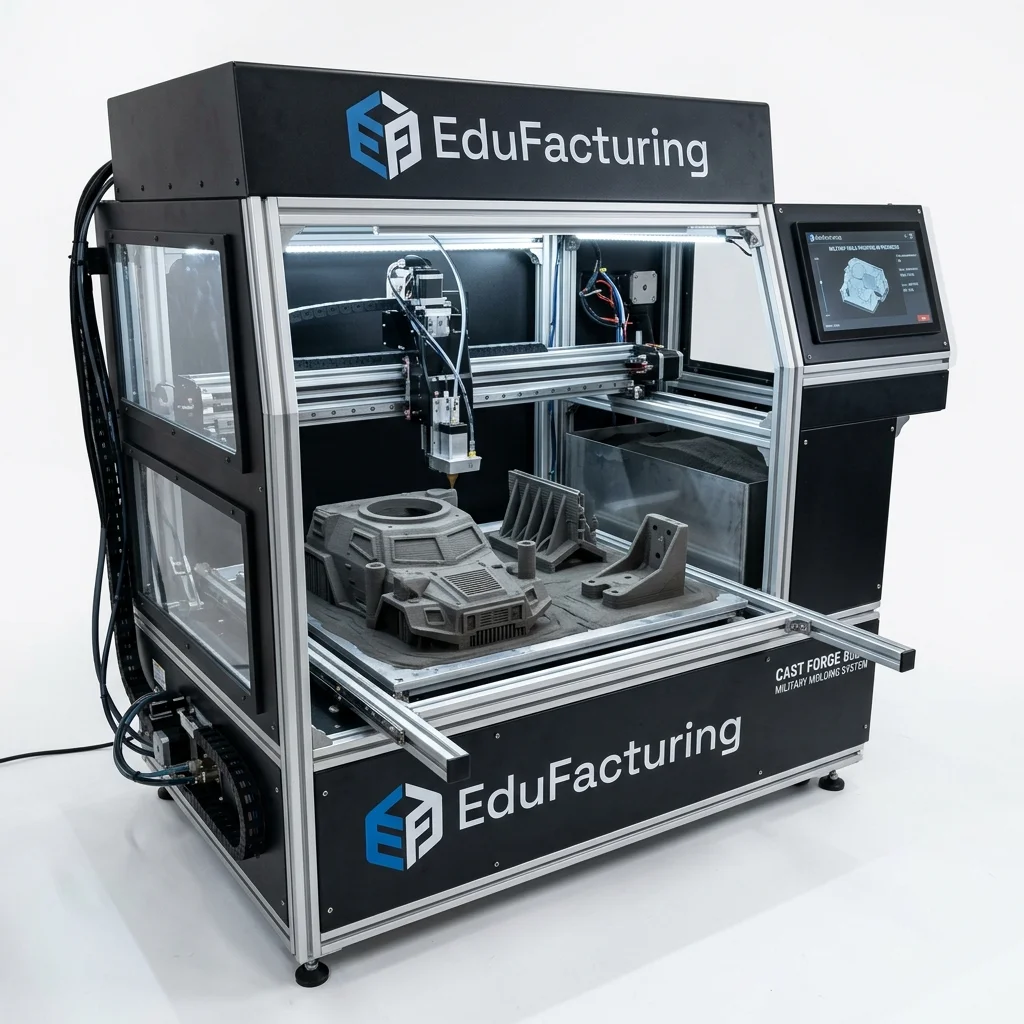
Creating casting molds through 3D printing drastically reduces the development time for critical military equipment. This innovative integration between additive and traditional manufacturing methods enables rapid testing and validation of ballistic and protective elements before transitioning to mass production.
Typical Requirements
Casting molds in the defense industry require exceptional precision, high-temperature resistance, and the ability to withstand mechanical stress during the casting process. Smooth surfaces and strict tolerances are mandatory to ensure the proper functioning of the cast components.
Recommended Technologies and Printers
Systems with high accuracy and high part strength are recommended for producing casting molds. Industrial FDM, SLS (sls-2), SLM (slm-1, slm-2), MJF (mjf-1, mjf-2), and CFF (cff-1, cff-2) machines are suitable. Base models (1, 3, fdm-2) can be used for rapid conceptual prototyping of the molds themselves prior to creating the functional tooling.
Recommended Materials
Depending on the casting method (e.g., sand casting, investment casting, or direct injection), materials range from high-temperature polymers to specialized metal alloys. The most commonly used include:
- Polyamides (PA12-1, PA12-2) for strong polymer molds.
- Carbon-reinforced filaments (CF-1, CF-2) for increased rigidity.
- Polyurethanes (PU-1, PU-2) for flexible matrices.
- Metals like Titanium (Ti-1) and Aluminum (Al-1) for extreme conditions.
- Standard polymers (ABS-1, ABS-2) for basic master patterns.
Process and Timeline
The process of creating and using 3D printed molds involves several key stages:
- Step 1: Digital CAD design of the mold, accounting for material shrinkage tolerances.
- Step 2: 3D printing of the matrix or master pattern using the selected technology (e.g., MJF or SLM).
- Step 3: Post-processing and surface polishing to ensure smooth release of the casting.
- Step 4: Executing the casting process (pouring the metal or polymer).
- Step 5: Extraction, final machining, and quality control of the finished part.
Pros and Cons
Integrating additive technologies into tooling creation has distinct characteristics:
- Pros: Exceptional speed of manufacturing compared to traditional mold milling.
- Pros: Ability to design complex internal cooling channels in metal-printed molds (SLM).
- Pros: Lower cost for small to medium batches of parts.
- Cons: Limited lifespan of polymer molds when casting metals with high melting points.
- Cons: Requires additional post-processing to achieve perfectly smooth surfaces.
Cost Breakdown
The cost of a 3D printed casting mold depends on size, complexity, and material used. A sample calculation for a medium-sized protective component mold (polymer matrix):
- Design and optimization: 800 BGN
- Material costs (e.g., PA12): 450 BGN
- Machine time and printing (SLS/MJF): 1200 BGN
- Post-processing and finishing: 300 BGN
- Total: 2750 BGN
Real-World Examples & Common Challenges
Leading defense companies utilize SLM and MJF to create casting molds for body armor components and tactical vehicle parts. A major challenge is controlling thermal shrinkage during metal casting and ensuring proper venting in the printed molds, which requires an expert engineering approach.
Frequently Asked Questions (FAQ)
Interactive Analyzer for 3D Printing Military Equipment Casting Molds | Edufacturing
Select a profile to view detailed analysis.
The full picture
This article is one page from The Big Book of 3D Printing: 704 illustrated pages covering every technology, material and fix in one reference.
Read it on Kindle →Engineer, author of The Big Book of 3D Printing and additive manufacturing expert