

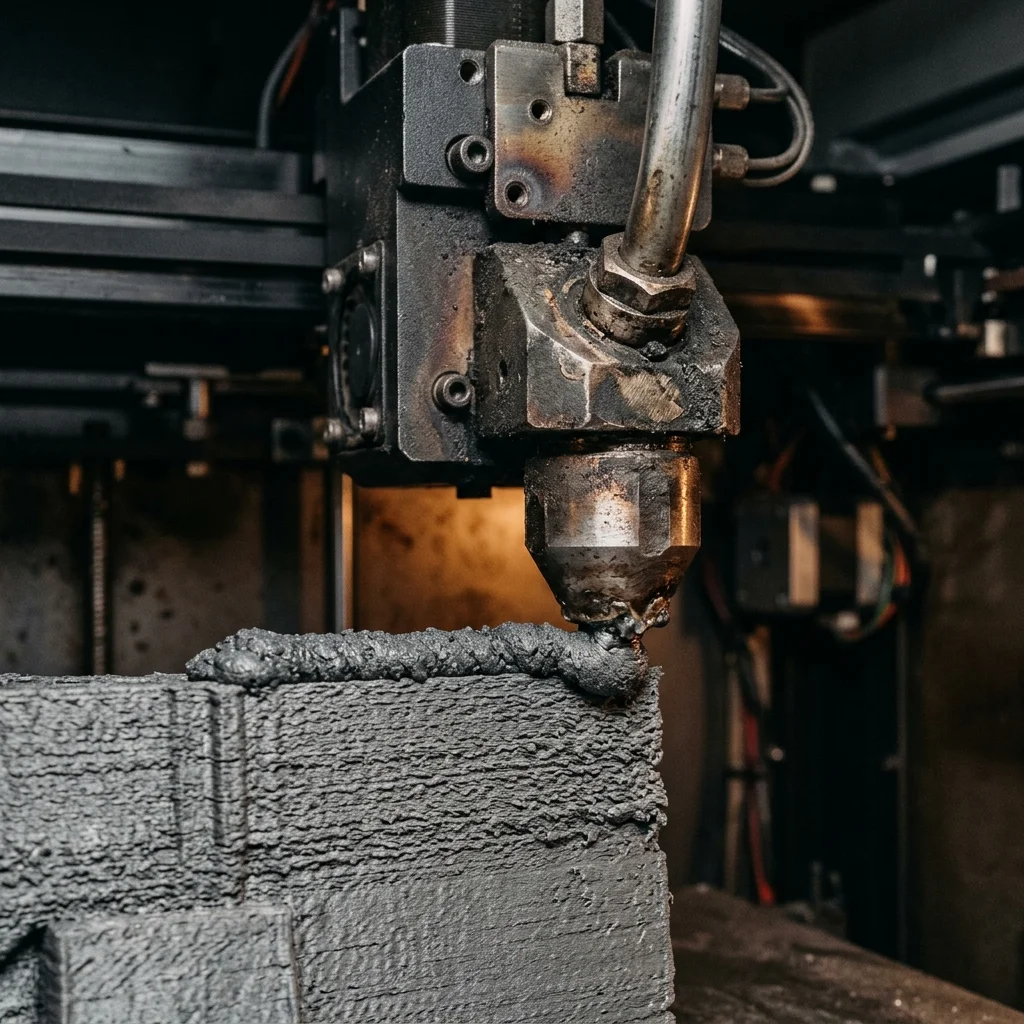
For the production of large-scale parts that must withstand harsh conditions, high temperatures, and environmental exposure, ABS and ASA are indispensable materials. When combined with FGF (Fused Granular Fabrication) technology, they offer unprecedented possibilities for the industry.
While ABS is the gold standard for mechanical strength and thermal stability, ASA builds upon this with exceptional resistance to UV radiation and weathering. Printing these materials on a massive scale is challenging, but the results are outstanding.
In this guide, we will explore how to overcome the difficulties of FGF printing with ABS/ASA, which systems are most suitable, and what the most common applications are.
Specifics of FGF Technology with ABS and ASA
FGF technology utilizes plastic pellets that are melted and extruded directly, drastically reducing material costs. This is highly beneficial for ABS and ASA, as these engineering plastics are expensive in filament form.
The main challenge with these materials is high thermal shrinkage. When printing massive parts, temperature differentials can cause severe warping and even layer splitting.
To manage this, FGF systems must feature an actively heated build chamber that maintains a consistent ambient temperature, allowing the part to cool down slowly and evenly.
-
High Thermal Resistance: Parts can withstand temperatures up to 90-100°C without deformation, perfect for automotive applications.
-
UV Resistance (ASA only): ASA does not yellow or become brittle under direct sunlight, making it perfect for outdoor applications.
-
Post-processing Capabilities: Both materials can be easily sanded, drilled, and smoothed using acetone vapor.
Recommended 3D Printers for Large-Scale ABS/ASA Printing
Because of the requirement for high temperatures and a controlled environment, not every FGF printer is suitable for ABS and ASA. You need industrial-grade systems.
-
3D Systems (Titan) Titan Atlas 3.6: Features a massive enclosed and heated chamber, which is absolutely mandatory for successfully printing large ABS/ASA parts.
-
CEAD AM Flexbot: Although it is an open robotic system, it can be integrated into specialized temperature-controlled cells to print these materials effectively.
-
Pollen AM Pam Series P: Provides extremely fine control over extrusion and is designed to handle high-temperature industrial polymers.
Recommended Material Brands and Technical Parameters
Choosing high-quality ABS and ASA pellets is critical. Low-quality granules may contain impurities that can clog the large nozzle or degrade mechanical properties.
For the best results, we recommend:
-
ColorFabb ColorFabb ASA: Offers superb UV resistance and consistent extrusion behavior.
-
Polymaker PolyLite ASA: Characterized by excellent mechanical properties and reduced warping compared to standard ABS.
-
Formfutura TitanX (ABS): An industrial-grade ABS optimized for better bed adhesion and lower thermal shrinkage.
Key parameters for printing with ABS/ASA pellets:
Extruder Temperature: 240°C – 270°C
Bed Temperature: 90°C – 110°C
Chamber Temperature: Minimum 70°C – 90°C
Cooling: Off (or very low for small overhangs)
Applications, Challenges, and Safety
Components produced from ABS and ASA are widely used in the automotive and aerospace industries, as well as for creating functional end-use products for outdoor environments.
The biggest issue, aside from warping, is the emission of harmful styrene fumes during printing. An enclosed chamber and proper air filtration systems (HEPA + active carbon) are mandatory for operator safety.
The cost of the pellets is significantly lower than filament, allowing for the cost-effective production of enormous panels and enclosures.
-
Automotive Parts: Bumpers, dashboards, and spoilers that require thermal resistance.
-
Outdoor Enclosures: ASA is ideal for telecommunication equipment boxes exposed to the elements.
-
Industrial Tooling: Strong, wear-resistant manufacturing jigs and fixtures.
Frequently Asked Questions (FAQ)
Interactive Analyzer for Fgf 3D Printing With Abs And Asa | Industrial Guide
Select a profile to view detailed analysis.
The full picture
This article is one page from The Big Book of 3D Printing: 704 illustrated pages covering every technology, material and fix in one reference.
Read it on Kindle →Engineer, author of The Big Book of 3D Printing and additive manufacturing expert