

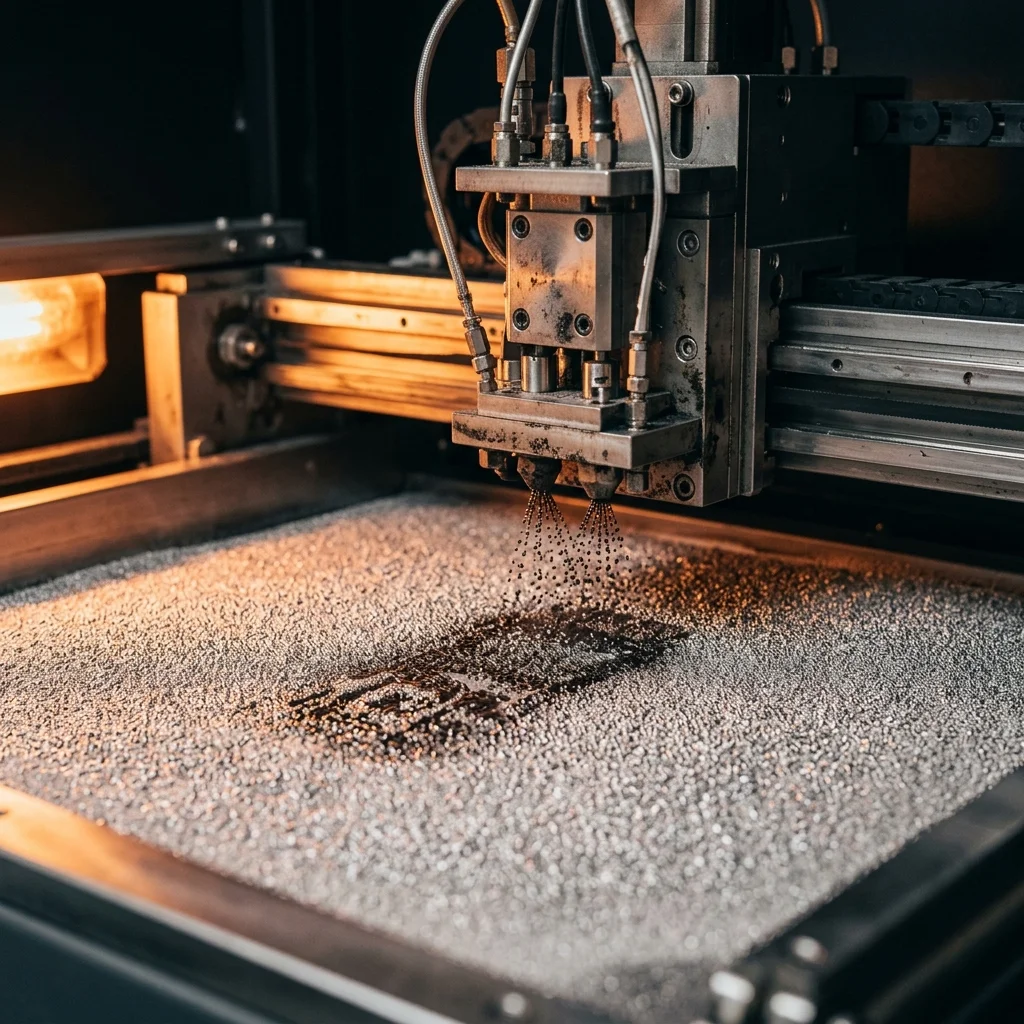
Metal Binder Jetting is revolutionizing serial additive manufacturing by offering exceptional speed and cost-effectiveness when working with metals like stainless steel.
Unlike laser-based technologies that melt the metal during printing, Binder Jetting uses a liquid binding agent to glue metal powder particles together layer by layer.
In this guide, we will explore the technology, the sintering process, and why stainless steel is an ideal material for this application.
Binder Jetting Technology Basics
The Binder Jetting process is fast and highly scalable. A print head moves over a layer of metal powder and precisely deposits a liquid binder.
Once printing is complete, the result is a ‘green part,’ which is fragile and held together only by the polymer glue.
This part must be carefully excavated from the loose powder, after which it undergoes a debinding and sintering process in a furnace where particles fuse together.
Advantages of Stainless Steel in Binder Jetting
Stainless steel (especially 316L and 17-4 PH alloys) is incredibly popular due to its strength, corrosion resistance, and thermal stability.
In Binder Jetting, the powder is not melted during the print phase, meaning the process does not generate internal thermal stresses.
-
Support-Free Printing: The surrounding loose powder acts as a support, allowing for extremely complex internal channels.
-
High Throughput: You can nest hundreds of parts in a single build volume, rivaling traditional injection molding speeds.
-
Lower Material Costs: Uses standard MIM (Metal Injection Molding) powders which are significantly cheaper than specialized AM powders.
Recommended Industrial Printers
The Metal Binder Jetting market is growing rapidly, with key players including:
-
Desktop Metal Desktop Metal Production System P-50: Designed for mass production, this system is one of the fastest on the market and aims to compete with casting.
-
ExOne (Desktop Metal) ExOne S-Max: An extremely reliable system widely known for sand casting molds, but also adaptable for direct metal applications.
-
HP HP Metal Jet S100: HP’s technology offers superb resolution, leveraging their extensive experience in inkjet printing to deliver parts with high density.
Recommended Brands and Materials
Fine metal powders from leading manufacturers are utilized:
-
EOS 316L Stainless Steel: An industry standard offering excellent corrosion resistance and biocompatibility.
-
Markforged 17-4 PH: A high-strength stainless steel that can be heat-treated for additional hardness, making it ideal for tooling.
-
BASF Ultrafuse 316L (FDM): While originally designed for FDM printers, this material follows the exact same debinding and sintering steps as Binder Jetting parts.
Pitfalls and Common Issues
Working with green parts and sintering requires rigorous process control:
-
Calculating Shrinkage: Parts shrink by up to 20% during sintering. This must be accurately compensated for in the slicing software beforehand.
-
Furnace Deformation: At the high temperatures of the sintering furnace, parts can sag. Specialized ceramic setters are often used to support complex overhangs.
-
Green Part Fragility: Before sintering, the parts are highly delicate and require careful handling during the depowdering stage.
Cost Estimate and Technical Parameters
Machine Investment: Spans from $100,000 for entry-level up to $1,000,000+ for massive production lines including furnaces.
Powder Pricing: Usually between $20 and $50 per kilogram, making it far more cost-effective for large batches.
Volumetric Shrinkage: Routinely hits 15% to 20% during the final thermal sintering stage.
Final Density: Achieves 96% to 99% solid metal density, providing excellent mechanical integrity.
Frequently Asked Questions (FAQ)
Ultimate Guide: Metal Binder Jetting With Stainless Steel Calculator
Interactive optimization calculator.
The full picture
This article is one page from The Big Book of 3D Printing: 704 illustrated pages covering every technology, material and fix in one reference.
Read it on Kindle →Engineer, author of The Big Book of 3D Printing and additive manufacturing expert