

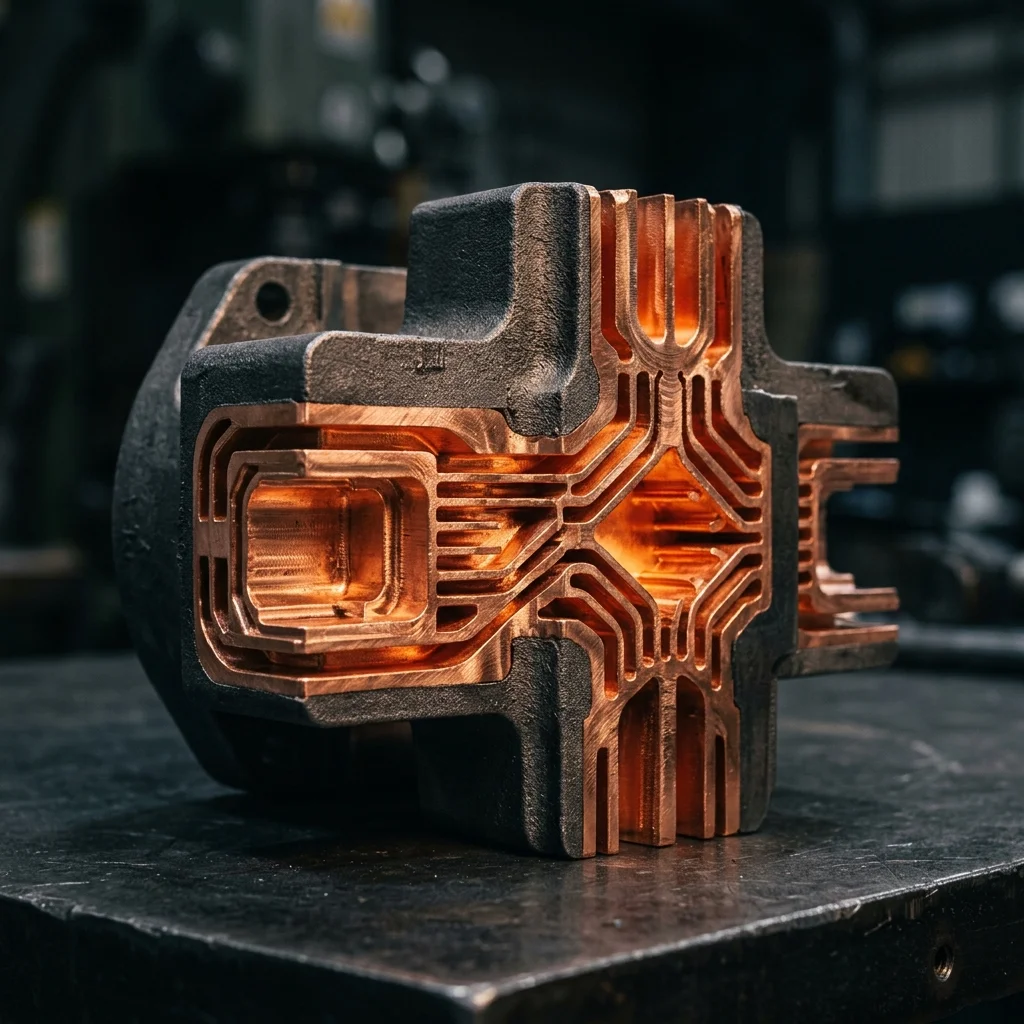
Industrial 3D printing via Selective Laser Melting (SLM) is transforming the way we manufacture components requiring extreme thermal and mechanical properties. When it comes to heat management and electrical conductivity, pure copper and its alloys are unmatched. On the other hand, tool steel is the backbone of mass production, offering wear resistance and durability at high temperatures. Combining these materials with the design freedom of SLM technology enables the creation of revolutionary products, from induction coils to injection molds with conformal cooling channels. In this guide, we will look at the process, applications, and challenges of 3D printing copper and tool steel.
Specifics of SLM when working with Copper and Tool Steel
Working with copper and tool steel in SLM systems requires overcoming significant physical barriers.
With copper, the primary challenge is its extremely high thermal conductivity and high reflectivity to infrared lasers (wavelength around 1064 nm) standard in most printers. To melt copper effectively without the energy dissipating instantly, specialized green or blue lasers (which are absorbed much better by copper) or extremely high-power infrared lasers (above 400W-1000W) are often used.
With tool steel (such as H13 or M300), the challenge is its tendency to crack due to high temperature gradients during printing. Since this material contains a high amount of carbon and alloying elements to achieve hardness, rapid cooling creates enormous internal stresses. Therefore, the build platforms often need to be heated to very high temperatures (200°C – 500°C) to slow the cooling rate and prevent part distortion or cracking.
Why these materials? Thermal Conductivity and Wear Resistance
The applications of these materials focus on their extreme physical characteristics:
- Conformal Cooling in Tooling: This is the largest market for 3D printed tool steel. Traditional plastic injection molds use straight cooling channels (drilled with a bit). SLM allows the creation of channels that closely follow the 3D contours of the mold (conformal cooling), which can reduce injection cycle times by 20-50% and improve the quality of the plastic part.
- High-Efficiency Heat Exchangers and Inductors: Pure copper is ideal for induction coils and compact heat exchangers. SLM enables geometries with massive internal surface area that maximize heat transfer in an extremely small volume, which is critical in aerospace and motorsports.
- Electrical Contacts and Components: For the electric motor industry, printing complex copper stators or specific connectors opens the path to more efficient and lighter motors.
Best SLM 3D Printers for Copper and Steel
Machine selection heavily depends on the material:
- EOS EOS M 290: A perfect choice for tool steel. The system offers options for heating the build platform, which is key for working with steels like Maraging Steel M300 or H13. EOS also provides parameters for specific copper alloys.
- Desktop Metal Shop System: This system works excellently with tool steels (like H13) via the Binder Jetting process. Although the parts must be sintered in a furnace, this technology allows for mass production of steel components without the need for complex supports and the struggle with internal stresses characteristic of laser melting.
- SLM Solutions SLM 280 2.0: This powerful machine is highly suitable for working with copper and its alloys, thanks to the high laser power options. The multiple lasers help in the faster construction of massive copper or steel components.
Recommended Powders and Alloys
Material development here is key for successful printing:
- Markforged Pure Copper: Used in their Metal X system (FFF/FDM technology, not pure SLM), this material offers an excellent alternative for creating parts from near 100% pure copper for heatsinks and inductors with a lower initial equipment investment.
- EOS CuCr1Zr (Copper Alloy): This is a copper alloy optimized for SLM printing. The addition of chromium and zirconium improves laser absorption and mechanical strength while maintaining extremely high thermal and electrical conductivity.
- Desktop Metal H13 Tool Steel: H13 is an industry-standard hot-work tool steel offering excellent resistance to thermal fatigue. Used in Binder Jetting systems, it is ideal for creating dies and tooling.
Cost Estimation and Defect Avoidance
Working with these engineering materials requires precise planning:
- Costs: Powders of copper and tool steel are relatively affordable (50-150 EUR/kg) compared to titanium or precious metals. The primary cost is machine time and expensive post-processing.
- Tool Steel Processing: Printed molds strictly undergo a heat treatment process (hardening and tempering) to reach the required hardness (often over 50 HRC). Subsequently, contact surfaces must be CNC machined to achieve perfect tolerances.
- Copper Safety: Fine copper powder is highly reactive and poses an explosion risk. Handling requires strict safety protocols and proper management of the protective atmosphere (argon) inside the printer.
Frequently Asked Questions (FAQ)
Slm 3D Printing With Copper And Tool Steel | Edufacturing Calculator
Interactive optimization calculator.
The full picture
This article is one page from The Big Book of 3D Printing: 704 illustrated pages covering every technology, material and fix in one reference.
Read it on Kindle →Engineer, author of The Big Book of 3D Printing and additive manufacturing expert