

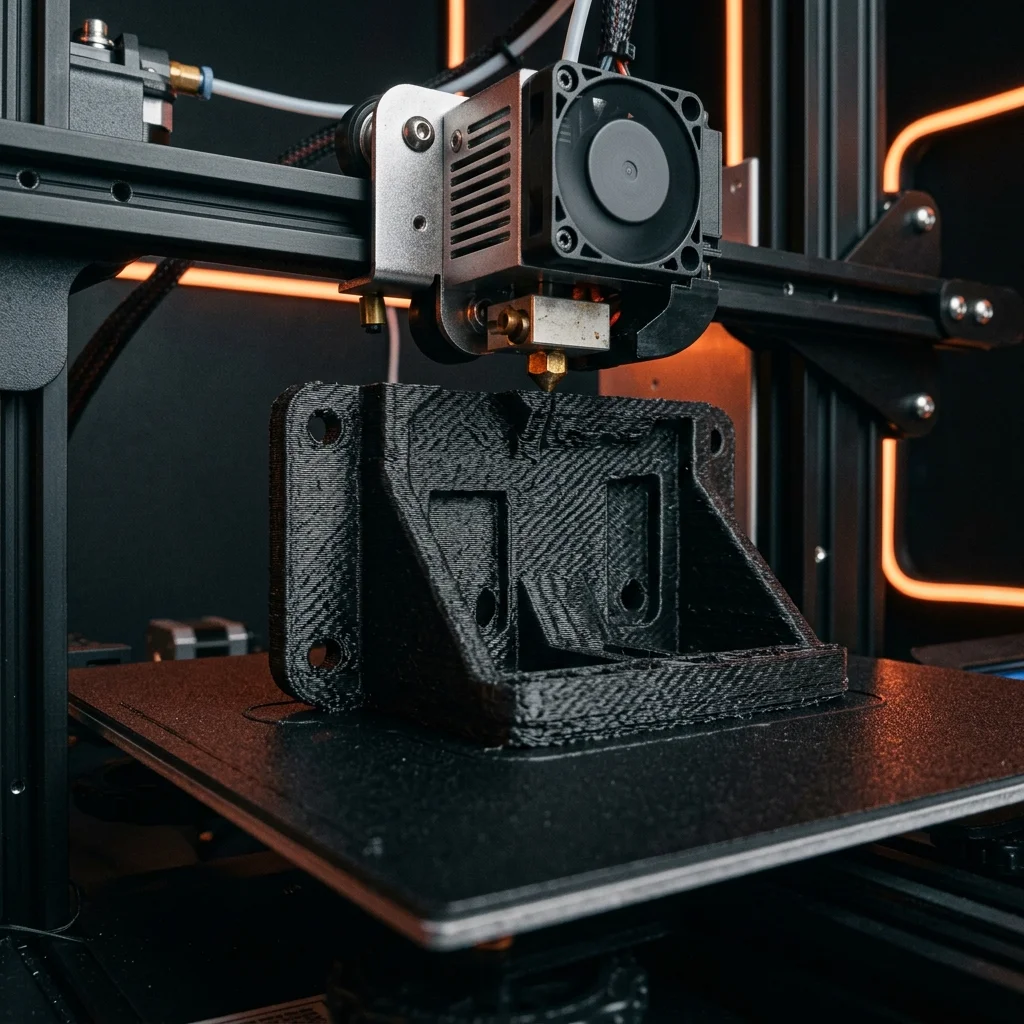
Carbon Fiber composites in FDM represent one of the most significant engineering applications of desktop 3D printing. With 15-30% carbon fibers in a polymer matrix (PA6, PLA, PETG, ABS), these filaments deliver mechanical strength approaching thin-walled aluminum casting, at a fraction of the weight and at a price that enables custom production. In this guide we cover the differences between CF filament types, which printers are suitable for CF composites, which aren’t, and real engineering examples, from robot EOAT to structural elements in drones.
Why Carbon Fiber in FDM
Standard PLA has flexural strength around 70 MPa. Standard Nylon (PA6): around 60 MPa. Aluminum 6061-T6: around 250 MPa.
Carbon Fiber reinforced Nylon (PA6-CF with 25% carbon fibers): around 130-150 MPa. That’s 2× stiffer than pure Nylon, and 60% of aluminum, but at 30% of the weight of aluminum.
For real engineering applications, the difference is critical:
Weight: an aluminum EOAT for a robot weighs 2-3 kg. PA6-CF EOAT weighs 0.6-0.8 kg. For a robot running 24/7, lower weight reduces energy use and joint wear.
Corrosion: aluminum oxidizes. PA6-CF doesn’t. For food (food industry), water, chemistry: PA6-CF doesn’t corrode.
Insulation: PA6-CF is an electrical insulator (unlike aluminum). Useful for electronic applications.
Price: aluminum EOAT with CNC machining, €200-€800. PA6-CF EOAT from desktop 3D printing: €30-€100.
Production speed: from CAD to finished EOAT, aluminum 2-4 weeks. PA6-CF: 1-2 days.
When CF composites are NOT a sensible choice:
- High temperatures (above 120°C HDT for PA6-CF). For applications above 120°C choose PEEK or industrial Nylon.
- Taps under high pressure (10+ bar). FDM composites have micro-pores between layers.
- Structural applications with real safety (steering wheel, brake mechanism). FDM, despite CF, is not a certified material for critical-safety applications.
For engineering applications with mechanical load, wear, EOAT, tooling and fixtures: CF composites are among the most sensible FDM materials.
Carbon Fiber filament types
PLA-CF (PLA with carbon fibers, 15-25% by volume):
PLA matrix with CF reinforcement. Retains PLA’s ease of printing, but adds a matte black surface and significantly higher stiffness.
Recommended brands: Polymaker PolyLite PLA-CF (€55/kg), eSUN ePLA-CF (€38-€45/kg), Bambu Lab PLA-CF (€32/kg).
Ideal for: light decorative engineering look, beginner experience with composites, prototypes with acceptable mechanical strength. PLA-CF is good for parts that aren’t under high load but need to look ‘professional’ (matte black).
PETG-CF:
PETG matrix with CF reinforcement. More heat-resistant than PLA-CF (75-80°C HDT vs 55-60°C). Prints more cleanly than PA6-CF for beginners.
Recommended brands: Fiberlogy PET-CF (€42/kg), eSUN ePETG-CF (€45/kg), Polymaker PolyLite PETG-CF (€55/kg).
Ideal for: functional prototypes, EOAT in higher temperatures, housings with high heat resistance.
PA6-CF (Nylon 6 with carbon fibers):
Nylon 6 matrix with 15-30% CF reinforcement. The strongest of the common CF filaments. High mechanical strength, low friction, good wear resistance.
Recommended brands: Polymaker PolyMide PA6-CF (€78-€90/kg), Bambu Lab PA-CF (€70/kg), Markforged Onyx (€180/kg, for specialized Markforged printers).
Ideal for: robot EOAT, structural elements in drones, gears under high load, engineering prototypes with real functional application.
PA12-CF (Nylon 12 with CF):
Nylon 12 matrix. Similar mechanical strength to PA6-CF, but with lower moisture absorption (PA12 absorbs 1-2% moisture, PA6 absorbs 5-7%).
Recommended brands: Polymaker PolyMide PA12-CF (€85-€95/kg), BASF Ultrafuse PA12-CF (€140/kg).
Ideal for: applications in humid environments (marine, taps, chemical industry), applications with long operational time.
ABS-CF:
Less used. ABS matrix with CF. Higher HDT than PLA-CF (95°C), but more complex printing.
Recommended brands: Polymaker PolyLite ABS-CF (€55/kg).
PEEK-CF (for specialized applications):
Industrial material. €350-€500/kg. Requires specialized printer (Intamsys Funmat HT, Stratasys F900, Markforged FX20). Not for standard Bambu or Prusa printers.
Recommended printers for Carbon Fiber
CRITICAL: CF filaments are abrasive. A standard brass nozzle (€2-€5) wears out after 100-200 g of CF filament. For CF printing mandatory: hardened steel nozzle (€15-€30) or diamond (Hardened Steel, €40-€80).
For beginner CF experience (PLA-CF, PETG-CF):
- Bambu Lab A1 (€420) + Hardened Steel Hotend (€15-€30): excellent starting point. Prints PLA-CF and PETG-CF cleanly.
- Prusa MK4S (€999) + Hardened Steel Nozzle (€25): alternative with European support.
For serious work with CF composites (PA6-CF, PA12-CF):
- Bambu Lab X1-Carbon (€1449): enclosed body (necessary for quality Nylon printing), Hardened Steel Hotend in standard package, excellent Cura-based slicer.
- Prusa MK4S with Prusa Enclosure (€999 + €330): combo for PA6-CF and PA12-CF.
- Bambu Lab P1S (€700): budget enclosed alternative.
- Anycubic Kobra 2 Max (€500): large build volume for bigger CF composite parts.
For industrial application (PEEK-CF, PA-CF with high certification):
- Intamsys Funmat HT (€8,000): desktop industrial printer with 360-450°C hotend and enclosed body 90°C.
- Markforged Mark Two / X7 (€18,000-€35,000): specialized for CF and Continuous Fiber Reinforcement.
- Stratasys F370 with Nylon CF support (€60,000+): industrial standard.
For a small engineering studio with 5-10 PA6-CF parts/month, we recommend Bambu Lab X1-Carbon (€1449) + Hardened Steel Hotend (included in the standard package) + 2-3 kg Polymaker PolyMide PA6-CF (€160-€240). Total around €1700-€1800 for a full start. ROI pays back in 3-6 months.
Optimal settings for PA6-CF
Nozzle temperature: 270-290°C (PA6-CF is more viscous than standard PA6). Start at 275°C, check flow with a test square. PA6-CF without enough heat doesn’t extrude evenly.
Bed temperature: 70-80°C. PA6 doesn’t adhere well to glass: recommend PEI or garolite plate. With Bambu Studio profile, Magigoo adhesive (€10) gives excellent adhesion.
Print speed: 30-60 mm/s. PA6-CF is sensitive to high speeds. Bambu X1-Carbon can print CF up to 100 mm/s, but for quality 50 mm/s is recommended.
Retraction: PA6-CF has high retraction sensitivity. Direct drive: 1.5-2.5 mm @ 30 mm/s. Bowden: 4-6 mm @ 25 mm/s.
Cooling: 0-30% (PA6-CF doesn’t like cooling, layer adhesion suffers with fast cooling). For the first 5-10 layers: no cooling. After that, up to 30%.
Layer height: 0.20 mm standard. CF filaments have better layer visibility than pure materials: go down to 0.16 mm for finer details.
Infill: 35-60% for functional parts. CF filaments are already strong at low infill: 100% infill adds little stiffness and a lot of time/material.
Wall pattern: 4-6 walls. More important to CF composite strength than infill.
Supports: tree supports recommended for CF composites (fewer marks), or clean breakaway supports from Polymaker PolySupport (but €45/kg).
Filament drying: PA6 is extremely hygroscopic, absorbs 5-7% moisture in 24 hours in a standard room. Before printing dry filament in a dryer (Bambu Lab Dryer €99, eSUN eBox €70) at 70°C for 6-12 hours. Without drying: wet prints are full of popping bubbles, the surface is grainy, mechanical strength reduced by 30-50%.
Real engineering applications
Example 1: EOAT for a robot in the food industry
Customer: a cannery. Orders EOAT (end-of-arm tooling): grippers at the end of a robot, lifting jars from a conveyor belt.
Solution: PolyMide PA6-CF on Bambu Lab X1-Carbon. 8-piece gripper (600 g total material), assembled with screws and heat-set inserts. Design and optimization time: 8 hours. Printing: 12 hours. Assembly and testing: 4 hours.
Cost: €50 material + €120 design labor + €30 assembly = €200 total. Aluminum EOAT with CNC machining would cost €600-€1200 and require 2-3 weeks delivery.
Example 2: Structural elements in an FPV drone
Customer: an FPV (First-Person View) drone racer.
Solution: PLA-CF for a 5-inch drone frame. 4 frame parts + motor mounts. Full frame weight: 85 g (vs 150 g for a standard fiberglass frame).
Cost: €15 material + €40 design labor = €55 total. A ready-made carbon frame from a store: €120-€200.
Advantage: in a crash, the drone can be reprinted in 4 hours for €15, instead of waiting 1-2 weeks for delivery.
Example 3: Gears for a packaging machine
Customer: a candy packaging company. The old machine has worn plastic gears. Original replacement: €250 for a set of 3 gears with 6-8 weeks delivery from Germany.
Solution: PolyMide PA6-CF for gears with heat-set metal inserts for smooth shaft rotation. Reverse engineering from existing broken parts (with a 3D scanner).
Cost: €35 material + €80 reverse engineering labor + €25 assembly = €140 total. The machine has run with 3D-printed gears for 18+ months without issue.
Example 4: Hinge mechanism for sliding doors (4-star hotel)
Customer: a 4-star hotel with sliding glass doors in the spa area. The hinge mechanisms wear out every 3-5 years.
Solution: PolyLite PETG-CF replacements for plastic hinge components. More moisture-resistant than standard PETG, cheaper than PA6-CF.
Cost: €20 material + €30 labor = €50 total for a full set. Original replacement (from door manufacturer): €300-€500.
Example 5: Cladding for an automatic 3D printer (Maker Space)
Customer: a Maker Space with an automatic 3D printer with standard plastic external cladding.
Solution: PA12-CF for new cladding with better heat stability and lower moisture absorption. More resistant to daily use by multiple users.
Cost: €120 material + €200 labor = €320 for a full cladding set. Original replacement doesn’t exist (non-standard machine).
These examples show that FDM Carbon Fiber composites aren’t just hobbyist applications: they solve real engineering problems with economics better than traditional methods.
Frequently Asked Questions (FAQ)
Fdm With Carbon Fiber Composites, For Engineering Functional Parts Calculator
Interactive optimization calculator.
The full picture
This article is one page from The Big Book of 3D Printing: 704 illustrated pages covering every technology, material and fix in one reference.
Read it on Kindle →Engineer, author of The Big Book of 3D Printing and additive manufacturing expert