

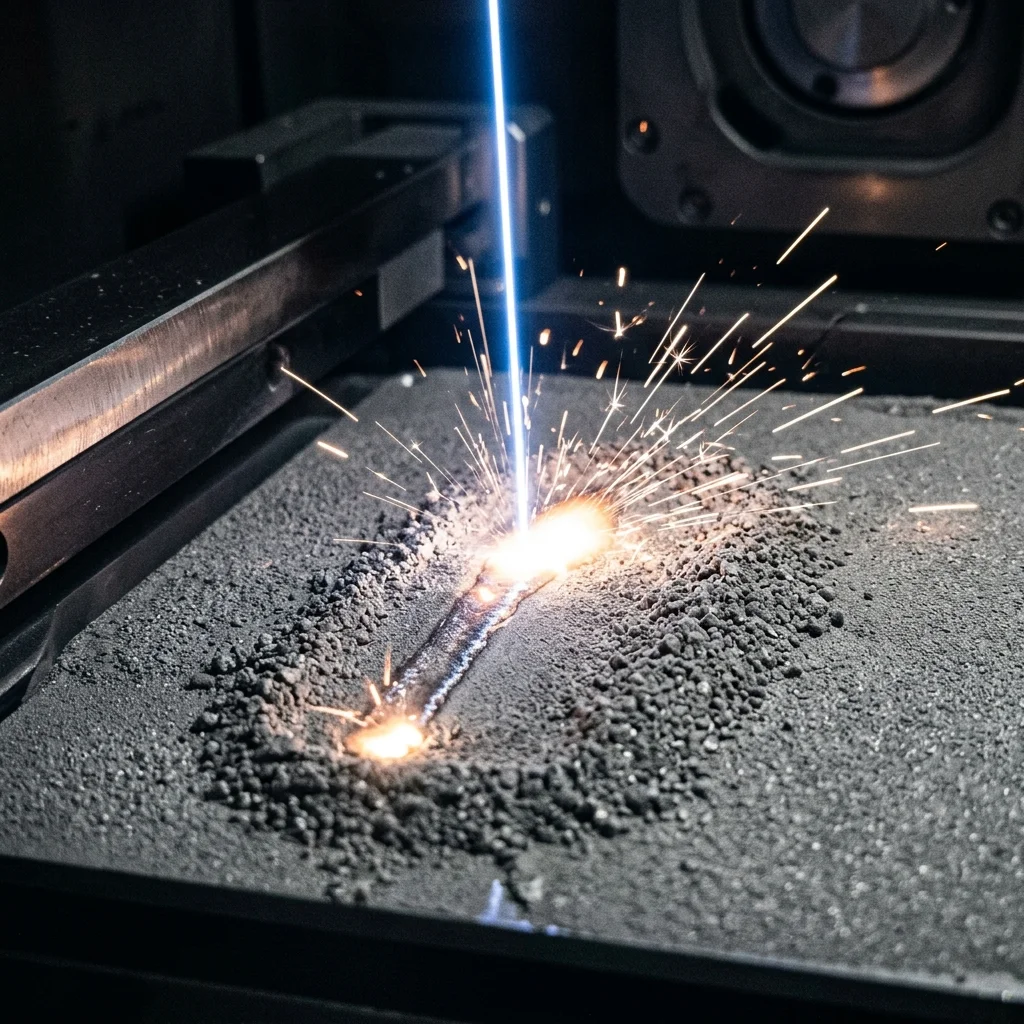
SLM (Selective Laser Melting) is a metal 3D printing technology: high-power fiber laser fully melts metal powder layer by layer, creating fully dense metal parts. Differs from SLS (which sinters polymer powder without full melt): SLM creates true metal with properties identical to cast alloy. Titanium (Ti6Al4V, Ti-CP) and aluminum (AlSi10Mg) are the workhorse SLM alloys: used in aerospace turbine blades, medical implants, automotive lightweight components. SLM hardware (€300,000-€2,000,000) is exclusively bureau outsource. This guide: what makes metal print different, which bureaus in EU, and cost expectations.
Why metal 3D printing
Traditional metal manufacturing: casting, CNC machining, forging. Known for thousands of years. Why 3D print metal?
-
Complex internal geometry: internal cooling channels in turbine blades, lattice-infill aerospace brackets, custom medical implants matching patient anatomy. CNC and casting cannot achieve this.
-
Lightweighting: topology-optimized brackets with 50-70% weight reduction vs solid metal. Critical in aerospace where each kg saves $50,000+ jet fuel over aircraft lifetime.
-
Bionic structures: bone-mimicking lattice grafts, blood vessel-replicating heat exchangers. Impossible without 3D print.
-
Single-part consolidation: replacing 30-part welded assembly with single printed part. Eliminates welds, reduces failure points.
-
On-demand spare parts: vintage aerospace parts unavailable from OEM, printed on demand from CAD scan.
-
Production-grade prototypes: aerospace clients require prototypes in same material as production. SLM is the only economic path.
When metal SLM economically justified:
- Complexity premium > weight/cost of additional CNC machining
- Unit cost < $5000 per part (above $5K, CNC from billet often cheaper)
- Volume 1-100 units (above 100, casting + machining wins)
- Critical performance requirements (lattice, lightweight, certified material)
Titanium vs Aluminum SLM
Titanium (Ti6Al4V):
- Tensile strength: 950-1200 MPa
- Density: 4.43 g/cm³
- Yield: 880 MPa
- Heat resistance: up to 350°C continuous
- Corrosion: virtually immune
- Cost: €150-€400 per kg powder, €5000-€20,000 per finished part
Applications: aerospace airframe components, jet engine turbine blades (specifically Ti-aluminum alloys), medical implants (hip stems, dental implants), automotive racing.
Aluminum (AlSi10Mg):
- Tensile strength: 350-450 MPa
- Density: 2.67 g/cm³
- Yield: 230-280 MPa
- Heat resistance: up to 180°C continuous
- Corrosion: good with anodizing
- Cost: €40-€100 per kg powder, €500-€5000 per finished part
Applications: automotive lightweight brackets, aerospace ducting, motorcycle parts, robotic end-effectors, consumer high-end electronics housings.
Choose titanium when: strength-to-weight critical, corrosion environment, medical implant. Choose aluminum when: cost critical, lightweight non-corrosive industrial parts, electronics.
For most engineering applications: aluminum SLM is the entry point. Titanium is specialty premium.
EU SLM bureaus
Materialise (Belgium) – premier EU SLM service. Multiple titanium + aluminum alloys. Certified ISO 13485 (medical), AS9100 (aerospace). Per-part minimum €200-€500, typical small parts €500-€3000.
GE Additive Customer Services: direct GE channel for Concept Laser SLM. Premium aerospace + medical. Typical €1000-€10,000 per part.
Protolabs (UK/Germany): fast-turnaround SLM. Express options. Slightly less specialized than Materialise but faster.
Sculpteo (France): limited SLM offering (mostly aluminum, occasional titanium). Lower-volume, design-prototype focus. €200-€1500 per part.
3T Additive Manufacturing (UK): specialty bureau focused on aerospace + motorsport SLM. Premium.
FKM Sintertechnik (Germany): industrial production SLM. Volume orders (100+ parts).
EOS Customer Service: direct EOS partner network. EOS makes SLM hardware; their service network is global.
AddUp Solutions (France): European-built SLM service. Multiple alloys including specialty steels.
Bulgaria-direct: no domestic SLM. ART PRINTING 3D LTD (Sofia) partnering with EU bureaus to offer SLM service to Bulgarian customers: order via Sofia office, parts come from EU bureau.
Cost calculation for SLM
Pricing structure typical for EU SLM bureau:
Material volume cost: heavily dependent on alloy. Aluminum AlSi10Mg: €1-€3 per cm³ printed volume Titanium Ti6Al4V: €5-€15 per cm³ printed volume Steel 316L: €1.5-€4 per cm³ Cobalt-Chrome: €15-€40 per cm³ (medical premium)
Minimum setup charge: €150-€500 per order (preheating powder bed, calibration). Discounted at higher quantities.
Post-processing: Heat treatment (stress relief): +€50-€200 per batch Hot Isostatic Pressing (HIP) for fatigue strength: +€100-€500 per batch (mandatory for aerospace) Support removal: +€20-€100 per part Surface finishing (machining critical surfaces): +€50-€500 per part Polishing: +€100-€1000 per part for mirror finish
Delivery: 7-21 working days (longer than SLS due to complexity).
Examples:
Small aluminum bracket (50×30×20 mm, 15 cm³): material €30 + setup €150 + post €50 = €230 first part. Subsequent identical: €100 each.
Medium titanium aerospace bracket (150×100×30 mm, 50 cm³, lattice infill 50%): material €400 + setup €200 + HIP €300 + machining €200 = €1100 first part. Batch of 5: €700 each.
Large titanium medical implant (custom hip stem, 80 cm³): material €800 + setup €300 + biocompatibility cert €500 + machining €1000 + ISO 13485 docs €500 = €3100 per part.
Design tips for SLM
DfAM (Design for Additive Manufacturing) principles for SLM:
-
Overhang angle: minimum 45° from build plate. Below this: supports needed (waste material + post-process). Design organic curves vs sharp overhangs.
-
Wall thickness: minimum 0.5 mm for titanium, 0.8 mm for aluminum (laser can struggle below this).
-
Hole diameter: minimum 1 mm horizontal, 0.5 mm vertical. Below: need post-drilling for clean hole.
-
Aspect ratio: tall thin parts need thicker base for stability. Tower-tall geometry in SLM more likely to delaminate during print.
-
Internal channels: prefer 30°+ branching, no flat horizontal channels (powder evacuation issue). Add powder-removal access ports.
-
Lattice infill: gyroid pattern preferred (self-supporting, no internal supports needed). Octet pattern for high stiffness.
-
Surface finishing: critical surfaces (mating, sealing), leave +0.2-0.3 mm machining allowance. SLM as-printed surface is rough (Ra 6-12 µm).
-
Heat treatment consideration: titanium parts WILL deform during stress relief. Design oversized + use machining to bring critical dimensions in spec.
-
Topology optimization: use Fusion 360 Generative Design or Altair Inspire to compute lightweight structures. SLM thrives on topology-optimized parts.
-
Build orientation: align critical surfaces vertically when possible (vertical surfaces have better finish than horizontal in SLM).
Frequently Asked Questions (FAQ)
Slm With Titanium And Aluminum, Metal 3D Printing Calculator
Interactive optimization calculator.
The full picture
This article is one page from The Big Book of 3D Printing: 704 illustrated pages covering every technology, material and fix in one reference.
Read it on Kindle →Engineer, author of The Big Book of 3D Printing and additive manufacturing expert