

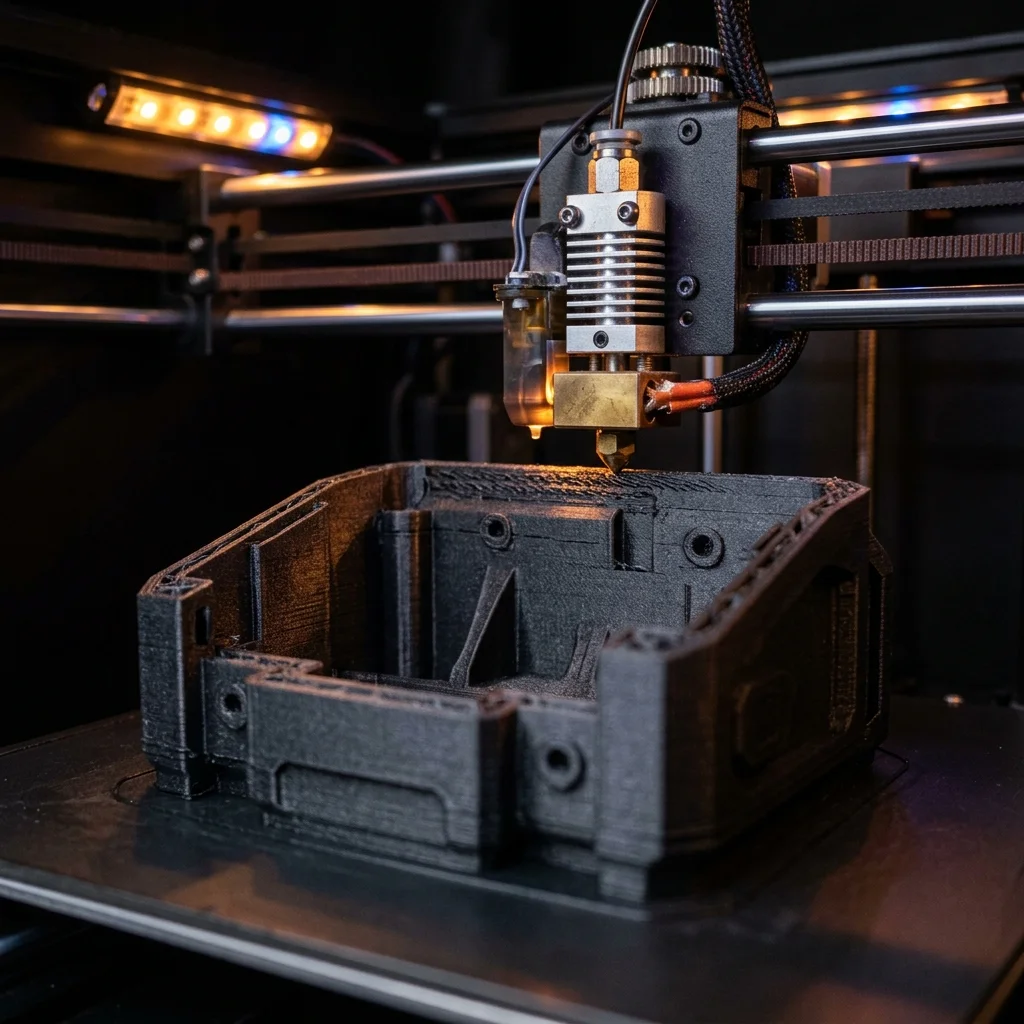
ABS (acrylonitrile-butadiene-styrene) and ASA (acrylonitrile-styrene-acrylate) are the two thermoplastics most professional FDM owners reach for when they need real heat resistance, UV resistance, and mechanical toughness. ABS melts around 240°C and softens at 95°C: nearly double PLA’s threshold. ASA adds UV resistance, making parts suitable for direct sun for years. But both materials demand an enclosure and printing experience: warping and cracking are common reality without preparation. This guide shows how to print ABS and ASA reliably, which printers are suitable, and when to prefer them over PETG or Nylon.
When ABS, when ASA, when neither
ABS has been the engineering standard since the 70s: Lego bricks are ABS. It has good tensile strength (40 MPa), excellent impact resistance, and softens around 95-100°C. That makes it suitable for parts in a car, hand tools, tool handles, and anything that would otherwise deform in a hot environment. It can also be acetone-glued, allowing chemical bonding of separately printed parts.
ASA is the modern successor to ABS for outdoor applications. It has all ABS’s pluses plus UV resistance: an ASA part in direct sun for 5 years doesn’t yellow or become brittle. ASA is the choice for automotive accessories, antennas, drone parts, and anything that will live outdoors.
When not: if you work without an enclosure, if your room has no ventilation (ABS emits styrene fumes), if you have asthma or respiratory issues. In those cases, PETG-CF (carbon-fiber-filled PETG) or ASA-CF is a better choice than pure ABS/ASA.
Recommended FDM printers
Bambu Lab X1-Carbon (€1449): gold standard for ABS/ASA. Actively heated enclosure to 60°C, hardened steel nozzle, AMS multimaterial. Recommended for anyone serious about ABS printing.
Prusa MK4 with Prusa Enclosure (€999 + €330): open-source choice. The enclosure is an add-on but makes the printer ABS-capable. Recommended for tinkerers and production farms.
Creality K1 Max (€800): enclosed chamber, large platform (300×300×300 mm), hardware-heated bed to 120°C. Recommended for large ABS prototypes.
Qidi Plus 4 (€650): professional enclosed printer with heated chamber to 65°C. Slightly less popular in Bulgaria, but excellent build quality.
Avoid: open-frame printers like stock Ender 3 or Bambu A1 for ABS, warping will frustrate every print over 50 mm. You can improvise an enclosure with acrylic panels, but a factory-enclosed machine makes everything easier.
Recommended ABS/ASA brands
Polymaker PolyLite ABS: standard ABS, good price €25-€30/kg. Prints cleanly in Bambu X1 or Prusa with enclosure. Recommended for starting.
Prusament ASA: Prusa’s own ASA. Exceptionally UV stable, good layer adhesion. €32-€38/kg.
Bambu Lab ABS: optimized for Bambu X1 with AMS auto-recognition. €28/kg. Recommended if you have a Bambu.
FormFutura ApolloX (ASA): specialized ASA with improved print stability and cleaner finish. €35-€40/kg. Recommended for outdoor applications.
Fiberlogy FiberSatin ABS: matte finish ABS with better layer hiding. €28/kg.
For specialized: ABS-CF (carbon fiber, less warping), ABS-X (impact resistant), ASA-AERO (for drone parts).
Optimal ABS/ASA settings
Nozzle temperature: 240-260°C. Start at 245°C, raise if under-extrusion. ASA often wants 250-255°C.
Bed temperature: 100-110°C. Don’t drop below 95°C: warping is guaranteed. PEI sheet or textured glass with thin ABS slurry layer helps.
Chamber temperature: 40-60°C. This is important. Without heated chamber, large parts warp. On X1-Carbon and K1 Max this is automatic; on Prusa Enclosure: passive (but adequate for parts under 150 mm).
Speed: 40-60 mm/s. ABS dislikes high speed: layer adhesion suffers.
Cooling: 0-30%. ABS and ASA do NOT like cooling. First 20 layers: 0% cooling. After that max 30%.
Layer height: 0.20 mm.
First layer: slow (15-20 mm/s), hot (105-110°C), tight (Z-offset 0.12-0.15 mm). Brim 5-8 mm mandatory for parts over 100 mm.
Common mistakes
Warping (lifted corners): most common ABS issue. Solutions: chamber heater (X1 or K1 Max), 8mm brim, slower first layer, ABS slurry on the bed. Without enclosed chamber, accept that warping is inherent.
Layer cracking (splits between layers): chamber temperature is too low, or cooling is too high. Disable cooling entirely for first 15 layers. Raise nozzle temperature by 5°C.
Elephant foot (flared base): bed temperature too high OR Z-offset too low. Lower bed by 5°C, or raise Z-offset by 0.05 mm.
Nozzle congestion (clogging): ABS is more sensitive to poor-quality filament. Dry filament 4 hours at 60°C. Ensure all-metal hotend (standard PTFE-lined hotends don’t work well above 240°C).
Ugly first layer: raise first-layer flow rate to 105%, lower speed to 15 mm/s, do bed leveling with paper test on hot bed.
Frequently Asked Questions (FAQ)
Interactive Analyzer for Fdm With Abs And Asa, The Tough Choice For Demanding Environments
Select a profile to view detailed analysis.
The full picture
This article is one page from The Big Book of 3D Printing: 704 illustrated pages covering every technology, material and fix in one reference.
Read it on Kindle →Engineer, author of The Big Book of 3D Printing and additive manufacturing expert