

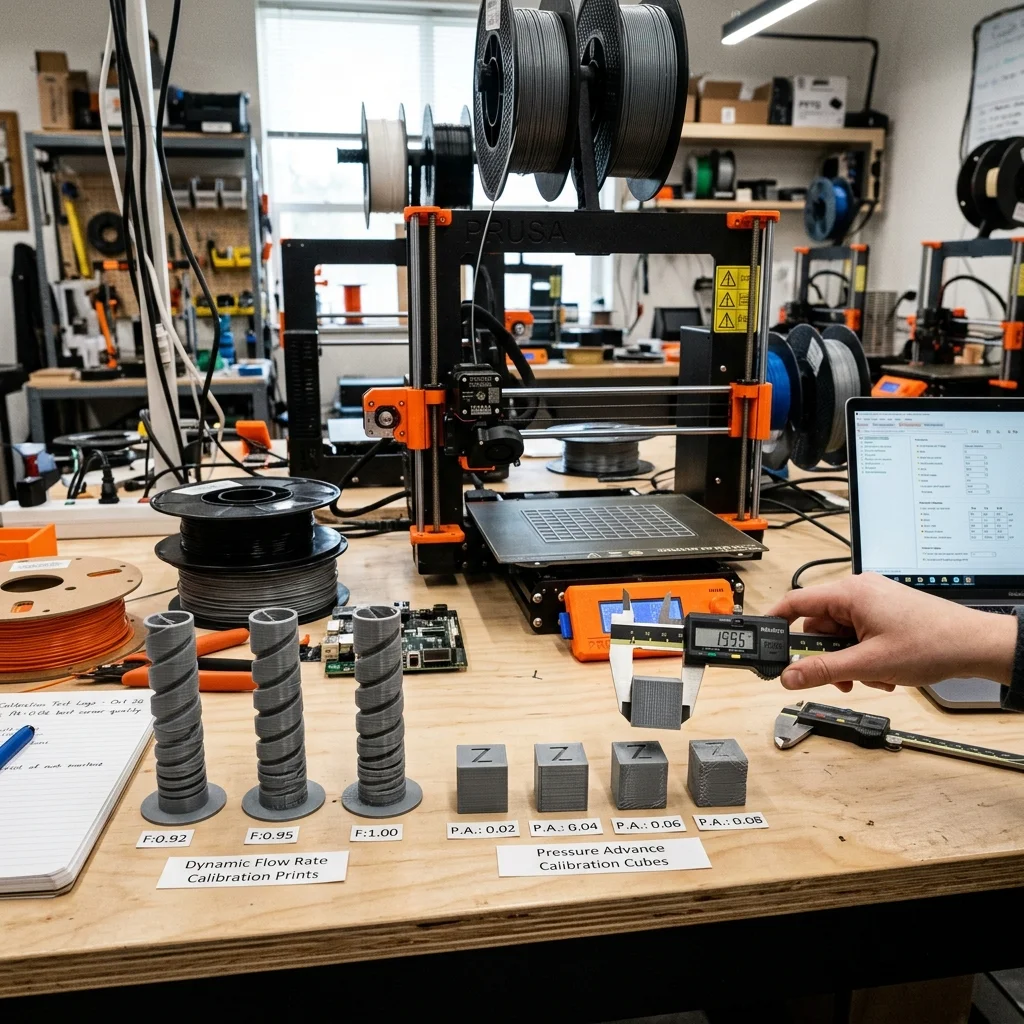
In 2025–2026, dynamic flow rate calibration automates the process of determining precise extrusion flow rates without manual testing. Correct flow is critical: too high → blobs; too low → gaps.
Methods
- Gravimetric: Extrude 100 mm, weigh output, compare to theoretical. ±1% accuracy.
- Dimensional: Print thin-wall cube, measure with calipers, calculate correction.
- Automatic (Bambu/Prusa): Built-in auto-flow prints test lines, sensor selects optimal flow.
- Pressure-Based Sensing: Real-time pressure measurement in bowden/hotend for closed-loop correction.
Interactive Filament Selector
Answer 3 quick questions and find the optimal material for your project.
1. What are the mechanical requirements for the part?
2. What temperature will the part operate at?
3. Are there any specific environmental requirements?
Our recommendation:
PLA filament
Ideal for easy printing, model visualization and decorative parts.
Pros and Cons
Pros:
- Precision: Eliminates human error.
- Speed: Auto-flow tests take < 5 minutes.
Cons:
- Hardware: Pressure sensing requires additional sensor.
- Limited Availability: Auto-flow only on Bambu and Prusa.
FAQ
Interactive Analyzer for Dynamic Flow Rate Calibration: Gravimetric, Dimensional, And Auto-Flow Methods
Select a profile to view detailed analysis.
The full picture
This article is one page from The Big Book of 3D Printing: 704 illustrated pages covering every technology, material and fix in one reference.
Read it on Kindle →Engineer, author of The Big Book of 3D Printing and additive manufacturing expert