

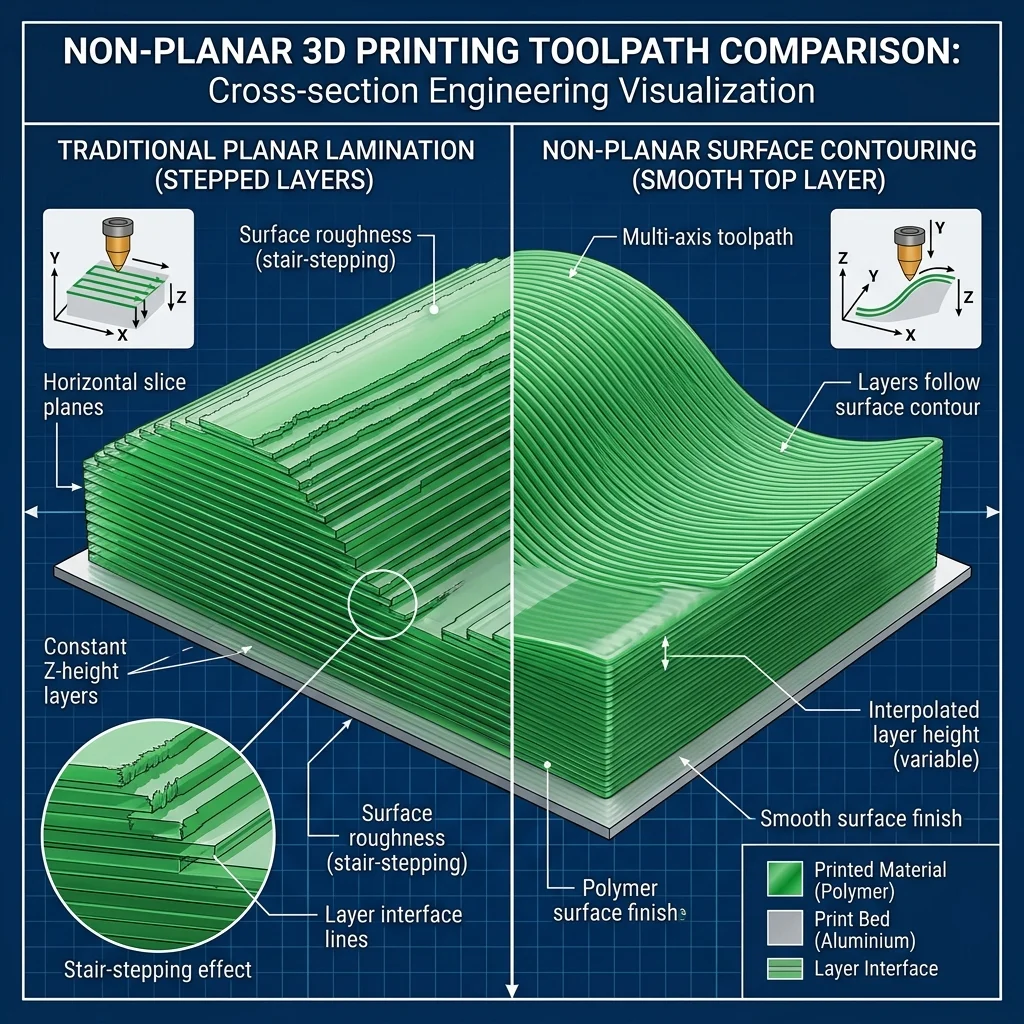
In 2025–2026, non-planar 3D printing addresses the fundamental limitation of layer-based FDM: staircase artifacts on angled surfaces. Instead of flat horizontal layers, the nozzle moves in 3D, following surface contours.
The Problem: Staircase Artifacts
Standard slicing approximates angled surfaces with flat steps. Step height = Layer Height × tan(slope angle).
Interactive Filament Selector
Answer 3 quick questions and find the optimal material for your project.
1. What are the mechanical requirements for the part?
2. What temperature will the part operate at?
3. Are there any specific environmental requirements?
Our recommendation:
PLA filament
Ideal for easy printing, model visualization and decorative parts.
Non-Planar Concept
- Base printed normally (planar layers).
- Top 3–5 layers transition to non-planar mode: nozzle moves in Z while printing, following surface contour.
- Result: smooth top surface without staircase artifacts.
Kinematic Requirements
| Kinematics | Non-Planar Support | Limitation |
|---|---|---|
| Cartesian | Limited | Bed moves in Y, collision risk |
| CoreXY | Good | Bed moves only in Z |
| Delta | Excellent | Natural 3-axis freedom |
| 5-Axis Robot | Perfect | Full angular freedom |
Pros and Cons
Pros:
- Smooth Top Surfaces: Eliminates staircase artifacts.
- Faster Printing: Thick layers for body + non-planar for surface.
Cons:
- Limited Angle: 15–25° from horizontal.
- Collision Risk: Hotend may collide with part.
- Limited Software Support: Few slicers support non-planar.
FAQ
Interactive Analyzer for Non-Planar 3D Printing: Smooth Surfaces Without Staircases
Select a profile to view detailed analysis.
The full picture
This article is one page from The Big Book of 3D Printing: 704 illustrated pages covering every technology, material and fix in one reference.
Read it on Kindle →Engineer, author of The Big Book of 3D Printing and additive manufacturing expert