

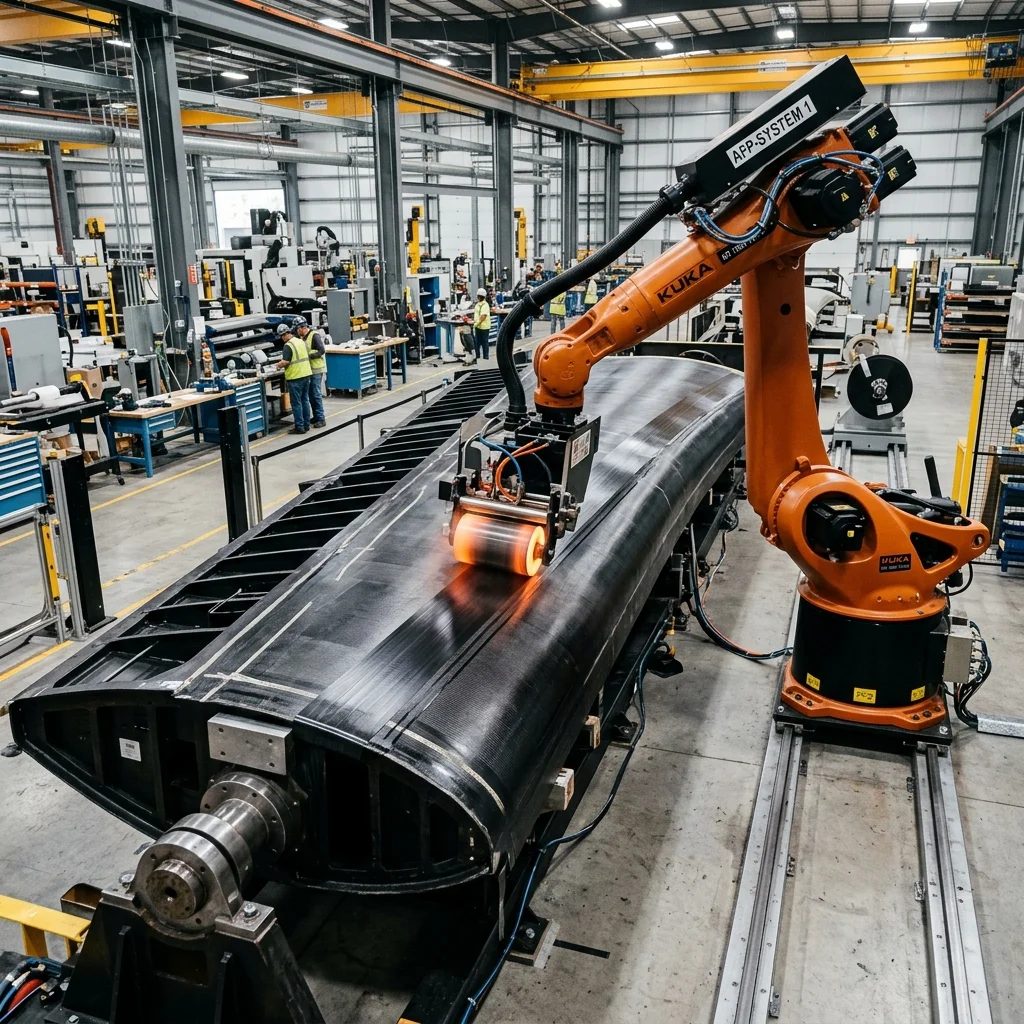
In 2025–2026, Thermoplastic Composite Placement (TCP) bridges the gap between additive manufacturing and classical aerospace composite layup (AFP/ATL). TCP deposits pre-impregnated thermoplastic tapes (UD tapes) of CF/PEEK, CF/PPS, or CF/PA6 with in-situ consolidation: eliminating autoclave curing entirely.
Principle: In-Situ Consolidation
- Heating: Laser, hot gas, or IR lamp heats tape and substrate to matrix melt temperature (250–400°C).
- Compaction: A roller presses the molten tape against the previous layer for molecular diffusion bonding.
- Cooling: The tape crystallizes, forming a permanent bond.
- Repeat: Next tape placed at desired angle (0°, ±45°, 90°).
Interactive Filament Selector
Answer 3 quick questions and find the optimal material for your project.
1. What are the mechanical requirements for the part?
2. What temperature will the part operate at?
3. Are there any specific environmental requirements?
Our recommendation:
PLA filament
Ideal for easy printing, model visualization and decorative parts.
Materials and Properties
| Material | Matrix $T_m$ | UTS (UD, 0°) | Modulus (UD, 0°) | Application |
|---|---|---|---|---|
| CF/PEEK | 343°C | 2100 MPa | 135 GPa | Aerospace structural |
| CF/PPS | 280°C | 1600 MPa | 125 GPa | Chemical resistant |
| CF/PA6 | 220°C | 1200 MPa | 95 GPa | Automotive |
| GF/PP | 165°C | 600 MPa | 35 GPa | Automotive mass |
Pros and Cons
Pros:
- No Autoclave: In-situ consolidation eliminates expensive autoclave curing.
- Recyclability: Thermoplastic matrices are recyclable (unlike epoxy).
- Weldability: TCP parts can be ultrasonically or thermally welded.
Cons:
- Expensive Raw Materials: CF/PEEK UD tape costs €100–300/kg.
- Complex Equipment: Robotic TCP head + laser + compaction system.
- Crystallization Control: Cooling rate affects crystallinity and mechanical properties.
FAQ
Interactive Analyzer for Thermoplastic Composite Placement (Tcp): Automated Layup Without Autoclave
Select a profile to view detailed analysis.
The full picture
This article is one page from The Big Book of 3D Printing: 704 illustrated pages covering every technology, material and fix in one reference.
Read it on Kindle →Engineer, author of The Big Book of 3D Printing and additive manufacturing expert