

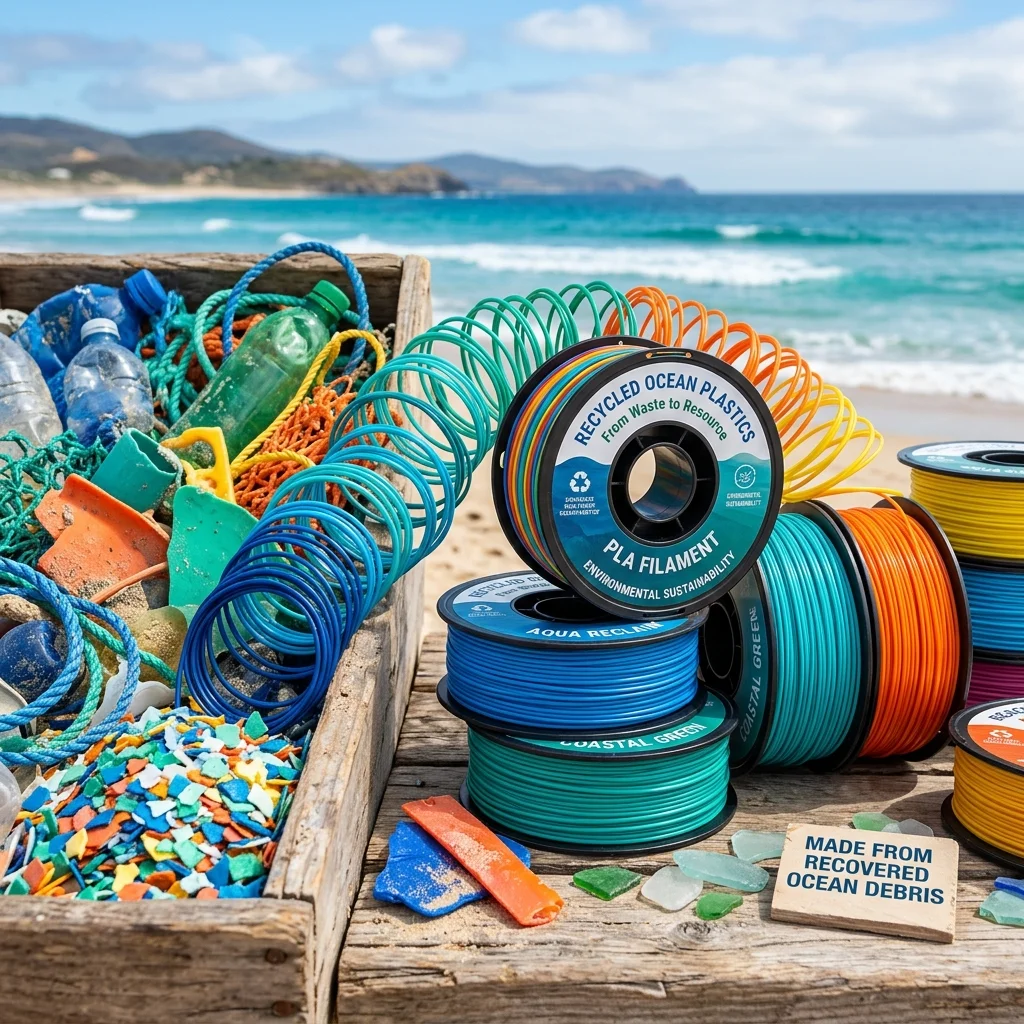
In 2025–2026, the additive manufacturing sector is increasingly prioritizing the circular economy and product lifecycle management. 3D printing users and industrial producers alike require solutions that reduce carbon footprints and prevent plastic waste from entering natural habitats.
Recycled PLA (rPLA) sourced from ocean-bound plastics represents a promising step toward circular manufacturing. However, transforming environmental plastic waste into high-quality, 3D printable filament with a precise diameter tolerance of $pm0.02text{ mm}$ requires overcoming complex material science and polymer chemistry challenges.
Polymer Degradation: Chemistry of the Recycling Process
Polylactic acid (PLA) is a bio-polyester, but unlike metals that can be melted repeatedly with negligible property loss, semi-crystalline thermoplastics suffer from polymer degradation during their lifecycle and subsequent reprocessing.
Ocean-bound plastics are exposed to solar UV radiation, salt water, and mechanical stress, triggering photo-oxidative and hydrolytic degradation. During mechanical recycling (shredding and pelletizing) and thermal re-extrusion (temperatures exceeding $200^circtext{C}$), high shear stresses and heat cause chain scission – the cleavage of ester bonds along the polymer backbone: $$text{–CH(CH}_3)text{–CO–O–} + text{H}_2text{O} longrightarrow text{–CH(CH}_3)text{–COOH} + text{HO–CH(CH}_3)text{–}$$
This structural degradation has several critical consequences:
- Decrease in Molecular Weight ($M_w$): The long polymer chains are severed into shorter macromolecular segments. Lower molecular weight decreases physical chain entanglements.
- Tensile Strength Reduction: With fewer chain entanglements to resist mechanical deformation, the material becomes brittle, experiencing a $30%$ to $40%$ reduction in tensile strength compared to virgin PLA.
- Increase in Melt Flow Index (MFI): Shorter chains slide past each other more easily in the molten state. This decrease in melt viscosity (high MFI) causes unstable extrusion, severe bridging sag, and poor surface finish.
Compounding Strategies: Blending and Chain Extenders
To restore the mechanical integrity of recycled ocean-bound PLA and make it suitable for high-precision FDM/FFF 3D printing, manufacturers employ two primary compounding techniques:
1. Virgin PLA Blending
100% recycled ocean PLA is generally too degraded for high-quality filament extrusion. Manufacturers blend rPLA with virgin PLA (vPLA), typically in ratios of 30% rPLA / 70% vPLA or 50% rPLA / 50% vPLA. The virgin polymer introduces long, unbranched chains that stabilize the polymer matrix and restore mechanical properties.
2. Reactive Chain Extenders
To chemically reconnect the degraded polymer chains, reactive additives called chain extenders are introduced during compounding. The most common chain extenders are epoxy-functionalized styrene-acrylic oligomers (such as the Joncryl ADR series).
The epoxy groups of the chain extender react with the terminal carboxyl ($text{–COOH}$) and hydroxyl ($text{–OH}$) groups of the degraded PLA chains: $$text{PLA–COOH} + text{Epoxy–Ring} longrightarrow text{PLA–COO–CH}_2text{–CH(OH)–}$$
This reaction re-links the short chains into longer linear or branched structures, effectively raising the molecular weight, lowering the MFI (restoring melt strength), and recovering tensile properties close to those of virgin PLA.
Ocean Collection and Purification Workflow
Sourcing, purifying, and processing marine waste into commercial 3D printing filament involves a rigorous multi-step industrial process:
- Collection & Interception: Focuses on ocean-bound plastics collected within 50 km of coastlines, rivers, and estuaries. Intercepting the plastic before it drifts into the open ocean minimizes severe UV and saltwater degradation.
- Spectroscopic Sorting: Collected plastics are sorted using automated Near-Infrared (NIR) spectroscopy. This technology identifies the infrared signature of different polymers, separating PLA from PET, HDPE, and PP in milliseconds.
- Purification & Washing: The sorted PLA waste is shredded into flakes and subjected to aggressive, multi-stage hot washing with specialized surfactants. This process removes salts, sand, organic bio-fouling (algae, barnacles), and adhesive residues. Any remaining salt or organic matter would carbonate (burn) at $210^circtext{C}$ in the 3D printer nozzle, causing severe clogs.
- Compounding & Pelletizing: The washed flakes are dried and fed into a co-rotating twin-screw extruder, where they are melt-blended with virgin PLA, chain extenders, and organic colorants to create uniform pellets.
- Filament Extrusion: The compounded pellets are extruded into filament, cooled in a water bath with active dual-axis laser diameter monitoring ($pm0.02text{ mm}$ tolerance), and wound onto recyclable cardboard spools.
Comparison Table: PLA Polymer Modifications
| Property | Virgin PLA (vPLA) | Raw Ocean rPLA (100%, Unmodified) | Modified Ocean rPLA (50/50 Blend + Chain Extender) | Industrial rPLA (Industrial Waste) |
|---|---|---|---|---|
| Tensile Strength (MPa) | 55 – 65 | 28 – 35 (Brittle) | 48 – 55 | 50 – 58 |
| Tensile Modulus (GPa) | 3.5 – 3.8 | 2.8 – 3.0 | 3.3 – 3.6 | 3.4 – 3.7 |
| Elongation at Break (%) | 4 – 6% | 1.5 – 2.5% | 3.5 – 5.0% | 3.8 – 5.2% |
| Melt Flow Index (MFI) | 6 – 8 g/10 min | > 15 g/10 min (Low viscosity) | 7 – 9 g/10 min | 6 – 9 g/10 min |
| Surface Finish Quality | Excellent | Poor (Drooping/Stringing) | Very Good | Excellent |
Recommended 3D Printing Parameters for Ocean rPLA
To ensure consistent print quality and mechanical strength when printing with modified ocean rPLA:
- Nozzle Temperature: 195°C – 215°C (Slightly lower than virgin PLA if the melt viscosity is high).
- Bed Temperature: 50°C – 60°C (PEI sheets or clean glass work best).
- Print Speed: 50 – 120 mm/s (Can be printed up to 150 mm/s on modern CoreXY printers if the filament contains high-performance chain extenders).
- Part Cooling Fan: 100% (Crucial for rapid cooling of the layers to prevent warping and sagging).
- Filament Conditioning: Active drying at 45°C – 50°C for 4 to 6 hours before printing is highly recommended. The degraded amorphous regions in recycled PLA increase its hygroscopicity, causing it to absorb moisture faster than virgin PLA.
3D Cost Calculator
Results:
Pros and Cons of Ocean rPLA Filament
Pros:
- Environmental Cleanup: Every kilogram of filament sold removes approximately one kilogram of ocean-bound plastic waste.
- Carbon Footprint Reduction: Production requires up to 60% less energy and generates fewer carbon emissions compared to producing virgin PLA.
- Standard FDM Compatibility: Prints on standard FDM/FFF hardware without requiring hardened nozzles or heated enclosures.
- Aesthetic Quality: Visually identical to virgin PLA, offering clean layer lines and minimal warping when properly tuned.
Cons:
- Higher Retail Cost: Sourcing, cleaning, sorting, and chemical compounding make it more expensive to produce than virgin PLA.
- Marginal Strength Loss: Tensile strength remains 10% to 15% lower than premium virgin PLA, even with chain extenders.
- Color Limitations: Sorting constraints make pastel or transparent colors difficult to produce; most ocean rPLA filaments are limited to dark, blue, or green tones.
Frequently Asked Questions (FAQ)
1. Is ocean rPLA biodegradable if it ends up back in the ocean?
Eco-Footprint of Recycled Pla (Rpla) From Ocean Plastics: Eco-Friendly Printing
Calculate saved CO2 emissions.
The full picture
This article is one page from The Big Book of 3D Printing: 704 illustrated pages covering every technology, material and fix in one reference.
Read it on Kindle →Engineer, author of The Big Book of 3D Printing and additive manufacturing expert