

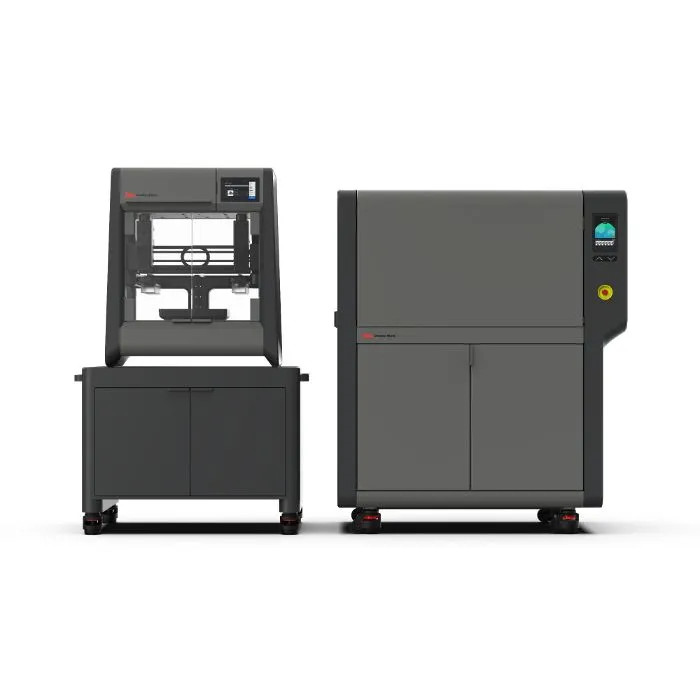
The Desktop Metal Studio System 2 is an office-friendly metal 3D printer using BMD (Bound Metal Deposition): extrusion of metal powder bound in a rod, followed by debinding and sintering in a furnace. No laser, no loose powder, no specialist ventilation: a safe production process right at the desk.
What it is
The Studio System 2 operates on BMD: metal powder is bound into solid rods with a wax-polymer binder. The printer extrudes these rods layer by layer to produce a so-called green part. This then goes through a two-step post-process: debinding (binder removal) and sintering in a dedicated furnace to a dense metal component. The result is a metal part with mechanical properties comparable to CNC machining or conventional casting, with no loose powder, no laser, and no need for specialist safety infrastructure. The machine targets engineering teams, R&D labs and small-batch manufacturers seeking access to functional metal parts directly in the office.
Technical specifications
| Technology | BMD: Bound Metal Deposition (bound metal rod extrusion) |
|---|---|
| Build volume | 300 × 200 × 200 mm |
| Process | 2-step: BMD printing → debinding → furnace sintering |
| Heat treatment | integrated Furnace for sintering to dense metal |
| Loose powder | none: bound metal rods only |
| Laser | no: laser-free process |
| Office safety | no specialist ventilation or ATEX zoning required |
| Class / Price | Industrial · ~€120,000 |
Applications and industries
- Metal part prototyping (rapid creation of functional metal prototypes to verify form, fit and mechanical load) without outsourcing to a CNC machine shop (Mechanical engineering and R&D)
- Tooling jigs and fixtures: production of metal jigs, fixtures and clamps for assembly lines demanding high mechanical durability and repeatability (Automotive and aerospace)
- Small-batch functional metal parts: printing end-use metal components in series of 1 to a few dozen pieces, replacing costly MIM or die-casting for low volumes (Medical devices and industrial manufacturing)
Production workflow
- Prepare the CAD model with shrinkage compensation: the Studio Fleet software automatically scales the geometry (~15–20%) to compensate for sintering shrinkage. The final sintered part achieves design dimensions within tolerance.
- BMD print of the green part: the printer extrudes the metal rod layer by layer, building the part with temporary supports from soluble binder. A solid but fragile green part, ready for debinding.
- Debinding (binder removal): the part is placed in the Debinder unit, which dissolves and removes most of the binder using solvent vapour. A brown part, binder removed, metal grains in contact, part ready for the furnace.
- Furnace sintering: the brown part is sintered at high temperature (close to melting point), metal grains fuse into a dense monolithic metal component. Dense metal part with mechanical properties comparable to conventional methods; residual porosity below 2%.
Key considerations
Materials and applications
Pick a material/alloy this machine processes to see its properties and typical applications:
Conclusion
The Studio System 2 offers a unique path to office-oriented metal production: BMD eliminates loose powder and the laser, making the process safe and accessible to engineering teams without ATEX infrastructure. The two-step debind+sinter workflow demands planning, but the result is dense metal parts in stainless steels, tool steels, copper and superalloys: straight from the desk.
The full picture
This article is one page from The Big Book of 3D Printing: 704 illustrated pages covering every technology, material and fix in one reference.
Read it on Kindle →Engineer, author of The Big Book of 3D Printing and additive manufacturing expert