

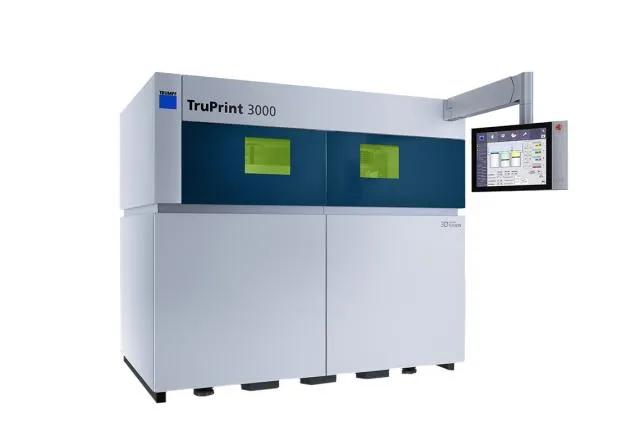
The Trumpf TruPrint 3000 is an industrial LMF/LPBF machine (Laser Metal Fusion) for selective laser melting of metal powder in a layer-by-layer process, designed for serial production of complex metal components. With a cylindrical build volume of Ø300 × 400 mm, an optional dual 500 W laser setup and full inert atmosphere, it delivers repeatability at aerospace and medical grade.
What it is
The TruPrint 3000 is a medium-format LPBF platform from Trumpf: a pioneer in laser technology. The machine fuses metal powder layer by layer with a focused Yb-fiber laser inside a fully inert nitrogen or argon atmosphere. The result is a dense (>99.9%), functional metal part directly from a CAD file. The multi-laser configuration (1 or 2 × 500 W) enables up to twice the build rate, and the cylindrical build field is optimised for rotational and revolution-body geometries. The system supports a broad alloy range, from titanium and stainless steel to nickel-based superalloys and cobalt-chrome.
Technical specifications
| Technology | LPBF / LMF (Laser Metal Fusion: layer-by-layer selective laser melting of alloyed metal powder) |
|---|---|
| Build volume | Ø 300 × 400 mm (cylindrical) |
| Laser system | 1 × 500 W Yb-fiber (standard); option 2 × 500 W (multi-laser) |
| Atmosphere | inert gas: nitrogen or argon; O₂ < 0.1 % |
| Layer thickness | 20 – 100 µm (typically 30–60 µm) |
| Positioning accuracy | ±30 µm (typical for LPBF class) |
| Class / Price | Industrial · ~€800,000 |
Applications and industries
- Medical implants and prosthetics: manufacturing of patient-specific orthopaedic implants, dental crowns and surgical instruments from Ti6Al4V and CoCr alloys with porous osseointegration surfaces, directly from CT/MRI data (Medical and dental industry)
- Aerospace structural components (flight brackets, fuel nozzles and heat exchangers from Inconel 718/625 with integrated cooling channels) unachievable by conventional machining, compliant with AS9100 (Aerospace and defence)
- Tooling with conformal cooling (injection-moulding dies and inserts from tool steel (H13, Maraging) with cooling channels following the cavity profile) reduced cycle times and less warp in the moulded part (Tooling industry and plastics processing)
Production workflow
- System preparation: load powder into the dosing unit, check seals and start inert-gas purge until O₂ < 0.1 %. Safe, oxidation-free chamber, prevents powder degradation and oxide-induced porosity.
- LPBF build: the machine deposits a powder layer (30–60 µm), the laser melts the regions defined by the CAD file, the platform lowers by one layer thickness, the cycle repeats. Layer by layer, a dense (>99.9 %) metal part is built with internal geometries unachievable by milling.
- Part removal and heat treatment: the part is cut from the platform (EDM or bandsaw), then undergoes HIP or vacuum heat treatment to relieve residual stresses and optimise the microstructure. Mechanical properties reach or exceed wrought equivalents; anisotropy is significantly reduced.
- Finishing (as required): CNC grinding, EDM, shot blasting or electrochemical polishing (ECP) of functional surfaces. Ra < 1.6 µm and geometric accuracy within ±0.05 mm achieved for certified applications.
Key considerations
Materials and applications
Pick a material/alloy this machine processes to see its properties and typical applications:
Conclusion
The TruPrint 3000 is a mature industrial LPBF platform positioned at the centre of the metal additive market: large enough for serial medical, aerospace and tooling components, flexible enough for a wide alloy range. The dual-laser option and cylindrical build field make it competitive on throughput, while Trumpf's reputation in precision laser manufacturing gives customers confidence in process repeatability. The investment is significant, but for operations with AS9100 or ISO 13485 requirements it is the obvious next step after process validation.
The full picture
This article is one page from The Big Book of 3D Printing: 704 illustrated pages covering every technology, material and fix in one reference.
Read it on Kindle →Engineer, author of The Big Book of 3D Printing and additive manufacturing expert