

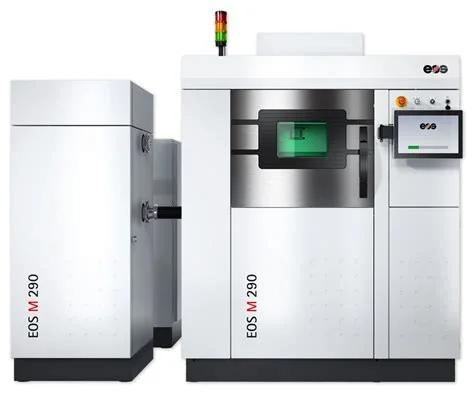
The EOS M 290 is an industrial DMLS/LPBF metal printer that has become the benchmark in aerospace and medical manufacturing. A 400 W laser melts metallic powder layer by layer in an inert atmosphere (N₂ or Ar), building dense metal parts directly from a CAD file: no tooling, no forming.
What it is
DMLS (Direct Metal Laser Sintering), more precisely termed LPBF (Laser Powder Bed Fusion), is a process in which fine metallic powder is spread in thin layers and a precision laser melts the material along each cross-section contour. The EOS M 290 is the workhorse of this technology in a production environment: build volume 250×250×325 mm, F-theta optic system and real-time process monitoring (EOSTATE MeltPool). The machine operates inside a fully sealed chamber under inert gas: a critical requirement to prevent oxidation of reactive alloys such as Ti6Al4V. Parts emerge fully dense (>99.5%) and comply with aerospace and medical standards.
Technical specifications
| Technology | DMLS / LPBF (Laser Powder Bed Fusion) |
|---|---|
| Build volume | 250 × 250 × 325 mm |
| Laser | 400 W Yb fibre laser |
| Beam diameter | 100 µm (focus spot) |
| Layer thickness | 20–80 µm (material-dependent) |
| Inert atmosphere | nitrogen (N₂) or argon (Ar) |
| Class / Price | Industrial · ~€600 000 |
Applications and industries
- Aerospace lightweight parts: fuel nozzles, structural brackets and lattice structures in Ti6Al4V and Inconel, reducing weight by up to 60% compared to machined equivalents (Aerospace and defence)
- Patient-specific medical implants (spinal cages, hip cups and dental crowns from Ti6Al4V and CoCr) personalised geometry, porous surface for osseointegration (Medical and dental)
- Tooling with conformal cooling (injection mould inserts and die-casting cores with cooling channels that follow the cavity contour exactly) shorter cycle times and higher dimensional accuracy of castings (Automotive and mould making)
Production workflow
- CAD preparation: add support structures and determine part orientation. Optimal orientation minimises supports, residual stresses and build time.
- LPBF build: the machine spreads powder and the laser melts each layer inside an inert atmosphere. Fully dense metal structure (>99.5%) without oxidation of reactive alloys.
- Part removal from the build plate and heat treatment / HIP (Hot Isostatic Pressing). Residual stresses relieved, microporosity closed, mechanical properties finalised.
- Support removal and surface finishing (grinding, polishing, HF etching where required). Final geometric accuracy and required surface roughness for functional use.
Key considerations
Materials and applications
Pick a material/alloy this machine processes to see its properties and typical applications:
Conclusion
The EOS M 290 is the production standard for DMLS/LPBF: the machine to which aerospace, medical and automotive manufacturers entrust their most critical components. The process demands serious infrastructure (inert gas, heat treatment, CT inspection), but delivers metal parts with mechanical properties matching or exceeding conventional manufacturing, combined with geometric freedom unachievable by any other route.
The full picture
This article is one page from The Big Book of 3D Printing: 704 illustrated pages covering every technology, material and fix in one reference.
Read it on Kindle →Engineer, author of The Big Book of 3D Printing and additive manufacturing expert