

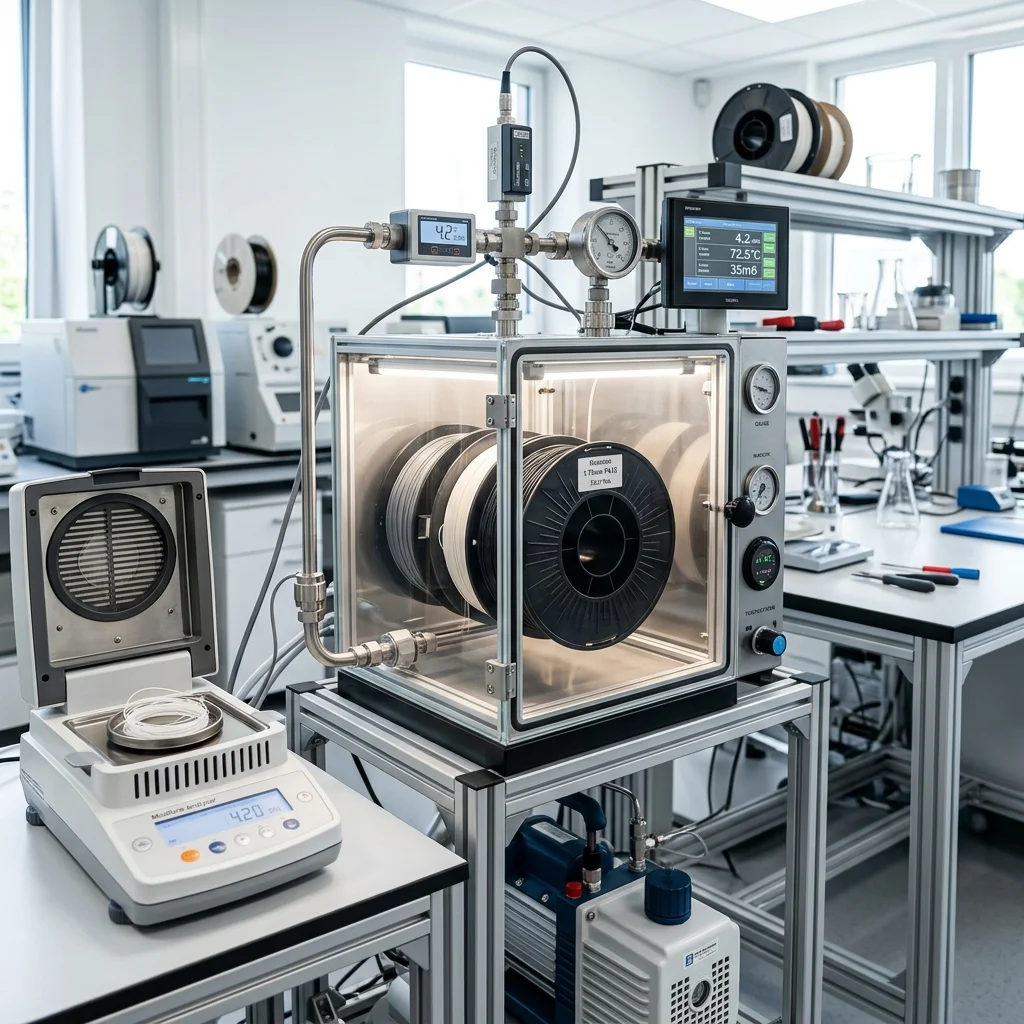
In the transition from hobbyist experimentation to industrial-grade additive manufacturing, hardware alone is not enough. The secret to flawless, dimensionally accurate, and structurally sound 3D prints lies in material science. One of the most insidious enemies of polymer extrusion is invisible to the naked eye: atmospheric moisture. Hygroscopic materials like PA (Nylon), PC, TPU, and even standard PETG actively absorb water molecules from ambient air. When fed into a 300°C hotend, this trapped moisture wreaks havoc. Mastering filament drying is not just a troubleshooting step; it is a foundational prerequisite for true digital manufacturing.
The Molecular Enemy: Hydrolysis and Chain Scission
Many users believe moisture merely causes visual defects like hissing or bubbling on the surface. The reality is far more destructive. When water-saturated polymer enters the melt zone, the water flashes into steam, expanding violently. Worse yet is the chemical reaction called hydrolysis. At elevated temperatures, water molecules attack and sever the long polymer chains. This 'chain scission' drastically reduces the molecular weight of the plastic. The result? A printed part that might look acceptable but suffers from a catastrophic loss of tensile strength and severely compromised layer adhesion.
Thermodynamics of Drying: Time, Temperature, and Tg
Drying is a thermodynamic process where thermal energy forces moisture out of the polymer matrix. The key to successful drying is to approach the glass transition temperature (Tg) of the material without exceeding it. If you push past the Tg, the filament will soften and fuse into a solid block on the spool. For PLA, the recommended temperature is around 45-50°C for 4-8 hours. For engineering-grade materials like Polycarbonate (PC) or Nylon (PA), temperatures reach 80-100°C for 12 to 24 hours. It is also critical to verify the thermal resistance of the plastic spool itself, as cheaper spools will warp at temperatures above 60°C.
Active Drying vs. Passive Desiccation
A common misconception is that placing a spool in a sealed box with silica gel will 'dry' the filament. Silica gel is a passive desiccant: it is meant to maintain a low ambient humidity and prevent further water absorption. However, it lacks the energy required to pull bound moisture out of the polymer structure. To restore a saturated spool to its factory condition, active drying is mandatory: a combination of controlled heat and continuous airflow to vent the evaporated moisture out of the chamber. Without ventilation, you merely create a humid sauna for your plastic.
Industrial Best Practices for the Production Floor
To guarantee Zero Defect Manufacturing, drying must be integrated as a mandatory pre-flight checklist item. Even brand-new, factory-vacuum-sealed spools often contain residual moisture due to the water-cooling baths used during the filament manufacturing process. For highly hygroscopic materials, printing directly from an active dryer or a humidity-controlled 'dry box' is the optimal setup. Embedding precise digital hygrometers into your storage infrastructure provides real-time data, transforming 3D printing from a dark art into a predictable engineering process.
Conclusion
Ultimately, even the most advanced 3D printer is only as capable as the material fed into it. Understanding the physics of moisture absorption and enforcing rigorous drying protocols are the bedrock of reliable production. This aligns perfectly with the EduFacturing philosophy: providing you with the 'picks and shovels' of deep knowledge that give the hardware its true purpose and enable you to innovate without limits.
The full picture
This article is one page from The Big Book of 3D Printing: 704 illustrated pages covering every technology, material and fix in one reference.
Read it on Kindle →Engineer, author of The Big Book of 3D Printing and additive manufacturing expert