

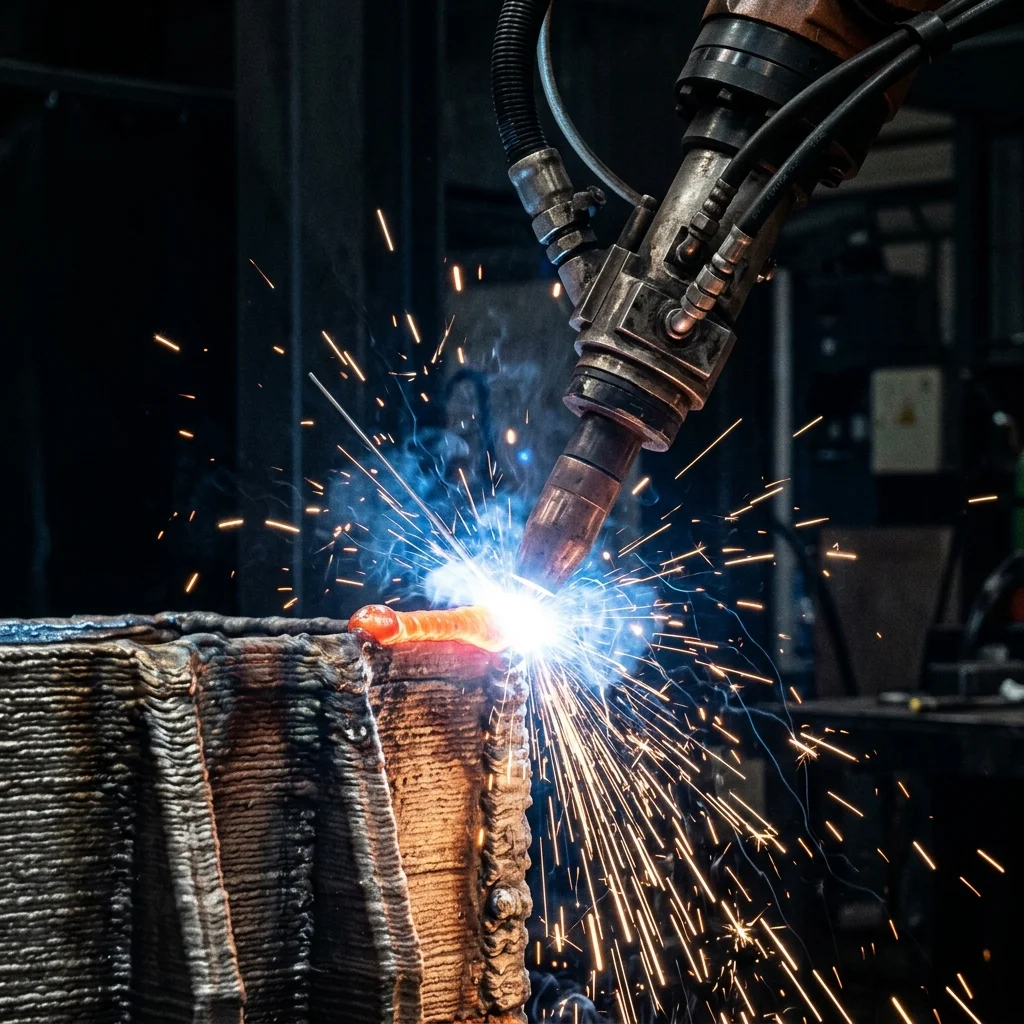
Wire Arc Additive Manufacturing (WAAM) is rapidly emerging as the go-to technology for producing large-scale metal components. By utilizing standard welding wire and an electric arc, WAAM achieves deposition rates far exceeding those of powder-bed systems. This guide explores the entire workflow of manufacturing stainless steel parts using WAAM, highlighting compatible robotic systems and techniques to overcome thermal challenges.
How WAAM Technology Works
WAAM belongs to the Directed Energy Deposition (DED) family. The process integrates industrial robotics (typically 6-axis arms) with standard arc welding equipment like MIG, MAG, or Plasma.
By moving the welding torch along a pre-programmed path, the system melts the wire feedstock to build the part layer by layer. The use of commercially available wire drastically reduces raw material costs compared to highly engineered metal powders.
Why Stainless Steel is Perfect for WAAM
Stainless steel grades boast exceptional weldability, making them ideal candidates for the WAAM process. They offer superior corrosion resistance and strong mechanical properties.
During deposition, stainless steel exhibits a very stable melt pool and lower susceptibility to cracking compared to high-strength aluminum alloys. This makes it perfect for fabricating massive structural components for marine and energy applications.
Recommended Printers and WAAM Systems
-
MX3D M1: A versatile robotic system famous for creating large-scale functional structures like steel bridges. It utilizes the proprietary MetalXL software for smooth toolpath generation.
-
AML3D Arcemy: Industrial-scale, certified WAAM systems tailored for heavy industries. They are renowned for producing large marine components and pressure vessels.
-
Gefertec arc605: Unlike robotic arms, this system uses a 5-axis CNC kinematic platform. It offers superior dimensional accuracy and integrates easily into traditional machine shop environments.
Recommended Stainless Steel Materials
-
EOS 316L Stainless Steel: The powder equivalent to the ER316L wire used in WAAM. It is an austenitic stainless steel providing exceptional corrosion resistance against chlorides.
-
Markforged 17-4 PH: A martensitic precipitation-hardening stainless steel equivalent. It delivers an excellent combination of high strength and hardness after heat treatment.
-
BASF Ultrafuse 316L: A filament equivalent that highlights the popularity of 316L. In WAAM, standard industrial ER316L welding wire is used at a fraction of the cost.
Typical Industrial Applications
WAAM excels in producing medium to large-scale parts where traditional subtractive manufacturing results in immense material waste. Common applications include massive marine propellers and large flanges for the oil and gas industry.
Furthermore, WAAM’s ability to deposit material directly onto existing substrates makes it a premier technology for repairing and remanufacturing worn-out, high-value industrial machinery.
Common Pitfalls and How to Overcome Them
-
Thermal Distortion: The massive heat input introduces significant residual stresses. This requires pre-heating the build plate, strict interpass temperature control, and post-build stress-relief heat treatments.
-
Rough Surface Finish: WAAM produces a characteristic wavy surface. Near-net-shape parts universally require post-process CNC machining on functional mating surfaces.
-
Oxidation: Just like traditional welding, stainless steel WAAM requires a proper shielding gas environment (Argon or Argon/CO2 mixtures) to protect the molten metal pool.
Cost Estimation
Stainless Steel Welding Wire: ~€10 to €30 per kilogram.
Deposition Rate: 1 to 4 kilograms per hour.
Shielding Gas Costs: Moderate, scaling with the build volume and duration.
Machining Costs: High, as functional surfaces must be CNC milled to final tolerances.
Frequently Asked Questions (FAQ)
Interactive Analyzer for Waam 3D Printing With Stainless Steel: Complete Guide
Select a profile to view detailed analysis.
The full picture
This article is one page from The Big Book of 3D Printing: 704 illustrated pages covering every technology, material and fix in one reference.
Read it on Kindle →Engineer, author of The Big Book of 3D Printing and additive manufacturing expert