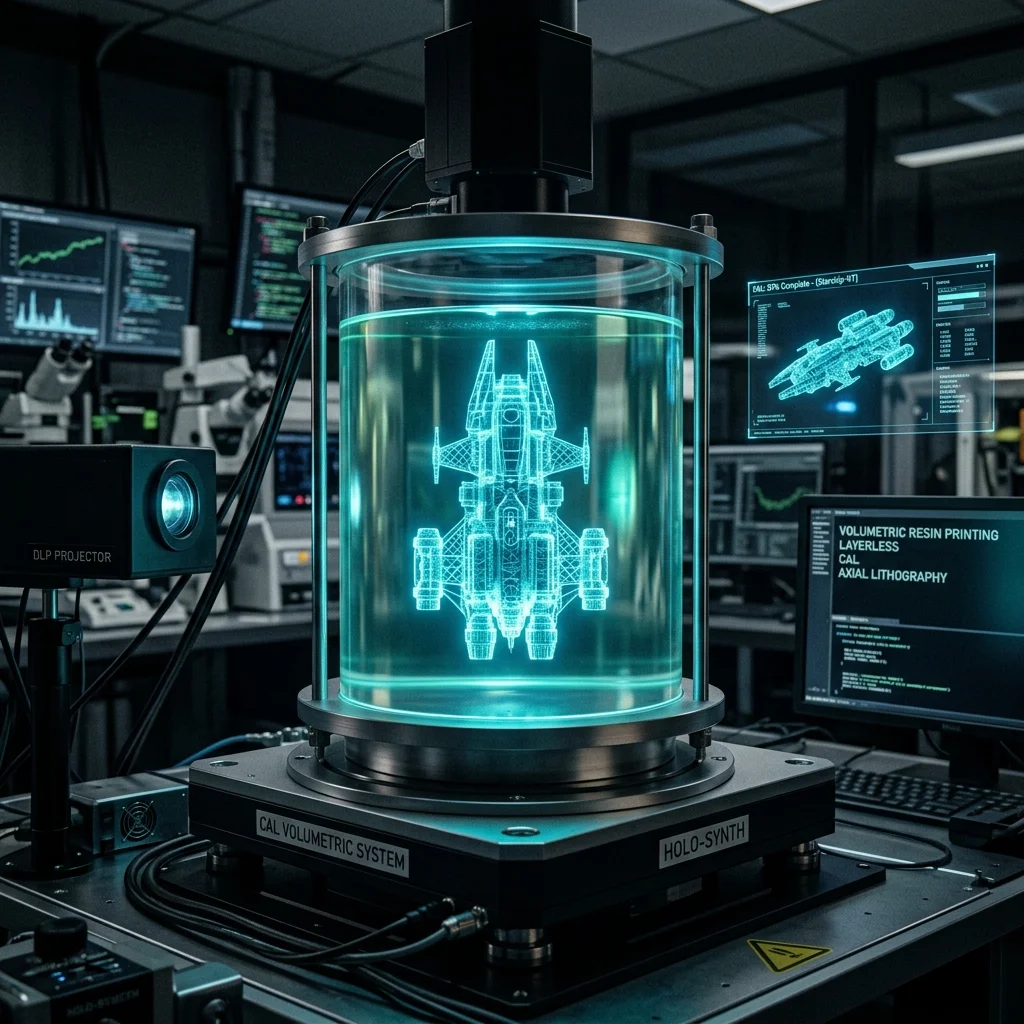
In 2025–2026, the broader class of layerless resin printing technologies has expanded beyond CAL to include xolography, multi-beam volumetric printing, and acoustic-assisted curing: all eliminating layer-by-layer construction entirely.
Layerless Technologies
1. CAL (Computed Axial Lithography)
Rotational projection from multiple angles. Speed: 30–120 seconds.
2. Xolography
Developed by xolo GmbH: uses two photoinitiators with different absorption spectra. Polymerization occurs only where both beams intersect. Resolution: 25–50 μm.
3. Multi-Beam Volumetric
Multiple laser beams intersect at a focus point inside the resin. Curing occurs only at the focal point.
4. Acoustic-Assisted
Ultrasonic waves focus acoustic energy to trigger localized curing. Early research phase.
Interactive Filament Selector
Answer 3 quick questions and find the optimal material for your project.
1. What are the mechanical requirements for the part?
2. What temperature will the part operate at?
3. Are there any specific environmental requirements?
Our recommendation:
PLA filament
Ideal for easy printing, model visualization and decorative parts.
Technology Comparison
| Technology | Resolution | Speed | Volume | TRL |
|---|---|---|---|---|
| CAL | 50–100 μm | 30–120 s | Ø100 mm | 6–7 |
| Xolography | 25–50 μm | 10–60 s | 50×50×50 mm | 5–6 |
| Multi-Beam | 10–50 μm | Minutes | < 30 mm | 3–4 |
| Acoustic | 100–500 μm | Minutes | Variable | 2–3 |
Pros and Cons
Pros:
- Layer-Less: Isotropic properties, no staircase artifacts.
- Extreme Speed: Parts in seconds instead of hours.
- No Supports: Liquid resin supports the object.
Cons:
- Early Stage: Most technologies at TRL 3–6.
- Limited Volume: Maximum ~100 mm.
- Special Resins: Requires photoinitiators with nonlinear response.
FAQ
Interactive Analyzer for Layerless Volumetric Resin Printing: Cal, Xolography, And Beyond
Select a profile to view detailed analysis.
The full picture
This article is one page from The Big Book of 3D Printing: 704 illustrated pages covering every technology, material and fix in one reference.
Read it on Kindle →Engineer, author of The Big Book of 3D Printing and additive manufacturing expert
Updated on 11 September 2026
This article was written with AI assistance; the facts were checked against the sources on 11 September 2026.