

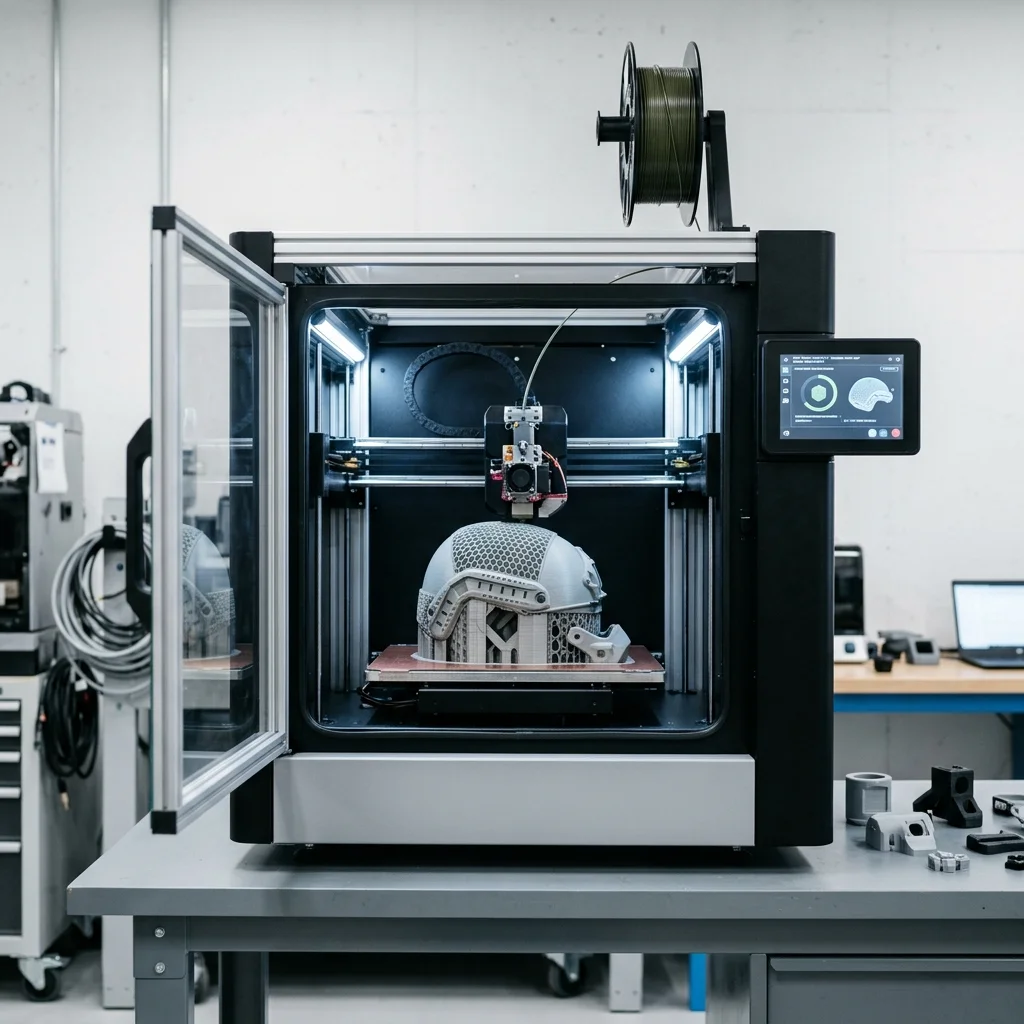
Working prototypes in the defense industry serve as a critical bridge between conceptual design and final production. 3D printing allows engineers and military specialists to test ergonomics, functionality, and durability of equipment in real-world conditions before making large-scale investments.
Typical Requirements
Military prototypes must accurately mimic the properties of the final product. This includes high impact resistance, chemical and UV resistance, and precise mechanical assemblies. Prototypes frequently undergo aggressive field testing.
Recommended Technologies and Printers
High strength and high detail are required for functional prototypes. SLS (sls-2) and MJF (mjf-1, mjf-2) technologies are an ideal choice for polymer parts due to their isotropic properties. CFF (cff-1, cff-2) provides strength comparable to aluminum, thanks to continuous carbon fibers. For metal prototypes, SLM (slm-1, slm-2) is used. Base FDM systems (1, 3, fdm-2) are excellent for rapid form iterations.
Recommended Materials
Material selection is critical for successful testing:
- Composites (CF-1, CF-2) for high rigidity and low weight.
- Engineering polymers (PA12-1, PA12-2) for excellent strength and flexibility.
- Titanium (Ti-1) and Aluminum (Al-1) for high-performance metal prototypes.
- ABS (ABS-1, ABS-2) for structural components.
- Flexible materials (PU-1, PU-2) for seals and shock-absorbing elements.
Process and Timeline
The development of a working prototype usually follows a rapid iterative cycle:
- Day 1: Requirements analysis and preparation of the 3D model for printing.
- Day 2: 3D printing the prototype using the appropriate technology.
- Day 3: Post-processing, component assembly, and hardware integration.
- Day 4: Conducting field or laboratory tests for functionality.
- Day 5: Result analysis and design adjustments.
Pros and Cons
Using additive manufacturing for military prototypes provides significant strategic advantages:
- Pros: Extremely fast development and testing cycle.
- Pros: Ability to customize and modify parts directly in the field.
- Pros: Significant reduction in research and development costs.
- Cons: Some printed materials may not fully meet certification requirements for combat application.
- Cons: Size limitations based on the build volume of the printers.
Cost Breakdown
Costs vary significantly depending on the technology. A sample breakdown for a functional prototype of a reinforced polymer communication module (CFF):
- Engineering time and preparation: 400 BGN
- Composite material costs: 350 BGN
- Machine time: 550 BGN
- Testing and validation: 600 BGN
- Total: 1900 BGN
Examples and Challenges
Military equipment developers regularly use 3D printing to prototype helmets, night vision systems, and modular weapon attachments. A major challenge is ensuring tolerances tight enough for integration with precision optics and electronics.
Frequently Asked Questions (FAQ)
Interactive Analyzer for 3D Printing Working Prototypes For Military Equipment
Select a profile to view detailed analysis.
The full picture
This article is one page from The Big Book of 3D Printing: 704 illustrated pages covering every technology, material and fix in one reference.
Read it on Kindle →Engineer, author of The Big Book of 3D Printing and additive manufacturing expert