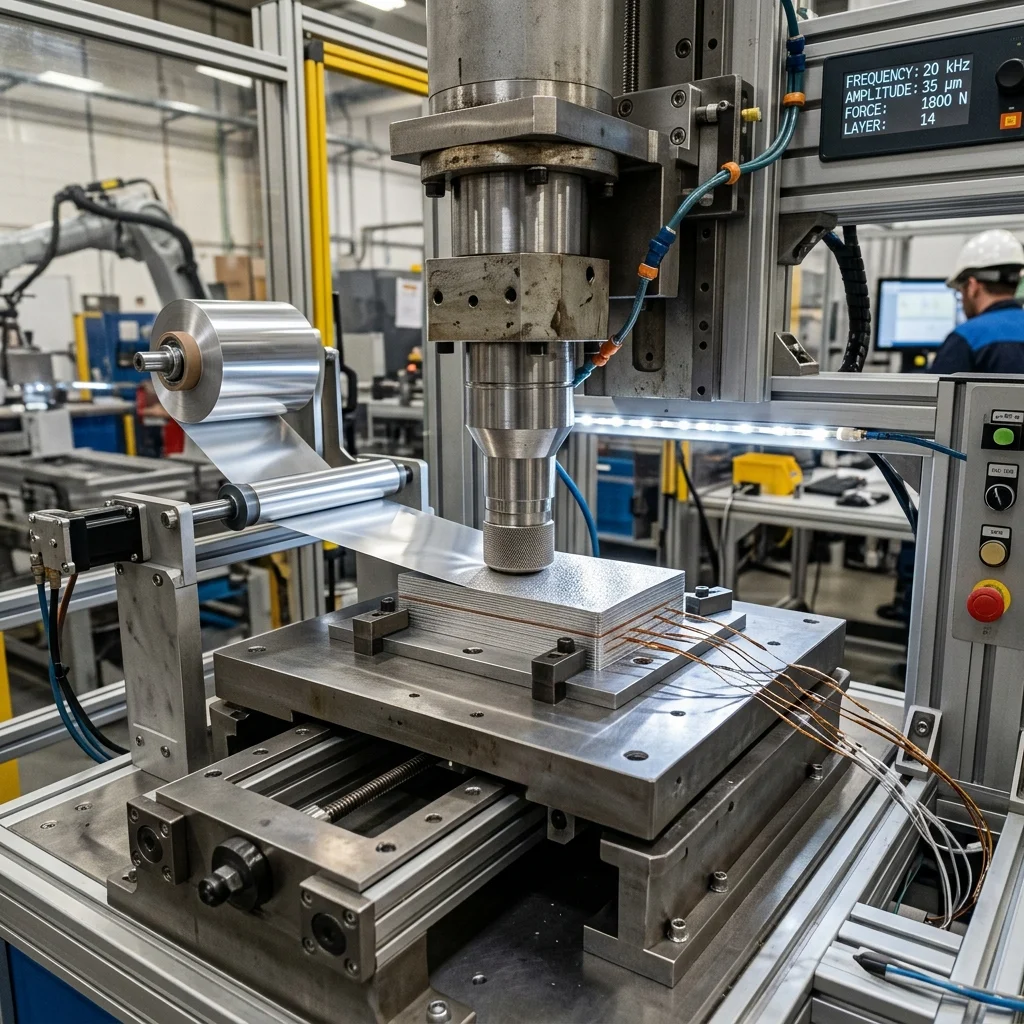
In 2025–2026, Ultrasonic Additive Manufacturing (UAM) enables solid-state bonding of metal foils through ultrasonic vibrations at temperatures well below melting point. UAM uniquely combines additive lamination with CNC subtractive machining in a single hybrid process, enabling multi-material structures and embedded electronics impossible with any other metal AM technology.
Principle: Ultrasonic Solid-State Bonding
- Metal Foil: Thin metal tape (50–250 μm) of aluminum, copper, titanium, or steel is placed on the substrate.
- Ultrasonic Horn (Sonotrode): A vibrating horn (20–40 kHz) presses and vibrates the foil with 500–3000 N normal force.
- Solid-State Bonding: Ultrasonic vibrations disrupt surface oxide films, create local plastic deformation, and form metallurgical bonds without melting (temperature < 50% of $T_m$).
- CNC Milling: After every N laminated layers, CNC mills contours to exact geometry.
Interactive Filament Selector
Answer 3 quick questions and find the optimal material for your project.
1. What are the mechanical requirements for the part?
2. What temperature will the part operate at?
3. Are there any specific environmental requirements?
Our recommendation:
PLA filament
Ideal for easy printing, model visualization and decorative parts.
Unique UAM Capabilities
- Multi-Material: Bond different metals in one part (Al + Cu, Ti + steel).
- Electronics Embedding: Low temperature (< 150°C) allows embedding sensors, optical fibers, and wiring inside metal structures.
- Integrated Channels: CNC between layers creates internal cooling/hydraulic channels.
Comparison with Other Metal AM
| Property | UAM | PBF-LB | WAAM | Cold Spray |
|---|---|---|---|---|
| Temperature | < 50% $T_m$ | > $T_m$ | > $T_m$ | < $T_m$ |
| Porosity | ~0% | < 0.5% | 1–3% | 1–5% |
| Multi-Material | Excellent | Limited | Limited | Moderate |
| Embed Electronics | Yes | No | No | No |
Pros and Cons
Pros:
- Low Temperature: Embed sensitive components.
- Multi-Material: Bond dissimilar metals.
- Zero Porosity: Solid-state process.
Cons:
- Low Volume Rate: Thin foils (50–250 μm) → slow for large volumes.
- Limited Geometry: Primarily block-like structures with CNC finishing.
FAQ
Ultrasonic Additive Manufacturing (Uam): Metal Foil Lamination Calculator
Interactive optimization calculator.
The full picture
This article is one page from The Big Book of 3D Printing: 704 illustrated pages covering every technology, material and fix in one reference.
Read it on Kindle →Engineer, author of The Big Book of 3D Printing and additive manufacturing expert
Updated on 11 September 2026
This article was written with AI assistance; the facts were checked against the sources on 11 September 2026.