

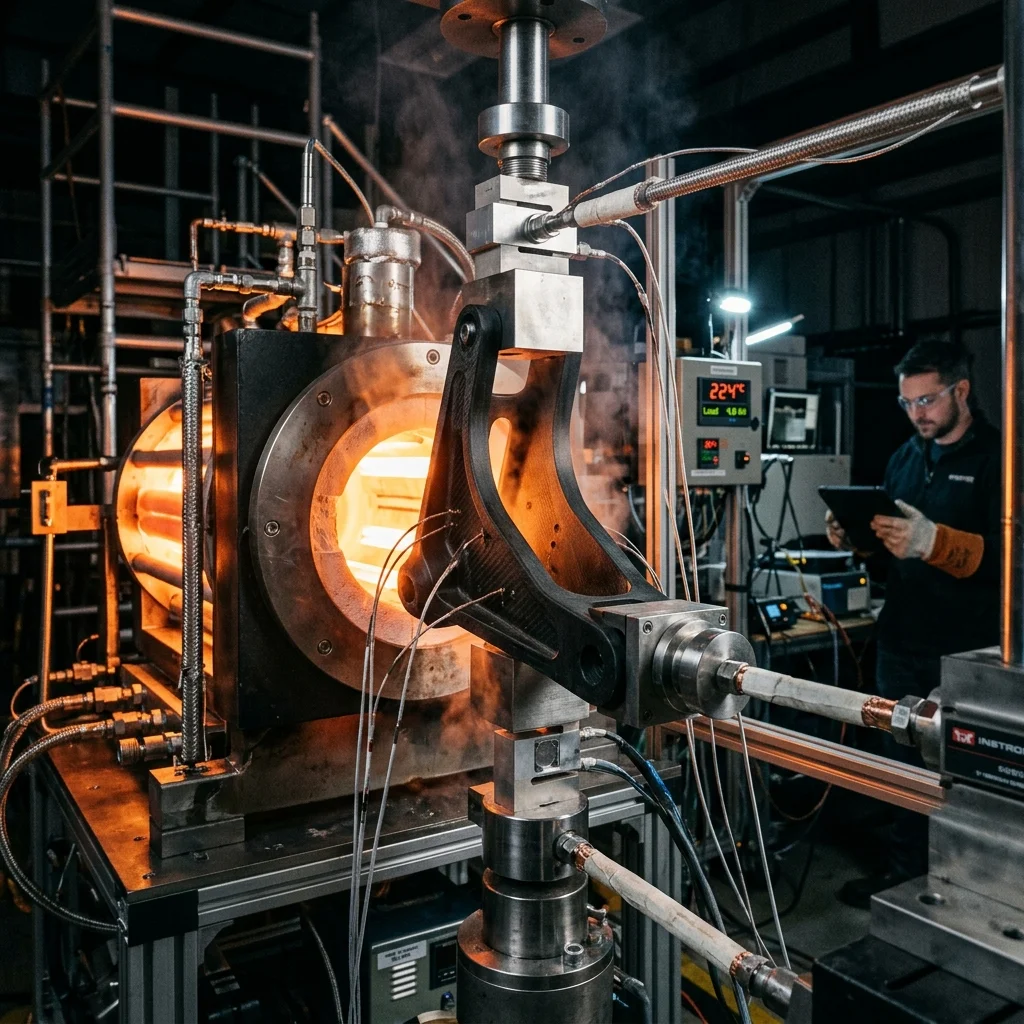
In 2025–2026, the demand for high-temperature, high-stiffness polymers in aerospace and defense continues to grow. Ultem CF (PEI reinforced with Chopped Carbon Fibers) combines the thermal endurance of polyetherimide with the mechanical reinforcement of carbon fibers, creating a composite material with an exceptional balance of thermal stability, mechanical strength, and dimensional accuracy.
Composite Science: PEI Matrix + CF Reinforcement
Ultem CF typically contains 10%–20% chopped carbon fibers (typical length 50–200 μm) in an amorphous PEI matrix. The combination works through two fundamental mechanisms:
1. Mechanical Reinforcement
Carbon fibers have an elastic modulus of 230 GPa (standard T300 carbon), compared to ~3.5 GPa for the PEI matrix. At 15% CF loading, the composite elastic modulus increases to 8–12 GPa: a three-fold improvement. The fibers carry tensile and bending loads while the polymer matrix bonds and distributes the load.
2. Dimensional Stability
Carbon fibers have a coefficient of thermal expansion (CTE) near zero along their longitudinal axis. Embedding them in the PEI matrix dramatically reduces the overall composite CTE, from ~55 μm/m·°C (neat PEI) to ~15–25 μm/m·°C. This means minimal warpage during printing and high dimensional accuracy.
Interactive Filament Selector
Answer 3 quick questions and find the optimal material for your project.
1. What are the mechanical requirements for the part?
2. What temperature will the part operate at?
3. Are there any specific environmental requirements?
Our recommendation:
PLA filament
Ideal for easy printing, model visualization and decorative parts.
Mechanical Properties: Comparison
| Property | PEI (Ultem 1010) | PEI-CF (Ultem CF) | Aluminum 6061 |
|---|---|---|---|
| Elastic Modulus | 3.3 GPa | 8–12 GPa | 69 GPa |
| Tensile Strength | 81 MPa | 110–145 MPa | 310 MPa |
| $T_g$ (Glass Transition) | 217°C | 217°C | N/A (metal) |
| HDT (1.82 MPa) | 216°C | 218°C | N/A |
| CTE (Linear) | 55 μm/m·°C | 15–25 μm/m·°C | 23.6 μm/m·°C |
| Density | 1.27 g/cm³ | 1.35–1.40 g/cm³ | 2.70 g/cm³ |
| UL 94 | V-0 | V-0 | N/A |
Key Takeaway: Ultem CF achieves CTE lower than aluminum at half the density, making it an ideal metal replacement in aerospace and aviation where weight is critical.
Print Parameters
| Parameter | Value | Rationale |
|---|---|---|
| Nozzle Temperature | 370°C – 410°C | Higher than neat PEI due to increased melt viscosity from CF. |
| Bed Temperature | 130°C – 160°C | Maintains adhesion without thermal shock. |
| Heated Chamber | 100°C – 160°C | Mandatory! Prevents delamination and residual stress buildup. |
| Print Speed | 15 – 25 mm/s | Required for controlling fiber orientation. |
| Nozzle | Hardened Steel ≥ 0.4 mm | Carbon fibers are extremely abrasive! |
| Part Cooling | 0% | No airflow, thermal shock causes immediate cracking. |
| Drying | 120°C for 12+ hours | Critical, moisture in PEI-CF causes stringing and bubbling. |
Anisotropy: The Fiber Orientation Challenge
During FDM printing, chopped carbon fibers align predominantly along the extrusion direction (X/Y axis). This means:
- X/Y strength is significantly higher than Z-axis strength.
- Z-axis inter-layer strength is limited by polymer matrix adhesion between layers, as fibers do not bridge across them.
Strategy for Minimizing Anisotropy:
- Orient the part in the slicer so that primary loads align with X/Y.
- Increase chamber temperature for better inter-layer molecular entanglement.
- Consider hybrid infill strategies: alternating layer angles (0°/90°, ±45°).
Pros and Cons
Pros:
- Extreme Thermal Endurance: Operates at 200°C without deformation.
- High Specific Strength: Strength-to-weight ratio superior to many metals.
- Flame Retardancy: UL 94 V-0, FAR 25.853 compliant, directly suitable for aviation.
- Dimensional Stability: CTE lower than aluminum.
Cons:
- Extremely Expensive Equipment: Requires industrial-class printers (Stratasys Fortus/F900 or miniFactory Ultra).
- Abrasiveness: Rapidly wears nozzles, even hardened steel.
- Anisotropy: Z-axis strength significantly lower than X/Y.
- High Filament Cost: Ultem CF is among the most expensive FDM materials (~$300–$500/kg).
Frequently Asked Questions (FAQ)
Ultem Cf: Carbon Fiber Reinforced Pei For Aerospace Composites Calculator
Interactive optimization calculator.
The full picture
This article is one page from The Big Book of 3D Printing: 704 illustrated pages covering every technology, material and fix in one reference.
Read it on Kindle →Engineer, author of The Big Book of 3D Printing and additive manufacturing expert