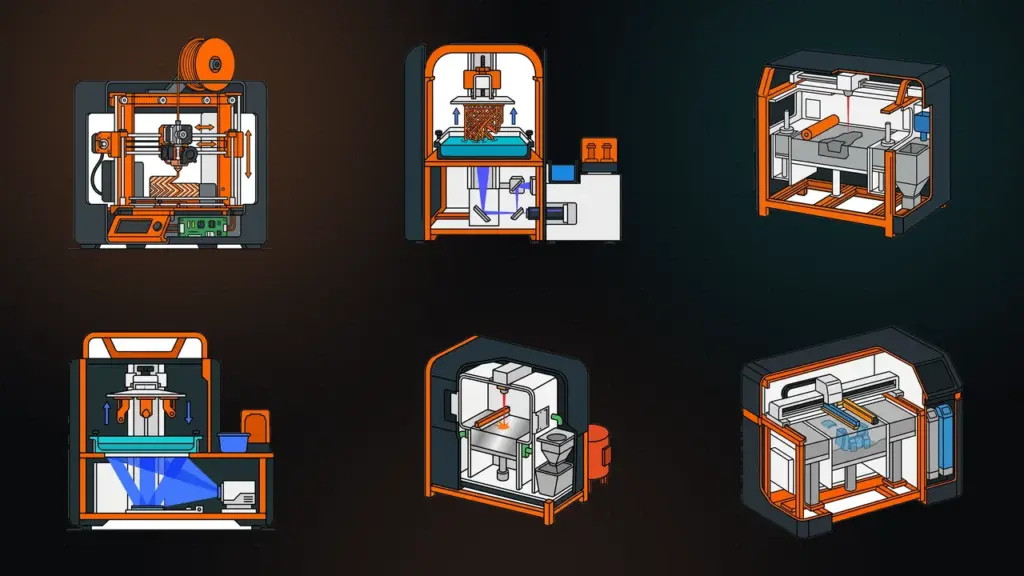
When someone says “I have a 3D printer”, that can mean entirely different machines. 3D printing is a family of technologies, each with a different principle, materials, cost and application. Understanding the differences is the first step to the right choice. Here are the main types, grouped by how they build the part.
Group 1: Extrusion (material melting)
The most widespread approach – the material is melted and deposited layer by layer.
FDM / FFF
Fused filament fabrication. A heated nozzle lays down thermoplastic filament. Most affordable, diverse materials, ideal for functional parts and prototypes.
Strengths
Low cost, easy maintenance, a wide choice of filaments (PLA, PETG, ABS, nylon, composites). Great for beginners and for business.
Group 2: Photopolymerization (resin curing)
Liquid resin is selectively cured with light – for high detail.
SLA
Stereolithography – a laser cures the resin point by point. Exceptional precision and a smooth surface.
DLP / LCD
A whole layer is cured at once with a projector or LCD mask. Faster than SLA, accessible for hobby and dental use.
Resin technologies are irreplaceable for miniatures, jewellery, dental models and fine detail. See also the FDM for beginners guide for a comparison with extrusion.
Group 3: Powder bed (sintering and melting)
A laser or heat binds powdered material – for strong parts and series.
SLS
Selective laser sintering of polymer powder. No supports – complex geometries and moving assemblies in a single print.
MJF
HP’s Multi Jet Fusion. Serial production of polymer parts with good mechanical properties and repeatability.
DMLS / SLM / EBM
Metal printing – a laser or electron beam melts metal powder. Titanium, steel, Inconel for aerospace, medicine and tooling.
How to choose
Start from the part, not the machine. Ask: does it need to be strong and functional (FDM, SLS, metal), or high-detail (SLA, DLP)? How many do you need? What is the budget? The answers narrow the choice to 1–2 technologies.
Quick comparison
- Most affordable and versatile: FDM.
- Highest detail: SLA / DLP.
- Complex shapes without supports: SLS.
- Serial polymer production: MJF.
- Functional metal parts: DMLS / SLM / EBM.
Next step
Now that you know the types, browse the real machines in the printer catalog and compatible materials. To choose between the three most common, see FDM vs SLA vs SLS, and for beginners – FDM for beginners. If you need a part in a specific technology without buying a machine – our services cover FDM, SLA and metal on request.
The full picture
This article is one page from The Big Book of 3D Printing: 704 illustrated pages covering every technology, material and fix in one reference.
Read it on Kindle →Frequently asked questions
What is the difference between FDM and SLA 3D printing?
Which 3D printing technology is best for complex shapes without supports?
What 3D printing technology is used for metal parts?
How do I choose the right 3D printing technology for my project?
Engineer, author of The Big Book of 3D Printing and additive manufacturing expert
Updated on 30 May 2026
This article was written with AI assistance; the facts were checked against the sources on 30 May 2026.