

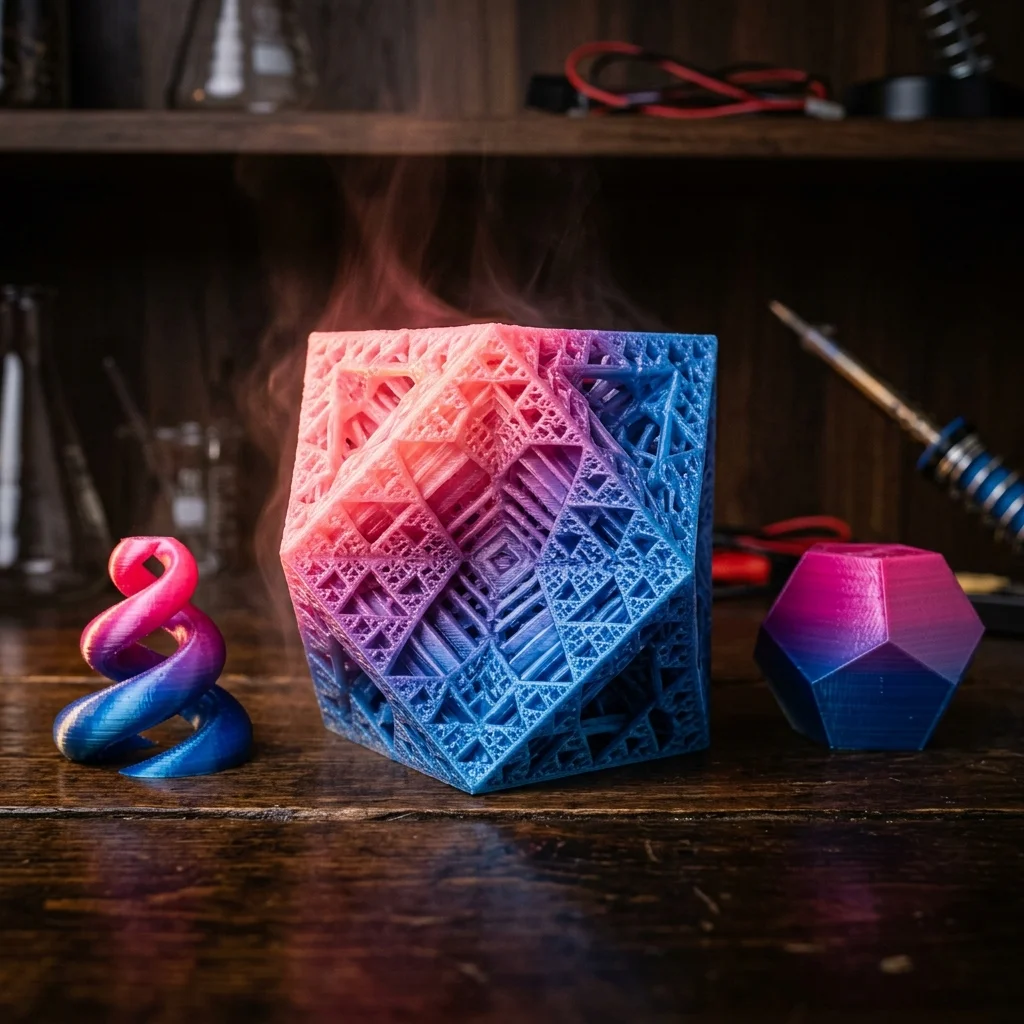
In 2025–2026, smart materials that respond directly to environmental stimuli are playing a larger role in functional prototyping. Thermochromic Filaments utilize microencapsulated chemistry to change color in response to temperature variations.
This behavior provides a cost-effective, non-electronic visual feedback loop for heat distribution, thermal mapping, and safety indicators.
Physicochemical Principles of Leuco Dye Thermochromism
Thermochromic filaments do not change color via chemical polymer degradation. Instead, they are compounded with microcapsules (1 to 10 microns in size) containing a three-part molecular system:
+-----------------------------------------------------------+
| Microcapsule (1-10 μm) |
| |
| [ Leuco Dye (variable) ] <---> [ Color Developer (acid) ] |
| |
| [ Solvent (fatty acid ester) ] |
+-----------------------------------------------------------+
- Leuco Dye: An organic molecule that can switch reversibly between two molecular configurations: colored (closed ring) and colorless (open ring).
- Color Developer: A weak organic acid that binds to the leuco dye. When bound, it forces the leuco dye into its colored state.
- Solvent: An organic ester or alcohol. The melting point of this solvent dictates the transition temperature of the material (e.g., 31°C or 45°C).
The Phase Transition Mechanism:
- Below Transition Temperature: The solvent remains crystalline (solid). The leuco dye and developer are held in close proximity, causing the dye to remain in its colored state (e.g., black or dark blue).
- Above Transition Temperature: The solvent undergoes a phase change and melts. The liquid solvent dissociates the leuco dye from the developer. The dye returns to its colorless state, revealing the base polymer’s natural color (e.g., transparent, yellow, or white).
Most commercial thermochromic pigments are reversible; as the solvent solidifies during cooling, the colored complex is re-established.
Interactive Filament Selector
Answer 3 quick questions and find the optimal material for your project.
1. What are the mechanical requirements for the part?
2. What temperature will the part operate at?
3. Are there any specific environmental requirements?
Our recommendation:
PLA filament
Ideal for easy printing, model visualization and decorative parts.
Engineering and Prototyping Applications
While thermochromic filaments are popular for novelty items, they serve functional engineering purposes:
- Safety Shrouds (Hot-Surface Indicators): Printing enclosures for hotends, motors, or electronic boards. If the hardware exceeds 45°C, the shroud shifts from green to bright yellow, warning operators of burn risks.
- Fluid Flow Diagnostics: Printing manifolds or pipe couplings that change color when hot fluid flows through, simplifying system troubleshooting.
- Thermal Distribution Models: Visualizing thermal gradients across physical prototypes during testing.
Print Settings & Thermal Degradation Limits
Thermochromic filaments are typically formulated on a PLA or ABS base. While they print similarly to standard materials, they require strict thermal limits:
[!WARNING] PERMANENT THERMAL DEGRADATION Leuco dyes are organic compounds encased in thin polymer shells and can be destroyed by overheating.
- Temperature Ceiling: Do not exceed 230°C for PLA-based thermochromic filaments.
- Consequences: Keeping the material inside a hot nozzle above 240°C for more than a few minutes breaks down the organic molecules within the microcapsules. The filament permanently loses its thermochromic property, turning a static brown or transparent color.
Pros and Cons of Thermochromic Materials
Pros:
- Passive Visual Feedback: Delivers immediate temperature indication without sensors, wires, or power.
- Fast Reaction Times: The phase change and color shift occur within milliseconds of reaching the threshold temperature.
- Easy Processing: Prints easily using standard desktop parameters.
Cons:
- UV Degradation: Organic leuco dyes degrade rapidly under ultraviolet light, losing color-changing properties after a few weeks of outdoor exposure.
- Temperature Restrictions: Limited to print temperatures below 230°C to prevent pigment damage.
- Fixed Transition Point: The trigger temperature is locked during chemical synthesis and cannot be modified by the user.
Frequently Asked Questions (FAQ)
Interactive Analyzer for Thermochromic Filaments: Color-Changing Materials Based On Temperature
Select a profile to view detailed analysis.
The full picture
This article is one page from The Big Book of 3D Printing: 704 illustrated pages covering every technology, material and fix in one reference.
Read it on Kindle →Engineer, author of The Big Book of 3D Printing and additive manufacturing expert