

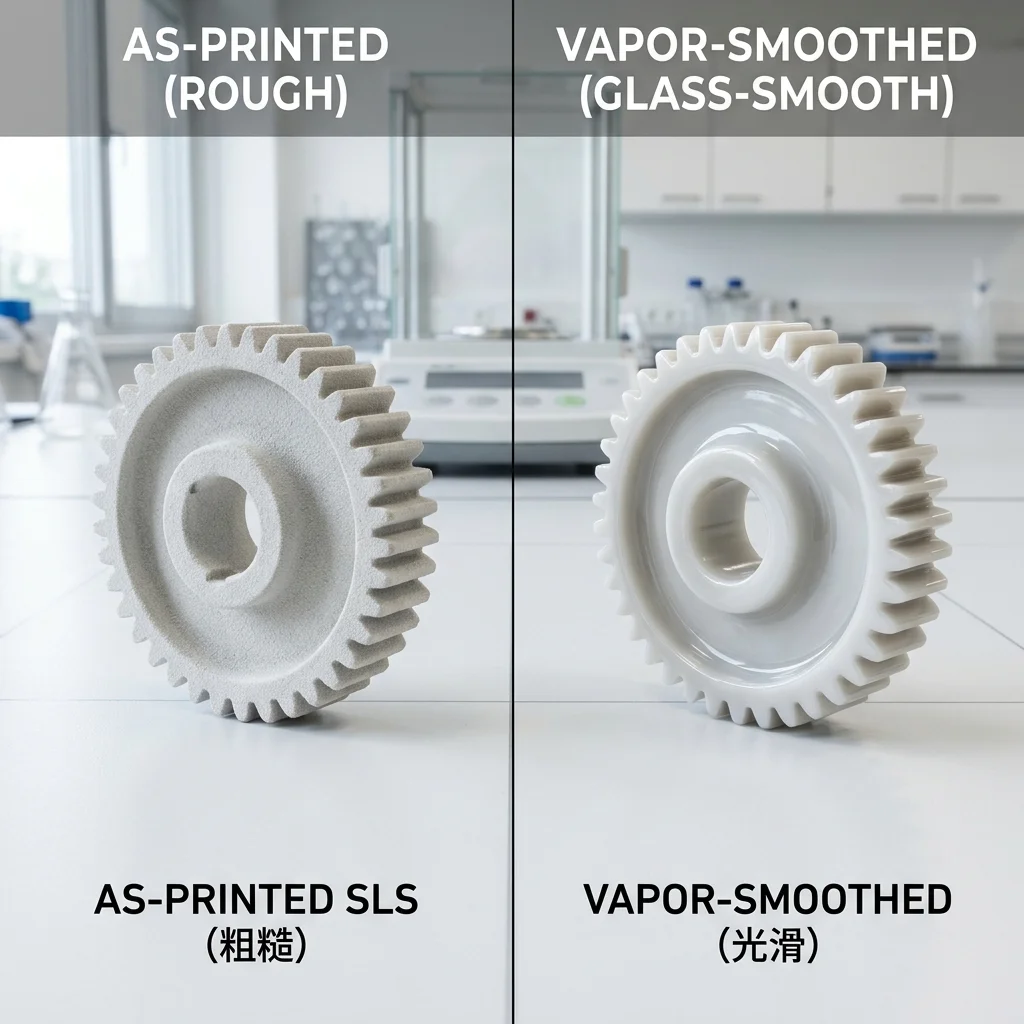
In 2025–2026, Vapor Smoothing has become an essential post-processing technology for SLS (Selective Laser Sintering) parts. SLS nylon (PA12, PA11) has a characteristically rough, porous surface (Ra = 8–15 μm) that absorbs moisture and traps contaminants. Vapor smoothing resolves this chemically, without mechanical sanding.
Operating Principle
- Sealed Chamber: The part is placed in a hermetic chamber.
- Solvent Vapor: The chamber fills with vapor from a specific solvent.
- Surface Dissolution: Vapor condenses on the part surface, partially dissolving the top 5–20 μm of polymer.
- Surface Flow: Dissolved polymer redistributes from “peaks” to “valleys” via surface tension (Laplace effect).
- Evaporation and Solidification: Solvent is removed, leaving a smooth, sealed surface.
Result: Roughness decreases from Ra 8–15 μm to Ra 0.5–2 μm (5–15× improvement).
Interactive Filament Selector
Answer 3 quick questions and find the optimal material for your project.
1. What are the mechanical requirements for the part?
2. What temperature will the part operate at?
3. Are there any specific environmental requirements?
Our recommendation:
PLA filament
Ideal for easy printing, model visualization and decorative parts.
Effects on Mechanical Properties
| Property | Before VS | After VS | Change |
|---|---|---|---|
| Roughness (Ra) | 8–15 μm | 0.5–2 μm | ↓ 5–15× |
| Tensile Strength | 48 MPa | 46–48 MPa | Negligible |
| Elongation | 15% | 18–22% | ↑ Improved |
| Water Absorption | 1.5–3% (24h) | 0.2–0.5% (24h) | ↓ Dramatically reduced |
Pros and Cons
Pros:
- Surface Sealing: Eliminates SLS porosity.
- Professional Aesthetics: Product-ready finish.
- Improved Water Resistance: Critical for moisture-exposed applications.
Cons:
- Expensive Equipment: PostPro SF > €50,000.
- Chemical Hazards: Solvents require ventilation and safety protocols.
- Material Limitations: Not all polymers respond to available solvents.
FAQ
Vapor Smoothing: Chemical Surface Treatment For Sls Parts Calculator
Interactive optimization calculator.
The full picture
This article is one page from The Big Book of 3D Printing: 704 illustrated pages covering every technology, material and fix in one reference.
Read it on Kindle →Engineer, author of The Big Book of 3D Printing and additive manufacturing expert