

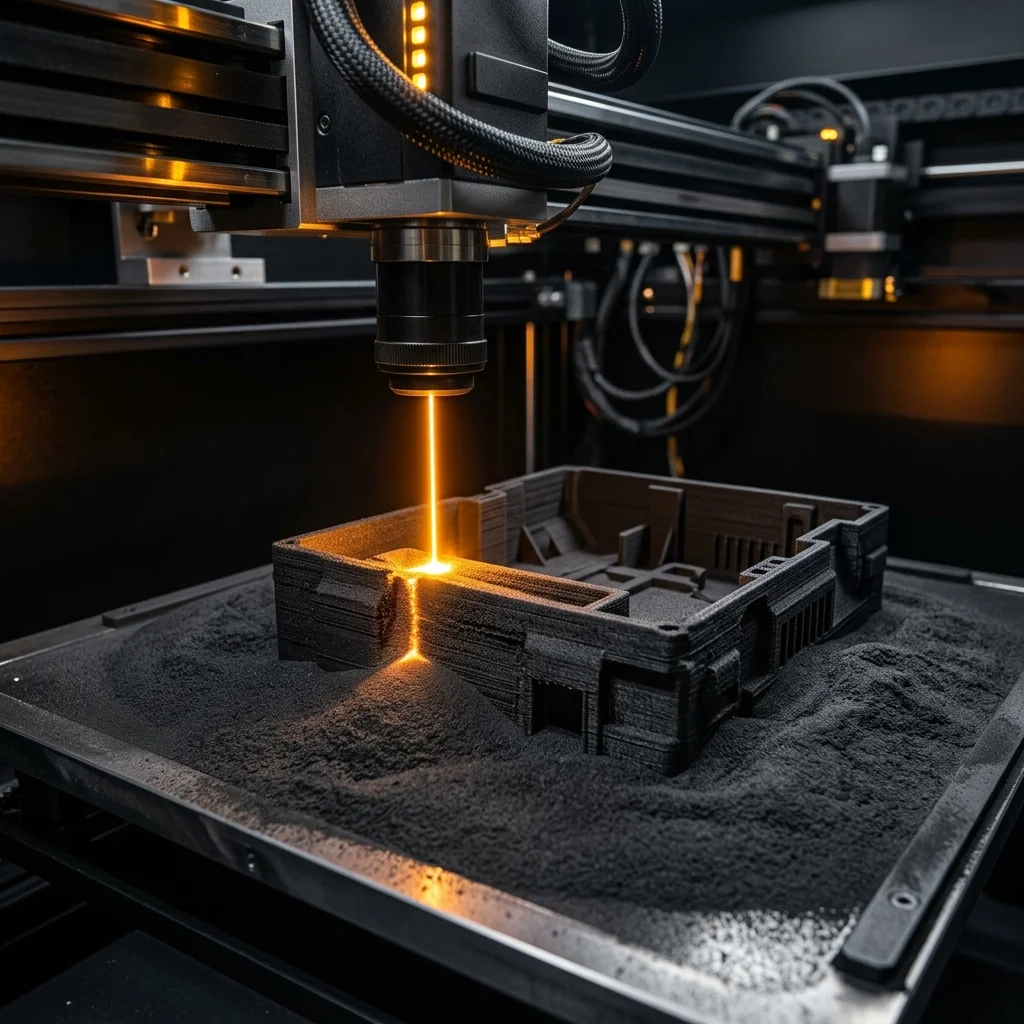
Selective Laser Sintering (SLS) offers design freedom as it does not require support structures. When combining SLS with ESD Safe materials, we gain the ability to create industrial parts that protect sensitive electronics.
These materials prevent the buildup of static electricity and safely dissipate it. They are crucial in electronics, automotive, and assembly line manufacturing.
SLS technology provides high strength and isotropic mechanical properties. This makes the printed ESD parts durable enough for end-use in a production environment.
Core Advantages and Features
-
No Supports Needed: SLS uses the unfused powder as a natural support. This allows printing complex geometries without additional post-processing.
-
Isotropic Strength: Parts have nearly identical strength in all directions (X, Y, and Z axes). This is critical for tooling durability.
-
Controlled Resistance: ESD materials offer a surface resistance typically in the 10^5 to 10^9 ohms range. This prevents sudden electrostatic discharges.
-
High Throughput: The ability for nesting (packing multiple parts in the build volume) drastically increases production capacity.
Recommended Printers and Materials
For optimal results and guaranteed anti-static properties, we recommend the following systems and materials:
Formlabs Fuse 1+ 30W: A compact and powerful industrial printer. Ideal for rapid prototyping and manufacturing.
Sinterit Lisa Pro: An affordable open-materials system. Suitable for laboratories and small batch production.
Sintratec S2: A modular system allowing easy production scaling. Offers excellent temperature control.
3DXTECH 3DXSTAT ESD PETG: Excellent chemical resistance. Good balance between strength and ease of printing.
Zortrax Z-ESD: Offers stable surface resistance. Guarantees high dimensional accuracy.
Formlabs ESD Resin: Specially developed for the Formlabs ecosystem. Provides a smooth surface and high detail.
Typical Applications and Common Issues
Anti-static materials are widely used for creating electronics enclosures, assembly jigs & fixtures, and components for production lines. They are indispensable in cleanrooms and semiconductor manufacturing.
-
Risk of Warping: Thermal deformation is possible in SLS printing with composite materials. Slow cooling of the parts inside the chamber is mandatory.
-
Powder Preservation: Unused powder must be stored in a dry environment. Moisture can severely degrade ESD properties and surface quality.
-
Post-print Cleaning: Thorough cleaning via sandblasting is necessary. Leaving unfused powder can disrupt the part’s conductivity.
Frequently Asked Questions (FAQ)
Interactive Analyzer for Printing Esd Safe Parts With Sls 3D Printers
Select a profile to view detailed analysis.
The full picture
This article is one page from The Big Book of 3D Printing: 704 illustrated pages covering every technology, material and fix in one reference.
Read it on Kindle →Engineer, author of The Big Book of 3D Printing and additive manufacturing expert