

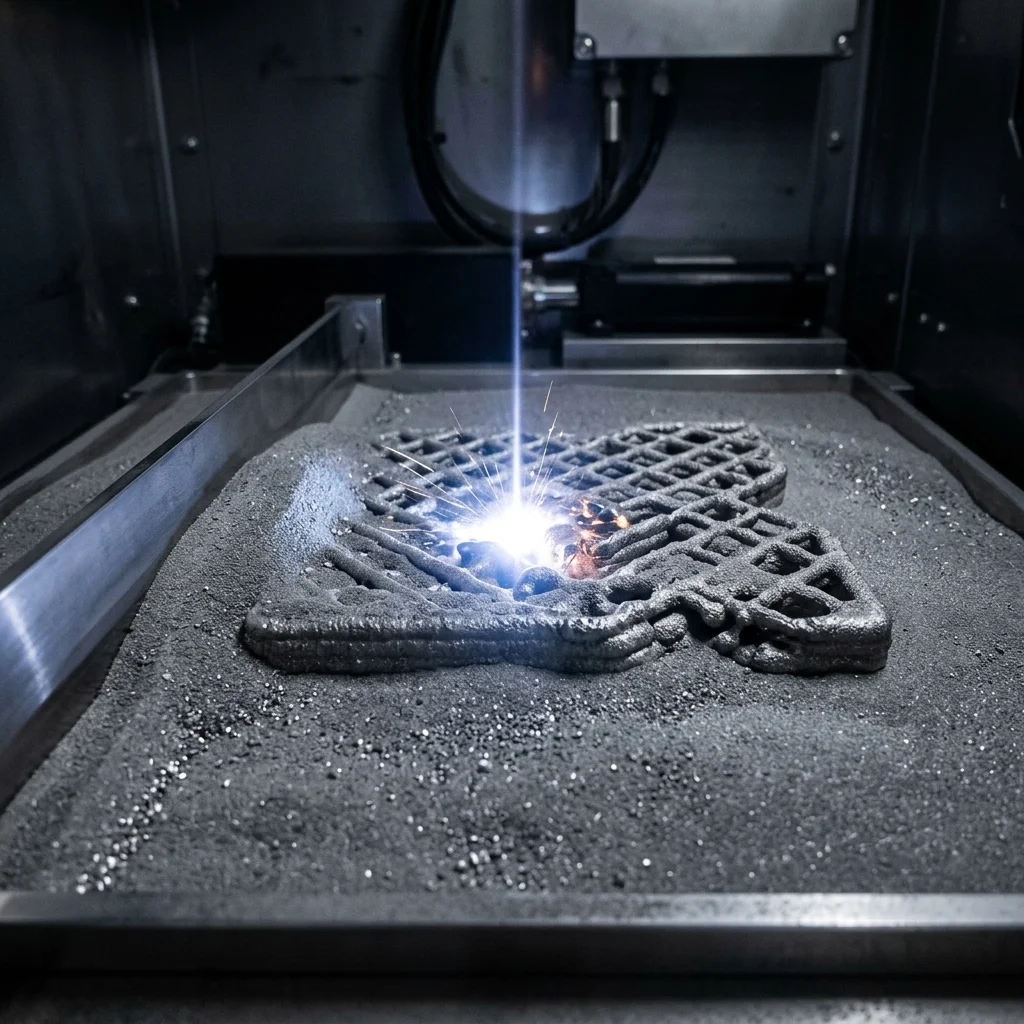
Selective Laser Melting (SLM), also known as Metal Powder Bed Fusion (Metal PBF), has revolutionized the manufacturing of stainless steel components. By using a high-powered laser to selectively melt fine metal powder layer by layer, SLM enables the creation of complex geometries that are impossible or too expensive to produce through traditional methods like milling, turning, or casting. Stainless steel, specifically alloys like 316L and 17-4 PH, is among the most popular materials in metal 3D printing due to its excellent combination of high strength, corrosion resistance, and biocompatibility. In this guide, we will explore in detail the process of printing stainless steel with SLM, discuss the leading machines and materials on the market, and analyze the typical challenges and costs associated with the technology.
What is SLM and why is it ideal for Stainless Steel
SLM (Selective Laser Melting) works by spreading a very thin layer of metal powder over a build platform, after which a high-powered laser precisely melts the cross-section of the part. The process is repeated thousands of times in a controlled environment (usually an inert gas like argon or nitrogen) until the object is completely built. Unlike some other metal 3D printing technologies, SLM fully melts the material, resulting in parts with nearly 100% density and mechanical properties comparable or even superior to forged materials.
Stainless steel is exceptionally well-suited for SLM due to its good flow characteristics in the molten state and excellent absorption of laser energy. Classic industrial alloys like 316L (austenitic stainless steel) provide superior resistance to corrosion and oxidation, while 17-4 PH (precipitation-hardening martensitic stainless steel) offers outstanding hardness and strength after proper heat treatment. The combination of SLM technology and these materials gives engineers the freedom to design and optimize parts without the constraints of traditional tooling.
Applications and Industrial Benefits of SLM Stainless Steel
The unique properties of stainless steel, combined with the design freedom offered by SLM, open doors to numerous industrial applications.
- Medical and Dental: 316L stainless steel is widely used for manufacturing surgical instruments, customized implants, and orthopedic devices. The ability to integrate porous structures into implants aids in better osseointegration.
- Aerospace and Automotive Industry: SLM allows the creation of topologically optimized components that are both lightweight and extremely strong. This includes brackets, fuel nozzles, and complex ducting.
- Food and Chemical Processing: Due to its corrosion resistance and ease of cleaning, printed stainless steel parts are ideal for pumps, valves, piping, and specialized filters.
- Tooling: Although tool steel is more commonly used for this purpose, stainless steel finds applications in creating conformally cooled injection molds where corrosion resistance is key.
Recommended 3D Printers for SLM and Stainless Steel
Choosing the right equipment is critical for achieving high-quality results. Here are three of the leading machines on the market suitable for working with stainless steel:
- EOS EOS M 290: This is arguably the most widespread and proven mid-format industrial metal 3D printing system. With a build volume of 250 x 250 x 325 mm and a powerful 400W fiber laser, the EOS M 290 offers exceptional consistency, perfect surface quality, and reliability, making it a standard in the aerospace and medical industries.
- SLM Solutions SLM 280 2.0: This system is renowned for its productivity and multi-laser configuration capabilities, including options with two 400W or two 700W lasers. This significantly accelerates the production process, making the SLM 280 2.0 an excellent choice for series production of stainless steel components.
- Desktop Metal Shop System: Although technically utilizing Binder Jetting technology (often positioned as an alternative/complement to SLM for larger batches), this system deserves attention for its accessibility and easy integration into traditional machine shops, offering excellent results with materials like 17-4 PH.
Leading Material Brands for Printing
The quality of the metal powder is just as important as the printer itself. The powder must have a spherical shape, proper particle size distribution, and high purity.
- EOS 316L Stainless Steel: Developed and optimized specifically for EOS systems, this powder guarantees predictable and high-quality results. Parts printed with it exhibit excellent corrosion resistance and high ductility.
- Markforged 17-4 PH: Known for its exceptional strength post heat treatment, this material (often offered in an extrusion format like Metal FFF/FDM, but also available as powder for industry) is ideal for functional prototypes, tools, and end-use components subjected to high loads.
- BASF Ultrafuse 316L: While it is a filament (FDM) based on metal powder encapsulated in a polymer matrix, it is a crucial accessible alternative to SLM for prototyping. After printing, the part undergoes a debinding and sintering process (MIM technology), becoming a 100% stainless steel metal part.
Common Pitfalls, Challenges, and Cost Estimation
Despite its advantages, SLM printing of stainless steel presents challenges:
- Thermal Stresses: Rapid heating and cooling during the process lead to the accumulation of internal stresses. If not managed properly by adding robust supports and optimizing orientation, the part may warp or even detach from the build plate.
- Post-Processing: Parts coming out of the printer are welded to the build plate and require cutting (often via EDM). Furthermore, the surface is usually rough (Ra 5-15 µm) and requires machining, sandblasting, or polishing to meet final requirements.
- Costs: SLM equipment costs from several hundred thousand to over a million euros. Stainless steel metal powder typically costs between 40 and 100 euros per kilogram. This makes the cost per part high. Therefore, SLM is economically justified only for complex, high-value-added parts where design benefits outweigh manufacturing costs.
Frequently Asked Questions (FAQ)
Interactive Analyzer for Ultimate Guide To 3D Printing Stainless Steel With Slm | Edufacturing
Select a profile to view detailed analysis.
The full picture
This article is one page from The Big Book of 3D Printing: 704 illustrated pages covering every technology, material and fix in one reference.
Read it on Kindle →Engineer, author of The Big Book of 3D Printing and additive manufacturing expert