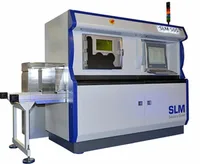
The SLM Solutions SLM 500 is a large industrial Selective Laser Melting (SLM/LPBF) machine equipped with four lasers delivering up to 2800 W of combined power. Its 500 × 280 × 365 mm build volume and multi-laser architecture make it suited for serial production of large-format metal parts with high density and repeatability.
What it is
The SLM 500 uses Selective Laser Melting technology (a form of Laser Powder Bed Fusion (LPBF)) in which four independent lasers simultaneously fuse metal powder layer by layer inside a protective inert atmosphere (nitrogen or argon). The quad-laser configuration (4 × 400 W or 4 × 700 W) allows parallel processing of the build volume, reducing build times by up to 90 % compared to single-laser systems. The machine features a fully closed powder-handling circuit, including automatic sieving and recycling of unused powder, which minimises operator exposure and lowers material costs. The SLM 500 is designed for aerospace and energy production environments where certified, near-zero-porosity parts with consistent microstructure are mandatory.
Technical specifications
| Technology | Selective Laser Melting: SLM / LPBF |
|---|---|
| Build volume | 500 × 280 × 365 mm |
| Lasers / Power | 4 lasers: 4 × 400 W or 4 × 700 W (up to 2800 W) |
| Layer thickness | 20 – 90 µm |
| Build atmosphere | inert gas: nitrogen or argon (< 0.1 % O₂) |
| Powder handling | closed loop: automatic sieving and recycling |
| Class / Price | Industrial · ~€1,200,000 |
Applications and industries
- Large-format aerospace components: Manufacturing structural parts with complex internal geometry: such as aircraft brackets, reflectors and monolithic housings, from Ti6Al4V and Inconel, achieving densities > 99.9 % with full batch traceability (Aerospace and defence)
- Turbine and energy parts: Serial build of cooling channels, burners and turbine blades from heat-resistant superalloys (Inconel 718/625), reducing lead time versus conventional machining (Energy and gas-turbine industry)
- High-throughput serial metal production (Parallel multi-laser processing to simultaneously build multiple parts in one cycle) medical implants, tooling inserts and automotive components from stainless steel and AlSi10Mg with repeatable mechanical properties (Medical, automotive and general engineering)
Production workflow
- Machine and powder preparation: verify oxygen level in the build chamber (< 0.1 %), load and sieve metal powder, confirm fill level in the feed reservoir. Inert atmosphere preventing powder oxidation and porosity in the parts.
- Quad-laser SLM build: the machine fuses layer by layer with all four lasers in parallel, following the scanning strategy parameters (power, speed, hatch spacing) from the validated build processor. Evenly distributed energy across the full build volume, part density > 99.9 % and reduced total build time.
- Heat treatment and separation from the build plate: parts undergo stress-relief annealing (or HIP when required) and are then separated from the build plate by EDM or band saw. Reduced residual stresses, stabilised microstructure and freed parts ready for downstream processing.
- Post-processing and finish: CNC machining of functional surfaces, abrasive or electrochemical finishing, CT or ultrasound inspection for internal defects, and final metrology verification. Parts at final dimensions and surface quality matching the drawing, with complete certification documentation.
Key considerations
Materials and applications
Pick a material/alloy this machine processes to see its properties and typical applications:
Conclusion
The SLM Solutions SLM 500 is one of the most capable platforms in industrial metal additive manufacturing: the four-laser configuration, closed powder circuit and generous build envelope make it particularly well-suited for serial production of certified parts in aerospace and energy. The investment is substantial, but with proper implementation and process validation the machine delivers a competitive advantage that is difficult to replicate with conventional technologies.
The full picture
This article is one page from The Big Book of 3D Printing: 704 illustrated pages covering every technology, material and fix in one reference.
Read it on Kindle →Engineer, author of The Big Book of 3D Printing and additive manufacturing expert
Updated on 11 September 2026
This article was written with AI assistance; the facts were checked against the sources on 11 September 2026.